What Are National Socialist Building Codes Part 2 : Ancient Wooden Building Methods Meet the Modern World

Link to Part 1. What are National Socialist Building Codes? An Overview of Wood Technology
Link to article about revitalizing old Roman architecture: Will National Socialists Revive Ancient Roman Building Methods?
Part 2. The Absolute Necessity for Creating “National Forests” and Nature Reserves”
By Randall Lee Hilburn
The sheer longevity of the products that were made in Medieval Europe prove their absolute superiority over modern methods.
MEDIEVAL ARCHITECTS, ENGINEERS, AND TRADESMEN BUILT FOR LONGEVITY, AND NOT SIMPLY FOR FUNCTION, JUST LIKE THEIR ANCIENT ROMAN COUNTERPARTS. BUILDING THINGS TO LAST STANDS IN MARKED CONTRAST TO THEIR MODERN COUNTERPARTS WHO BUILD FOR MAXIMUM PROFITABILITY.
BUILDING ALL PRODUCTS WITH THE GOAL OF MAKING MAXIMAL PROFITS IS ALWAYS THE CHIEF REQUIREMENT UNDER A CAPITALIST SYSTEM. HOWEVER, MEDIEVAL PRODUCTION AND BUILDING PRACTICES GENERALLY TAKE TIME, AND OFTEN SUCH METHODS REQUIRE A GREAT DEAL OF TIME, WHICH RESULTS IN THE WORST CARDINAL SIN UNDER CAPITALISM: REDUCED PROFITS. THIS IS EXACTLY WHY OLD MEDIEVAL WAYS OF MAKING THINGS WERE ABANDONED AS THE INDUSTRIAL REVOLUTION PROGRESSED.
The best modern structures only have a service life of 50 years at best. A basic well-built contemporary structure will typically last maybe 20 to 30 years, but there are exceptions to this trend of course: the famous Empire State Building is around 90 years old for example. The creations of the legendary English Architect & Astronomer Christopher Wren, which still sit in London, England, have lasted for 300 years or more (more on this gentleman later). But then again, Mr. Wren did his design work based on Aristotelian and Latin Physics (very interesting.)
Historical Note: During the London Blitz, The Chancellor gave instructions that the Luftwaffe were not to bomb any of Wren’s old structures because Hitler considered the buildings that Wren designed to be Cultural Treasures for the entire Aryans race. Of course, Hitler had originally wanted to be an architect.
In contrast, there are thousands of of Medieval European wooden structures which have lasted for more than 1,000 years. The so-called Norwegian Stave Churches, which were actually originally Old Heathen Temples, were converted to Christian Churches long ago, and many of these grand old buildings are now over 1,000 years old.

The image seen above shows the old Heddal Stave Church in the Notodden municipality of Norway. The Heddal church is the largest and most well-known of Norway’s 28 surviving original stave churches. This building was constructed around the year 1200 A.D, but nobody can say the exact year of this building’s construction. Image courtesy of wikipedia.org
The world record for the age of a standing wooden building is held by the Horyu-ji Temple of Nara, Japan. The Horyu-ji Temple is still in use to this day, and this temple is not so much one building but a collection of buildings that were constructed in the year 607 A.D. This collection of wooden buildings has lasted for more than 1,400 Years.

The above image of Japan’s Horyu-ji temple is furnished courtesy of Japan-guide.com
In order to reinstate Medieval Building Methods, the strictly human elements must be factored into consideration along with the availability of certain other materials which may or may not be still on hand. We must also have ready access to THE PROPER SPECIES OF TREES AND THE PROPER GRADES OF WOOD. Usually, the needed species of trees are technically still available. But! The quality of the wood is no longer present like it was in the past.
MODERN LUMBER IS NOW OVERWHELMINGLY PRODUCED BY TREE FARMS INSTEAD OF BY THE TREES BEING ALLOWED TO GROW NATURALLY LIKE THEY WERE DURING MEDIEVAL DAYS. GROWING TREES ON PLANTATIONS AUTOMATICALLY RESULTS IN GROSSLY INFERIOR FOREST PRODUCTS.
Modern lumber has an inferior quality of grain compared to Medieval lumber, and modern lumber is also structurally much weaker than Medieval lumber. Modern lumber additionally molds and rots faster than old types or lumber. Modern lumber is also more attractive to insect pests than old Medieval wood stocks. Trees that are grown on commercial tree farms in our time are also much more prone to disease and blight than trees that have grown naturally in forests.

The image above shows Germany’s famous Black Forest region. Image courtesy of spadreams.com
A complete conversion to Medieval wood procurement methods cannot be done overnight, so there will has to be a transitional period until enough of the appropriate kinds and grades of wood becomes available once more.
UNDER NATIONAL SOCIALISM, GOOD QUALITY WOOD WILL ABSOLUTELY AND DEFINITELY BECOME AVAILABLE IN TIME; IT IS JUST A MATTER OF HAVING THE WILL TO DO IT, WHICH OF COURSE, IS A NATIONAL SOCIALIST SPECIALTY.

Part 3. Killing Two Birds with One Stone: Establishing A System of National Forests & Nature Preserves
By Randall Lee Hilburn
The first purpose for setting aside dedicated forest land is, of course, to preserve the natural world for its own sake because National Socialists are called to be guardians of the Earth and guardians of the soil. The Tree People are our cousins upon the Earth, and just like we Aryans, the Tree People will always have more than just a monetary value. Seeing the Tree People as living beings who are worthy of our respect and our love stands in marked contrast to the way that conditions are now under the heels of the Hebrews.
As was oftentimes discussed in the early days of the Third Reich: If The Folk individually and/or collectively lose connection to the land itself, then we lose connection to who we as a Folk. To our Aryan Blood & Soil, which are invariably part-and-parcel of each other, we as a Folk are Nobility, and the Earth on which we dwell is Sacred.
Staying within the tenants of National Socialism’s DEEP ECOLOGY PHILOSOPHY, and developing True Human Civilization and not the present Hebrew Civilization(sic), are also of critical importance. Thus, we see the necessity to establish a system of NATIONAL FORESTS where trees will be first managed, then finally allowed to grow NATURALLY.

Image of the Tatoburg Wald in the Rheinland portion of Germany furnished courtesy of spadreams.com
WITHIN SUCH A NATIONAL SOCIALIST SYSTEM, TREES WILL BE TOTALLY PROTECTED UNTIL SUCH TIME AS THE FORESTS CAN BEGIN TO ONCE AGAIN NATURALLY MANAGE THEMSELVES. AFTER THE FORRESTS ARE ABLE TO MANAGE THEMSELVES, THEN THE NECESSARY TREES OF THE NEEDED QUALITY WILL BE INDIVIDUALLY AND SELECTIVELY HARVESTED, WHICH WILL ALSO INVOLVE THE APPROPRIATE RITUALS THAT HONOR AND GIVE THANKS TO THE SPRIT OF EACH TREE WHICH IS CUT.
AS HAPPENED IN THE THIRD REICH, CLEAR-CUTTING WILL BE OUTLAWED AND TREE PLANTATIONS WILL BE DE-PRIORITIZED AS MUCH AS POSSIBLE. LAWS AGAINST DESTRUCTIVE AND GREEDY CLEARCUTTING PRACTICES WILL ALSO BE STRICTLY ENFORCED IN FUTURE NATIONAL SOCIALIST SOCIETIES.
IN NATIONAL SOCIALSIT SOCIETY, THE HARVESTING OF TREES WILL NEVER BE CARRIED OUT IN SUCH A WAY AS TO HARM THE HEALTH OF THE OVERALL FOREST.
A HEALTHY FOREST WILL ALWAYS FUNCTION OVERALL AS A SINGLE LIVING ORGANISM, AND A SENTIENT LIVING ORGANISM AT THAT, JUST AS THE FOLK IS A SINGLE LIVING ORGANISM THAT IS SENTIENT. EACH INDIVIDUAL COMPONENT OF THE FOREST AND THE FOLK IS SENTIENT AS WELL.

Image of an ancient Celtic Druid blessing a young tree is furnished courtesy of the brehonacademy.org
(Watch Joseph Goebbels movie “THE ENCHANTED FOREST” to see this film illustrate how the Teutoburger Wald/German Forest and the German Folk developed as natural parts of each other.)
We see a number of Medieval disciplines such as Medieval building methods, Medieval woodworking techniques, and Medieval craft practices which need to be looked at very closely and reinstituted to the extent that is possible in our present day. I will go so far as to say that these old Medieval craft and construction methods should be instituted and required by law to be taught as part an official building code for each National Socialist state.
I grew up in the Southern Appalachians in the Late 1950s and the early 1960s, so a number of old Medieval wood-cutting and wood-preserving practices were still known about and still practiced by my older relatives. Fortunately, I was able to experience some of the old Medieval wood-cutting and wood-treating processes in my youth, so I understand their advantages first hand. I saw log cabins that were built by my father’s people in the 1740’s which were still intact during the late 1960s.

Image of a historical Appalachian log cabin home furnished courtesy of shutterstock.com
Lumber grades are relative and not absolute; this fact must never be forgotten. Each year, the Zio-American lumber industry publishes a new guide for grading lumber, and this guide only applies to the lumber that was produced in that year ALONE. This wonky policy where lumber is only graded by very short-term criteria became absolutely necessary many decades ago because such a measure was needed to hide the CONSTANTLY DEGENERATING QUALITY OF THE TREES OF ANY GIVEN SPECIES AS TIME HAS PASSED.
Since the beginnings of the Industrial Revolution in the 1820s, GRADE “A” lumber has meant that the wood in question is the best lumber that is produced during that particular year. The designations and classifications of commercial lumber go down as I recall from “A” to “D,” then finally end in “Utility Grade” lumber (which is exclusively suitable for light and temporary construction projects along with making shipping pallets). Below the classification of “Utility Grade,” the wood is totally unsuitable for any construction purpose. The selection of grade “A” through “D” all depends on how the lumber will be used. “GRADE A CLEAR” for example means that “This lumber is of the best quality available, and it is totally free of any and all visual imperfections.”
“Grade A Clear” lumber is sometimes referred to as “Finish Grade Lumber” because its grain will be exposed in locations where aesthetics is of high importance, such as in fine woodworking applications and in fine furniture construction. The important thing to note here is that one year’s Lower Grade of lumber will in time become another year’s Higher Grade of lumber while trees that are capable of producing the original higher grade of wood are likely to be simply no longer available or at least they continually sit within the status of a critical supply shortage.

Image of lumber grain classifications furnished courtesy of grahamlumber.com
This same shortage of quality lumber grades also applies to lumber sizes, both in regards to their cross-sectional measurements and in regards to their to length dimensions. Larger cuts of lumber are often hard to purchase in today’s world because trees are no longer allowed to grow large enough in size to furnish the traditional larger timber cuts either in terms of diameter or in terms of length. When I worked around lumber in the late 1980s, dimensionally-stable standard boards measuring 20-feet in length were still available from some tree species, but these same larger cuts of wood have now become almost totally unobtainable. Up until the mid 1980’s, oak timbers that noted width measurements of 36” x 36” were still readily obtainable and they were still considered to be of a standard size.

Image above furnished courtesy of russrow.com
What I have discussed here is precisely why salvage lumber pieces from very old buildings that have been torn down often command such premium prices in today’s world. Sometimes a desire to obtain good and large timbers is the real reason that an old building gets demolished as of the 2020s; this salvaged lumber is much more valuable than the building itself. In the late 1980s, I saw an old warehouse which was built near Atlanta, Georgia that was constructed back in the 1820s get demolished. This old Atlanta, Georgia warehouse building yielded perfect and clear-grained Southern Yellow Pine timbers that were approximately 5-feet wide by 6-feet wide and they approached 100-feet in length.

Image above furnished courtesy of ancientforestalliance.org
The Art of Recycling Lumber
Supplemental commentary by James Rousse
An overview of National Socialist Wood Recycling Practices
Any society that is concerned with the welfare of their ecosystem and their land is eventually going to develop coherent polices which are designed to foster as much environmental well-being as possible. Public policies that encourage good stewardship of planet Earth’s resources ideally include measures to recycle any used consumer items and industrial waste products; however, these public policies should include measures to make good use of wood products that might be wasted otherwise. Good environmental stewardship involves ensuring that as little waste as possible ever makes its way to into landfills, then the next matter is to make sure that whatever materials make their way into landfills are processed in ways that are the least harmful to planet Earth’s ecosystem.
One key component of National Socialism is Deep Ecology; therefore, National Socialist societies will always make concerted efforts to reclaim, reuse, and recycle as much discarded and overlooked wood as possible. In future National Socialist societies, no urban, rural, or suburban trees will ever be cut down or trimmed to a notable degree without first having careful assessments of their potential cuts of lumber or firewood performed. Such assessments of almost every tree’s lumber potential before its felling or before any serious degree of trimming takes place would include assessing every tree’s trunk for potential cuts of useful lumber, but also assessing each tree’s larger branches to determine if they offer any potentially useful cuts of lumber. Even smaller trees can potentially provide a few smaller 2’ x 4’’ pieces of dimensional lumber, or they can even offer somewhat larger pieces of lumber such as 4’’ x 4’’ sections. Many parts of trees that are presently overlooked or discarded as sources of lumber can yield useful dimensional boards and timbers, and the ability to harvest useful timber from overlooked trees is especially notable when wood pieces are hewn and not sawn.

The image above shows a tree being cut down on a residential street in St. Petersburg, Florida. This image illustrates how larger tree branches can potentially yield decent cuts of lumber if the tree is cut and processed with mindfulness and skill. Image courtesy of treeservicestpetersburg.com
Future National Socialist societies will also perform careful assessments of any potentially useful materials that sit within older buildings before they are deconstructed. Future National Socialist programs that are designed to recycle and reclaim whatever parts of older building which might hold value will certainly include creating inventories of any potentially useful lumber. These inventory assessments of old building which are slated for deconstruction will also encompass studies of other materials besides wood, such as bricks, stones, metal pieces, and cement.
Harvesting Urban/Suburban Trees for Lumber
A 2025 study published by Southern Methodist University in Dallas, Texas notes that around six million urban and suburban trees are cut down each year across the 48 lower continental states of the Zio-American Empire, which translates to 7.2 billion board-feet of lumber. Sourcing 7.2 billion board feet of lumber equates to between 20% and 30% of the Zio-American Empire’s annual lumber consumption as of 2022.

Some urban trees are rather large and suitable for harvesting good structural-quality pieces of lumber. Image courtesy of tacomatreefoundation.org
The Zio-American Empire’s average tree cover for suburban areas hovers at around 35% of the total land area as of 2012, but many impoverished urban areas note tree cover percentages below 10%. Despite the uneven distribution of trees that grow across urban and suburban areas in North America, the U.S Forest Service still estimated that as of 2018, 127 million acres of urban trees covered the Zio-American Empire, and this number translates to 5.5 billion individual trees. This same governmental agency estimates that urban land will increase from being 3% of the continuous 48-states’ land area to covering 8.6% of the Zio-American Empire’s continental landmass by 2060, so harvesting urban lumber is a needed goal in the upcoming years across the North American continent, but elsewhere as well.

Image of common urban trees furnished courtesy of greenblue.com
Admittedly, not all of the wood that gets cut down across urban and suburban settings is suitable for proper construction purposes; therefore, the real amount of solid lumber that is usable for structural use within this annual harvest of urban trees may only fulfill 10% of the Zio-American Empire’s annual needs.
According to the U.S. Forest Service’s website, the Zio-American Empire’s annual profits for the lumber industry hovered somewhere around 288 billion U.S dollars in 2023. In that same year, the Zio-American lumber industry employed 950,000 people across the empire. If 10% of the Zio-American Empire’s annual lumber use can potentially be met by sourcing urban lumber mass, then this means that harvesting urban lumber is potentially a 28 billion U.S dollar per year industry in 2023’s dollars.
At this time, the urban lumber industry is still rather small across the Zio-American Empire, and the rest of planet Earth as well, yet this industry is growing rapidly on a worldwide level. The United States Forest Service estimates that urban trees across the Zio-American Empire are cut down at a rate of 2% per year, so this represents a huge pool of usable lumber. The U.S. Forest Service also notes that the potential annual value of collected leaf waste from deciduous trees that accumulates each autumn in urban and suburban areas is estimated to be around 551 million U.S dollars. This same agency also estimates that around 16 million cords of firewood can be harvested per year from Zio-American urban lumber sources alone.

The image above shows wood cuttings from a suburban yard that are not suitable for use as structural wood sections, but such cuts of wood can be dried and used as firewood. Urban waste wood has other used besides just being cut for lumber or burned, and these uses include making fence posts, furniture, and wood siting. Image courtesy of bobvila.com
Despite seeing some success with the spread of urban forestry practices, estimates still speculate that around 20% of all urban trees that are cut down across the Zio-American Empire each year still end up rotting in landfills.The Arbor Day Foundation’s website notes that as of 2022, around 8.65% of all Zio-American urban trees were cut into usable lumber and around 67% of all wood from the trunks of felled urban and suburban trees were made into wood chips, with the rest of all cut urban trees being typically turned into firewood.
As of 2026, most of the Zio-American Empire’s urban wood is not transformed into dimensional lumber because many municipalities and companies are still unaware that resources exist to upcycle felled urban trees into cut dimensional lumber; thus, the biggest problem in this area of commerce is a widespread lack of awareness about urban lumber processing capabilities and the available programs that exist within this realm of industry. In summary, most of the Zio-American Empire’s cut urban trees fail to become dimensional lumber simply because no local companies are available to gather and transform recently felled urban trees into dimensional lumber.

Image of cut and air-drying urban lumber furnished courtesy of fastcompany.com
Despite a persistent and troubling lack of awareness about the potential for sourcing urban lumber, harvesting urban lumber does still offer its own inherent challenges. First, urban lumber is often filled with pieces of metal that can potentially damage sawblades. Urban trees also represent a wide variety of wood types from different tree species. Different species of trees produce lumber with varying degrees of hardness, varying degrees of rot resistance, varying levels of tensile strength, and differing appearances, so the types of trees that are cut down in urban zones has a huge bearing on the nature of the finished lumber products.
Urban tree grow in varying sizes, so harvesting this wood offers less efficiency than cutting trees that are usually of uniform size that all come from the same species. Urban trees often grow in isolation from other trees, so these line trees tend to grow shorter and wider than they would if they developed within a dense forest setting.

As the image that is featured above shows, urban trees often grow shorter and wider than trees of the same species that grow in more crowded forest environments. Due to their shape, the two trees that are shown in the image above would not yield much high quality lumber that is suitable for use in heavy load-bearing places. Image courtesy of facetnw.com
Trees that grow outside of forests tent to produce wood that has less consistent grain patterns and more knots. Urban lumber harvesting also offers less consistent supplies of wood, which in turn poses its own set of sales problems and logistical problems.
Possible solutions to the challenges posed by collecting and processing unsteady urban lumber supplies include creating continent-wide sales networks that document standardized urban wood products. Creating supply networks for urban lumber products that span continents offers the possibility for consumers to reliably purchase lumber stocks which are harvested from the same species of trees which are also available in set dimensions. Admittedly, having urban lumber shipped in from distant locations to meet local building needs does raise the cost of the lumber in question; however, the environmental savings that are gleaned from using such harvested urban lumber could potentially offset the added financial costs of these practices.
Rise of the “Splice Buildings”
One solution to the problem of urban lumber’s inconsistency of available wood species is to create architectural blueprints that are simply designed to be built from a certain baseline of weak lumber. Making architectural plans that operate under the assumption that weak types of structural lumber will be used can suffice by simply calling for thicker cuts of wood to compensate for using weaker types of lumber. When an architectural plans call for using weak types of lumber, then switching out the buildings assigned structural parts with stronger types of wood from different species of trees makes no difference in the building’s eventual structural integrity. The Wood Database website notes that Polonia wood has about half the “Modulus of Rupture” strength as Douglas Fir.
For the record, Polonia is a common urban tree that is noted for its fast growth rate and relatively light and flimsy wood. By contrast, Douglas Fir is the standard structural lumber that is used for creating new buildings in many parts of North America; therefore, simply creating architectural blueprints that are based on Polonia wood can potentially allow builders to make sound buildings by forming spliced together structural sections from whatever differing types of wood are available locally. Wood that has a low Modulus of Rupture than Polonia should probably be avoided anyway.

The image seen above shows Douglas Fir trees growing in a forest. Image courtesy of wikipedia.org

The image seen above shows a very large and old Douglas Fir tree. The tallest currently living Douglas Fir tree is located in Coos County, Oregon and this old tree stands at 327 feet tall. Douglas Fir trees are officially classified as the fourth tallest species of tree on planet Earth. The image above is furnished courtesy of ancientforestalliance.org

The image seen above shows a large Polonia tree growing on a golf course in Oregon. Polonia is a very fast-growing and versatile tree that can survive in many climatic zones. Polonia is also renown for producing copious amounts of honey from nearby bees due to its prolific flowing. Despite offering nice features, Polonia wood is not very sturdy, nor is it very rot-resistant, plus it is considered to be very prone to checking and splitting. Image furnished courtesy of landscapeplants.oregonstate.edu
Smaller buildings and new home additions could be built by using structural beams that are harvested from varying types of urban trees by using 4’’ x 4’’ structural pieces of no more than 10-feet in length in place of the standard 2’’ x 4’’ pieces that are often used for making conventional “Stick Built” structural framing that is so common today. Urban lumber pieces of thicker dimensions such as 12’’ x 12’’ pieces that run up to 10-feet in length or less can also be used for making timber framing construction projects, so long as these pieces from different tree species are only used to build smaller construction projects such as one-story buildings and home additions.
Future National Socialist urban wood collectors can also source and uses shorter pieces of dimensional lumber that measure as little as three feet in length. Shorter pieces of dimensional lumber can serve as structural support sections if they are properly spliced together to form larger timber beams by using traditional joinery methods. These traditional joinery methods of choice use no metal fasteners or adhesives, and these practices for splicing pieces of wood together originated in both Europe and Japan. Differing traditional joinery methods can link wood pieces together so solidly that the conjoined lumber sections function like continuous pieces of wood.
Traditional methods for joining two pieces of wood together to form a longer piece of wood are referred to as “Splice Joints.” Linking shorter pieces of timber together by creating traditional chiseled wooden “Splice Joints” can allow woodworkers to essentially create structural support members from sections of wood that that are each too short to serves as viable support pieces on their own. The best approach for using splice joints to form longer timbers out of short wood pieces is to cut and set the splice joints while the wood is still freshly cut and “green” because wet and green lumber is easier to shape than dry lumber.

The image seen above shows a “Sumi Nihao Kama Tsugi“ which is considered to be one of the strongest splice joints for holding two pieces of wood tother to form a longer piece of wood.Image courtesy of X.com

The image above shows more angles concerning how two wood pieces are joined in a “Sumi Nihao Kama Sugi“ type of wood splice joint.

GIF of a Kanawa Tsugi joint is furnished courtesy of the joinery.jp

The image above shows how a fitted “Kanawa Tsugi“ splice joint appears. Image courtesy of bigsandwoodworking.com

The image seen above shows a Medieval European “Scarf Joint.” Image courtesy of medieval-carpentry.org.uk

The image seen above shows a classical European “Scarf Joint” that fulfills the same junctional function as different types of Japanese wood joints. The image seen above is furnished courtesy of familyhandiman.com

The image seen above shows a traditional European “Scarf Joint” that functions a lot like traditional Japanese “Kanawa Tsugi” splice joints. The splice joint seen above has a central pin that pressures the interlocking sections of wood together so that these cuts of wood function like single solid pieces of wood. Image courtesy of dontai.com

The image seen above shows a spliced structural support within a new home that is being made by traditional Japanese joinery methods. Spliced support beams like the one seen above offer builders and designers the option of using a motly assortment of wood pieces from different species of trees. These spliced cuts of wood can be made from pieces of differing lengths that are too short to use on their own for making wooden structures which are suitable for habitation. Image courtesy of bigsandwoodworking.com

Image of a spliced wooden structural support furnished courtesy of bigsandwoodworking.com

The image above shows a larger spiced wooden support beam. Image courtesy of the Woodworking Ideas forum on facebook.com
The Wooden Boat Magazine website published a recent article that was written by Jean-Baptiste R.G. Souppez which chronicles tests of strength that were performed on spliced lumber pieces versus continuous pieces of wood. As Souppez notes, European wood craftsmen have been using various types of traditional Scarf Joints for centuries, but in general, no scarf joint should have a joint length to timber width ratio of less than 4 to 1. This ratio stipulates that a 4 inch-wide board would need a 12 inch-long scarf joint to maintain any reasonable degree of strength. For traditional wooden sailing masts, this ration of a scarf joint’s length to wood thinness has traditionally been 12 to 1.
Any two wooden pieces that are conjoined by traditional European or Japanese spice joints will have varying levels of strength as they compare to single and continuous pieces of wood. For example, splice joints with a 4 to 1 length to width ration have only 65% of the strength as single pieces of wood. On the other hand, scarf joints with ratios greater than 12 to 1 post higher modulus of rupture numbers than continuous pieces of wood of the same length and of the same thickness. Souppez’s article notes that two pieces of wood which are conjoined with scarf joints of a 20 to 1 length to width ratio have 27% greater modulus of rupture numbers when they are tested against solid pieces of lumber. Timbers with long splice joints also have a 24% greater ability to flex when placed under pressure.

The image seen above shows a long scarf joint that is typically used when conjoining different pieces of wood together to form wooden masts for sailing ships. Image courtesy of hawila.org
Creating long splice joints with length ratios above 10 to 1 is untenable for shorter architectural pieces that are called for when craftsmen are constructing most smaller buildings, so architects will need to simply compensate for using spliced wooden sections with around 65% the strength of solid wooden pieces. Architects can simply compensate for these factors by calling for wood pieces that are larger than single pieces of wood while also factoring for wood that has about the Modulus of Rupture of Polonia. Architects and builders can create private homes and other smaller structures from a varying assortment of different wood species and pieces of odd sizes simply by over-engineering structural components in their plans.
It is also worth noting that National Socialist builders would treat every piece of sourced urban lumber with very careful preservation and dimensional-trimming processes, so each piece of varying and perhaps spiced urban lumber would be as rot-resistant and structurally stable as possible. Once two pieces of lumber from perhaps differing tree species are spiced together, then each one of these new spiced timbers would be subjected to the same preservation processes that are given to single sections of wood.
Architectural blueprints that are designed to incorporate whatever sourced urban cuts of wood that are available locally at a given time would most likely account for perhaps 10% of all new buildings, but this practice could potentially work well enough. Using cobbled-together wooden timber beams that are incorporate spice joints and represent differing wood species would mean doubling up timbers when such measures would be unnecessary with other types of construction and using more supports in each roof and wall section that would be called for otherwise.
A completed “Splice Building” would use much more lumber than other types of construction for the same amount of floor space, and a Splice Building would require more work to assemble than other types of buildings because each large support section would need to be assembled in a workshop by skilled craftsmen. Despite their drawbacks, creating Spice Buildings would make sense an a societal level simply because such methods allow builders and architects to use odd and short cuts of urban lumber that would be discarded otherwise.

The image above shows a larger timber section that is spliced together by a scarf joint. Image courtesy of preservationtimberframing.com

Image of a timber frame home that incorporates a spliced timber beam features courtesy of timberhomesllc.com
Gathering Reclaimed Lumber
Reclaimed lumber is wood that has been part of an existing structure which is then collected and used to serve as parts within a new structure. Reclaimed wood is often sourced from old buildings that are slated for removal or demolition. Older pieces of wood that are sourced from existing structures are often structurally sound, so they are suitable for use within new buildings. Simply aging wood does not automatically make it stronger; however, wood that has been part of a structure for a few decades is more dimensionally stable than newly cut wood whenever the old lumber is exposed to heat, cold, and fluctuations in humidity. Older wood is more dimensionally stable than newer wood because older wood has already experienced many cycles of expansion and contraction, so if an older piece of wood is ever going to warp, twist, or crack, then it have already finished making whatever changes it was ever going to make before it ever becomes part of a new structure.

The image seen above shows workers deconstructing an old home in San Antonio, Texas with the intention of reusing the old structure’s viable cuts of timber. Image courtesy of the San Antonio Reuse organization’s website.
Exactly how much wood is available by way of reclamation it hard to gauge at this time, but reclaimed wood does have the potential to meet at least some of any nation’s yearly lumber needs. The city of Portland, Oregon was the first Zio-American city to pass ordinance requiring that older buildings be deconstructed as opposed to simply being demolished. The process of “Deconstruction” involves initially performing an inventory of an old building’s potentially useful parts and then gathering these parts; whereases, the process of ‘Demolition” involves simply tearing down the building’s structure, then shipping the random rubble off to be buried in a landfill.
In 2019, the city of Portland commissioned a study that analyzed potential wood supplies which stem from policies that govern deconstructing older buildings. This 2019 study found that 41% of each deconstructed building’s material by weight consisted of recoverable lumber. The 23% of weight that came from deconstruction materials which were classified as “non-recoverable” lumber was labeled in this manner simply because the wooden pieces that receive this classification had coatings of paint which probably contained lead.
It turns out that layers of leaded paint can simply be removed from recovered lumber by using planer machines that have just a bit of water spraying on their cutting blades as they spin. Having a flow of water running onto a moving planer machine’s cutting blade decrease the level of poisonous dust that is produced. The water droplets that are produced by “wet planning” can also be filtered to further decrease any levels of airborne leaded paint. The point to remember is that this 23% of salvaged lumber that was classified as “unrecoverable” is not really unrecoverable, so the real percentage of usable wood that sits within older buildings is much higher than the city of Portland’s report suggests. Wood that has been chemically pressure treated with copper or arsenic compounds along with rotted wood are both most definitely unrecoverable. Wood that is heavily affected with toxic black molds must also be discarded and treated as toxic waste.

Image of wood with mold and water damage furnished courtesy of homestargroup.net
The 2019 city of Portland’s study found that a 2,000 square foot home yields around 6,000 board feet of recoverable lumber, but this number is larger if painted wood is properly processed. The state of Washington’s King County region notes that in 2025, there were 500 buildings demolished in the city of Seattle alone and 400 single family homes were demolished in other parts of King County, so each year King County alone can produce around 3 million board feet of lumber by deconstructing single-family homes alone. The LBM Journal published a 2019 online article which speculates that somewhere between 200,000 and 350,000 single family homes are demolished across the Zio-American Empire each year, so a conservative estimate would place the amount of recoverable lumber from these losses at around 1.2 billion board-feet, provided that each demolished home yields an average of 6,000 board-feet of lumber.
According to the LS Lumber Products company website, the Zio-American Empire purchased around 50 billion board feet of lumber in 2025, so by this estimate, collecting reclaimed wood from demolished homes could meet at least 2.4% of the empire’s annual wood needs. As of 2025, 10 million square feet of office building space was demolished across just 58 urban areas within the Zio-American Empire, so there is a huge amount of useful building materials that can also be reclaimed by deconstructing old commercial and institutional buildings.
As of 2025, more than one startup company is working to fully automate the processes of detecting and removing metal bits from incoming pieces of wood that were reclaimed from old buildings or sourced from recently cut urban trees. Automating the process or removing metal from urban-felled and salvaged lumber makes sourcing building materials from these channels much more appealing and economically viable. The urban lumber industry and the wood reclamation industry are still small, none the less, as of 2026, both the reclaimed lumber industry and the urban lumber-cutting industry were seeing double-digit annual market growth rates.
Part 4. – National Socialist Tradesmen are Master Craftsmen
By Randall Lee Hilburn
Previously, we have seen how things will work on mental and physical levels as such matters pertain to National Socialist architectural practices. We have also discussed how these same considerations pertain to the topic of humanity’s relationship with nature. Now, we will cover the fundamentals of National Socialist architecture on a philosophical and spiritual level.
Each National Socialist worker must approach his work as if he or she were a true master of the craft whether people work with their hands or works with their minds; this is the Aryan Way. Every National Socialist craftsman/craftswoman must do the best job that is possible with what is available. Each National Socialist craftsperson must produce the highest quality product this is possible which will also last as long as possible. These assumptions about how work will progress within National Socialist societies are of course based on the idea that each worker is operating in a solitary fashion or working for an enterprise that operates on National Socialist principles. The National Socialist philosophy towards work is as follows: “Give a good day’s work for a fair day’s pay, and perform all work, and give all payments as one National Socialist to another.”

Image courtesy of mortiseandtennonmag.com
As per the National Socialist way of doing business and working, this idea is central: As an independent tradesperson, always do the best work that you can, and always provide the best product for your customer. Also provide the best product or service that you can without overcharging any customers or clients and do your work without unnecessarily taking too long. National Socialist customers will not complain too much about having to pay a fair price for a fair job, nor will they complain too onerously about having to wait a bit longer for a job that is well-done or a product that is well-made. One must be willing to pay for what one receives, and one must be determined to provide the best product or the best service for which one is paid: This Is The National Socialist Way.
One of the principal reasons why the military equipment from the Third Reich’s army was of such exceptional quality was because the workers in German factories approached their tasks in the spirit of Master Craftsmen, even when the things that they were making were slated for mass-production. Tiger and Panther Tanks were designed by Ferdinand Porsche and built by workmen on the assembly line, yet these assembly line workers always thought of themselves as being master craftsmen as opposed to simply being laborers who toiled on an assembly line. By acting in the Spirit of National Socialist Master Craftsmen, Medieval construction practices will be reinstituted; how could things be any other way?
Part 5. Medieval Wood Treatments Meet the Modern World
Supplemental commentary by James Rousse
Many modern external preservation treatments for wood operate on the premise that the wood’s surface should be tightly sealed against all water penetration, but this methodology only creates external shells around wood that tend to trap water vapor within the wood. Watertight external shells that surround wooden pieces only encourage more internal rot as time passes because they prevent trapped water from escaping from the wood. Millions of wooden structures which were built in Europe’s Medieval era are still standing, and they are still in good condition after many centuries. Old Medieval European wooden structures endure for so long because the pieces of wood that constitute these quaint structures are treated with sealant coatings which repel water when it sits in a liquid form while also allowing vaporized water to freely arrive and depart as temperatures and levels of humidity change with weather patterns and fluctuate with changing seasons.
Medieval wood permits water vapor to arrive and depart with as little friction as possible which in turn prevents pools of liquid water from ever forming inside this old wood. The absence of liquid water pooling within pieces of Medieval-era wood prevent bacteria and funguses from ever eating the wood. Several Medieval wood treatment methods also prevent the growth of bacteria and fungus by acting as surface treatments which make wood less appealing for pests to eat from the outside going inward.
Know When to Say When
In Medieval Europe, and even in times before the Medieval era, trees were typically only cut during the winter months. These seasonally harvested pieces of Medieval wood were only cut in the month of January during the last days before a new moon. This practice was done to ensure that as little moisture and sap were present inside the cut wooden pieces as possible. Having the lowest amount of internal water and sugars sitting within a felled tree trunk in the form of sap ensured that the eventual lumber product would dry faster while offering pests the least amount of food.
Hewing is Helpful
In times past, dimensional lumber was shaped to its intended size by trimming it with axes and other sharpened tools. Traditional wood hewing techniques involve first using classic “Felling Axes” to set depth channels on the edges of the wooden logs that are slated for shaping. After the initial sets of depth cuts have been made, then “Adzes” are used to remove the appropriate masses of wood until the intended lumber dimensions have been achieved.

The image seen above shows a worker shaping a large wooden beam by using an Adze tool. Image furnished courtesy of antiquebeamsandboards.com

Image of an adze tool furnished courtesy of the FITTOOl store on amazon.com
The final surfacing of hewn dimensional lumber pieces is typically done by using a “Goose Wing” type of axe that is designed for trimming flat wooden surfaces. If truly flat and smooth surfaces are desired, then the timber’s sides and edges can be shaped by properly sharpened “Draw Knives.” Finishing wooden beams with draw knives may offer very smooth and flat surfaces, but traditionally hewn lumber benefits from having slightly uneven surfaces because smooth wooden faces are actually less able to flex and move with changes in temperature and humidity. The somewhat uneven surfaces that are found on most hewn structural timbers are able to accommodate cycles of expansion and contraction better than smooth surfaces because uneven surfaces offer places for expansions and contractions to move without forming surface cracks.

Image of a traditional “Goosewing” type of hewing axe furnished courtesy of northmen.com

The image seen above shows a worker hewing a large wooden beam by using a “goosewing” type of hewing axe. Image courtesy of mortiseandtennonmag.com

Image of a draw knife in use is furnished courtesy of kmtools.com
The process of hand-hewing creates wood that is a bit stronger and notably more resistant to rot and moisture penetration than wood that achieves its dimensions by being sawed. Researchers in Sweden have also discovered that wooden pieces which have been shaped by sharp fixed blades that are mounted on traditional hand tools are 40% less likely to ever develop splits at their ends than sawn wooden pieces. Wood that has been shaped by a turning lathe and chisel, or wood that had its surface finished with a modern planning machine, is also much more likely to develop mold and cracks on its surface than wooden pieces which were shaped by hand tools.
Hewn-lumber is more resistant to rot because axes, draw knives, and chisels tend to crush wood fibers at the microscopic level during the cutting process as opposed to severing the wood grains at a microscopic level. In turn, wood cells on the surfaces of hewn lumber still have their cellular walls intact which makes these surfaces less susceptible to penetration by liquid water. Hewn wood also has a smoother surface than sawn wood because the cellulose outer walls of the hewn wood’s individual cells that line the wood’s surface remain unbroken at the microscopic level. Although hewn lumber is less prone to rot, it is also harder to paint and stain once each piece of finished lumber is dry and ready for use.
On Golden Pond
“Ponding” is a traditional wood preservation method where pieces of lumber are kept weighted down and completely submerged in slow-moving streams and lakes for a matter of months, or even perhaps years before they are ever put to use. A 2003 research project from the Netherlands which tested the effects of ponding on finished wood products found that wood that had been ponded performed much better when subjected to strength tests. This same round of tests from the Netherlands also discovered that the process of soaking lumber in slow-moving streams along with rivers or ponds seems to relieve most internal tensions within the wood which in turn makes the wood less likely to split, crack, or check later on. Wood that has been ponded also tends to absorb later treatments such as boric acid saturation procedures and tannin-soaking more easily. The ponding process also makes wood more able to accept gaseous water vapor then to quickly release this same stored moisture which in turn makes ponded wood more resistant to rot.
The Tanning Parlor
Until quite recently, this Medieval wood preservation technique remained unknown to the modern world, and this technique was giving wood a tannin bath. A recent video that was posted on the YouTub.com channel called “Historia Prime” which is titled “The Medieval Board Strengthener Craftsmen Kept Quiet” discusses the newly rediscovered Medieval practice of soaking dimensional lumber in tannin-rich water baths.

The image seen above shows oak bark that is suitable for tanning leather and also treating wood. Image courtesy of natsca.blog
According to Historia Prime’s previously noted video, the practice of submerging cut pieces of lumber into the same tannin baths that were used to finish leather products was not rediscovered until the 2020s when Danish researchers accidentally learned that tannins remained on the surfaces of some very old pieces of timber from historical buildings. The process of preserving wood by soaking it in water that has high concentrations of tannins creates wood which is 70% more resistant to fungal rot and has a 12% to 40% better modulus of elasticity. Wood that has been treated with tannins is also more dimensionally stable and it shrinks 20% to 30% less during the drying process.
The tannin soaking process ideally starts with the wood resting in a bath of very hot water that only contains a weak concentration of tannins. Later, a series of hot water soakings progresses where each subsequent soaking offers a more concentrated level of tannins. This successive series of hot tannin baths should proceed for at least two weeks. The final soaking process penetrates the treated wood up to 10 millimeters and increases the wood’s weight by 10% to 20%.
The Limey
Soaking cut timbers in baths of water that contain slaked lime has been practiced in Europe since Medieval times and before. Slaked lime is also known as Calcium Hydroxide, and its chemical formula is Ca(OH)2. Slaked lime is made by heating limestone in kilns to produce “Quicklime,” then this quicklime solution is soaked in water until it becomes “Slaked Lime.”

Image of mixing a lime solution furnished courtesy of wiki.opensourcecology.org
The process of soaking wood in watery slaked lime baths with the goal of making the final product more resistant to fungus and bacteria usually involves using the same slaked lime mixtures that are used to make lime mortar for masonry. However, if slaked lime was not available during times past, then the wood was often treated with a series of soakings that involved mixing a formula which contained as much wood ash as the water could possibly dissolve. The process of soaking dimensional lumber in slaked lime solutions does not inhibit the wood’s ability to absorb and shed moisture, nor does it make the treated wood more brittle and less flexible.
A bath of slaked lime water is most effective when it follows a completed tannin bath treatment sequence because the presence of tannins does not prevent the slaked lime’s calcium hydroxide chemical formula from slowly changing back into calcium carbonate once it is exposed to the Earth’s oxygenated atmospheric gasses. The slow formation of calcium carbonate crystals within the wood’s internal fibers makes the wood less permeable to liquid water.
Tannins are water soluble substances, yet they do interact with calcium hydroxide to create new calcium tannate compounds which are not as soluble in water as they would be without the lime treatment; therefore, a lime-water soaking process that follows a tannin bath treatment renders the treated wood’s internal tannins less likely to leach out of the wood as time passes. The presence of Calcium Tannate within treated wood also chemically counteracts the enzymes that funguses use to break down and digest any cellulose which sits within the walls of wood’s cells. The presence of these Calcium Tannate compounds in turn makes wood that has been treated with slaked lime baths plus tannin treatments much more resistant to fungus infections.
Tannins have also been found to help boric acid remain inside of wood despite exposure to liquid water. Admittedly, boric acid treatments are a more modern type of wood preservation method, yet these processes are at least acceptably non-toxic and at least acceptably environmentally friendly; therefore, using boric acid to treat construction lumber is a type of process that National Socialist architects, engineers, and craftsmen would endorse. As has been discussed previously, wood that has been treated with boric acid is not recommended for use in applications which involve prolonged contact with food or continual contact with skin, but wood that has been treated with boric acid is considered safe enough to treat internal structural supports.
The Air Force
Quality construction lumber should always be dried in the air as opposed to dried in kilns, and this is the case because naturally dried wood has 60% fewer internal stresses. Naturally dried wood also retains more structural flexibility than kiln-dried lumber. Air-dried wood additionally has the ability to readily absorb water vapor then to quickly release this internal moisture as needed.
Wood that has been dried in the atmosphere over time is less prone rot as time passesdue to its ability to regulate moisture levels more effectively. It is wood’s ability to flex with changes in temperature and pressure that determines its true longevity as a building material, so any factors that make wood less flexible are not desirable. Aside from air-dried wood being more flexible and more dimensionally stable, wood that has been air dried is also less prone to cupping and splitting whenever it is shaped by tools.
Wood that is able to absorb water vapor, then to quickly discard excess moisture will resist rot the most effectively as time passes. By contrast, the process of kiln-drying wood leads to rapid shrinking for the cellulose outer shells of each cell within the wood, and this rapid drying process then results in cracking of the wood’s cellular shells at the microscopic level. This breaking of cellulose fibers within wood cells at the microscopic level allows moisture to enter wood and to remain where it would not be otherwise if the outer cellulose walls of each wood cell were still intact.
Aside from kiln-dried wood being more prone to retaining moisture as time passes, the kiln-drying process also tends to result in more warping and twisting of the wood’s internal fibers as time passes. As a section of wood’s internal fibers warp and twist during the drying process, this state of affairs creates more internal tensions within the wood as time passes. In summary, the accelerated drying process that wood experiences within specialized drying kilns creates more small internal fracture points which ultimately weakens the wood.
Wood generally dries at about one inch of depth per year, so larger wooden pieces can require several years to fully dry. The natural air-drying process for lumber is done best when the wood is kept out of direct sunlight and also kept away from exposure to rain, but ideally, air-drying wood should be given access to moving atmospheric air as well. Dedicated drying sheds for lumber typically have roofs and open sides, plus these structures should also keep every wooden section elevated above the building’s floor on pieces of non-wicking stone in order to prevent moisture from entering into the curing wood from below.
When wood is being dried, it should ideally be kept in a vertical alignment so that water cannot ever pool inside of the wood. The ends of every piece of air-drying lumber should also be coated with thick layers of boiled pitch or pine tar that are made from the same species of tree in order to prevent the drying pieces of wood from cracking at the ends.

The length of time needed for drying large pieces of wood vertically would necessitate drying sheds the size of old tobacco-curing barns. Image courtesy of the Connecticut Old Churches Houses Mills forum on facebook.com

Drying sheds for large wooden beams that are stored vertically for many years would resemble old tobacco barns more than conventional during sheds. Image of an old tobacco-drying barn furnished courtesy of istockphoto.com
Working for the Clamp Down
From Roman times forward into modern times, Europe used modified wine presses, modified olive oil presses, and adapted seed oil presses to align drying lumber. Heavy rocks were also used to press wood into its ideal shapes as it slowly dried within specialized drying sheds. This process of pressing and clamping wood as it slowly dries helps to ensure that the final product will not bend or warp nearly as much as unclamped wood as time passes. This process of vertically clamping wood pieces as they slowly air-dry helps to ensure that future temperature and humidity fluctuations create as few cracks and twists as possible inside finished wooden structures. Making many adjustments to each piece of drying wood’s clamp arrangements are typically necessary during the first few weeks of the wood’s drying process, but the need for adjusting the drying clamps lessens to about once per week for the rest of the curing process.
Smoke and Roast
The previously mentioned YouTube video titled “The Medieval Board Strengthener Craftsmen Kept Quiet” also notes that the same Medieval workshops which soaked their boards in tannin baths also cured their lumber in smoke houses for about six weeks before incorporating their finished wood pieces into building projects. Woodsmoke contains many phenol chemicals, so the process of curing dried lumber within dedicated smokehouses adds an additional layer of rot-resistance to the final product. The process of curing lumber by exposing it to weeks of concentrated wood smoke requires paying a bit of attention to the smokehouse’s temperature in order to avoid warping or splitting the wood; however, this process is generally not too difficult to perform if it is executed by skilled and trained professionals.

The image above shows a traditional smokehouse in England. Larger smokehouses such as the one seen above would be used to finish cuts of lumber that are ready to be made into new wooden structures. Image courtesy of historicengland.org.uk
Whitewashing
The ancient process of “Whitewashing” wood or stone involves applying a simple wash mixture that consists of slaked lime paste, water, and perhaps a bit of chalk for coloring. Lime wash is a very breathable coating for wood and masonry that also acts as a fire retardant. Lime wash additionally serves as a potent anti-fungal and anti-bacterial coating. Beeswax coatings can also be applied on top of dried limewash layers, so adding layers of line wash to finished wood pieces before adding final coatings of beeswax and pine-tar-based sealants is a sensible and tenable practice.

Image of a whitewashed barn interior furnished courtesy of pinterest.com

Image of a whitewashed barn interior furnished courtesy of lancasterfarming.com
Waxing Poetic
Once the wood has been treated, clamped, and dried, then it can be shaped by carpenters and used as building material. After treated cuts or wood have been used as a building material, then layers of external beeswax coatings, pine tar coatings, and boiled linseed oil coatings all help to add additional levels of protection against rot that still allow moisture to pass through while also repelling water that remains in liquid form. Medieval-era wood sealants that were commonly used include bee’s wax, boiled linseed oil, and pine tar. Each of these types of wood sealants work well in their own right, but the most effective external treatment consists of a three-part combination of bees wax, pine tar, and boiled linseed oil. Making this three-part formula involves simply mixing pine tar, beeswax, and proper boiled linseed oil together in equal parts.
Bees wax is a simple material to understand, and it is applied by melting this substance under heat, then applying it with paint brushes. Linseed oil is simply the oil that is made by compressing flax seeds. Pressed flax seed oil is then treated by being boiled under heat for many hours to form proper boiled linseed oil. The process of boiling flax seed oil essentially chemically changes the flax plant’s seed oil into what is effectively a formula that contains biological polymers.
Pine tar is made by heating pine wood in anaerobic environments. Differing methods exist for making pine tar from pieces of pine wood, but many of these old methods involve letting the pine wood smolder in earth-covered mounds for days at a time while collecting the dark liquid that pours from holes at the bottoms of these earth-covered mounds. In Spain, traditional pine-tar kilns are made from brick and they have dedicated piping systems which sit at the bottoms of the fire pits that heat these kilns. The collection pipes at the bottoms of these Spanish pine tar kilns gather and secrete the pine tar as it is made.
Application cycles for this three-part external treatment formula are most effective when the first coating consists of 75% pine turpentine and 25% from the three-part coating formula. Ideally these treatment cycles which involve using a three-part mixture of pine tar, boiled linseed oil, and beeswax progress over a period of four days. These stepped treatment processes involve applying the three-part mixture as it changes from a first coating that consists of 75% turpentine, then progresses to a mixture which has 50% turpentine. After the 50% turpentine mixture is applied, then a mix containing 25% turpentine is used. Eventually, a final coating which contains 0% turpentine is applied. This process of application for a three-part external protection solution is diluted with turpentine in order to help the formula penetrate into the wood as deeply as possible while also avoiding any issues with incomplete or uneven drying.
Part 6. The Advantages of Using Medieval Carpentry Methods
Supplemental Commentary by James Rousse
Traditional Medieval carpentry methods involve using wooden pegs as fasteners that hold wooden construction timbers together as opposed to using metal fastenings or glues to hold pieces of wood together. Wooden pegs that are made from the same wood as their surrounding timbers which are also given the same wood treatments as their surrounding timbers last longer than metal fastening. Wood pieces that are held together by wooden pegs last longer because properly conditioned wood pegs do not decay faster than their surrounding wood timbers.
Joint Venture
The joints that secure traditional wooden carpentry timbers together are also made from the same material as the wooden timbers that they hold together, so these purely wooden joints can expand and contract along with the wooden pieces they secure together without causing excessive internal pressures. This lack of internal pressure within traditional wooden carpentry lends itself to exceptional structural longevity. Traditional wooden mortise and tenon joints that are held together with offset holes that hold wooden fastening pegs sidestep the corrosion issue that plague metal joint fastenings, but unlike wooden joints that are held together by metal fastenings, entirely wooden timber joints actually get stronger and more secure as time passes.

The image of a traditional Mortise and Tenon joint is furnished courtesy of familyhandyman.com

Some traditional entirely wooden Mortise and Tenon joints use wooden pegs to secure their interlocking pieces of wood together, these wooden pegs are often referred to a s”Tree Nails.” Image courtesy of timberframehq.com

The image above shows interlocking mortise and tenon joints after assembly. Image courtesy of timberhomesllc.com
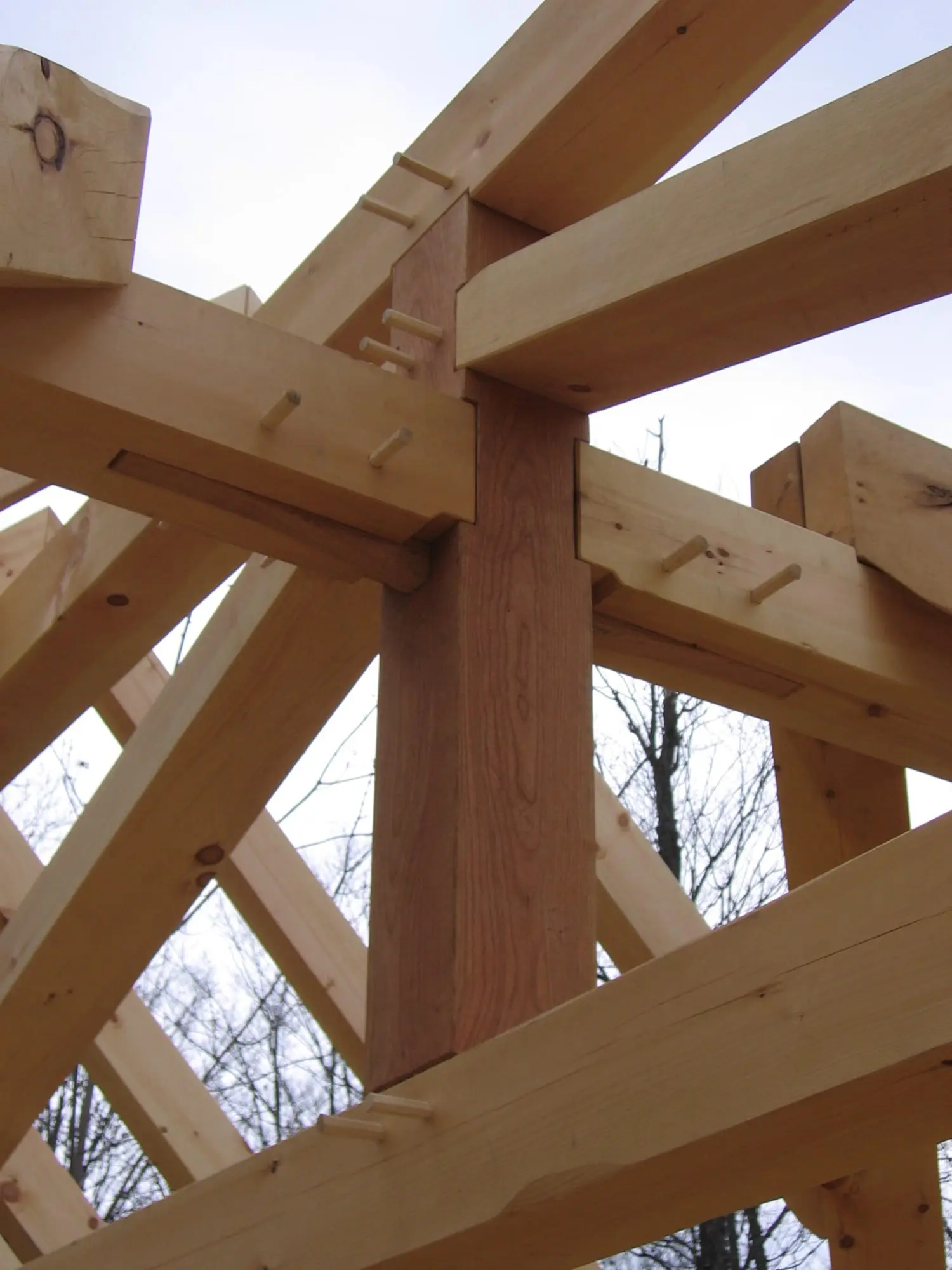
Image of mortise and tenon wooden joints furnished courtesy of timberhomesllc.com
The square holes that have been traditionally used to form mortise and tenon joints can actually be made quickly by using a type of basic hand tool from Roman and Medieval times that was called a Twybil in the English language. Using a Twybil makes creating solid mortise and tenon joints at a construction site or at a pre-fabrication workshop surprisingly fast and easy.

Image of a twybil furnished courtesy of oldtoolstore.co.uk
Purely wooden joints become stronger as time passes because the different sections that form these purely wooden connections swell and contract in tandem with the wooden beams they hold together, so these pieces of wood eventually behave like one continuous piece of wood. As noted earlier, unlike more modern buildings, medieval wooden construction methods create structures that remain solid, functional, and intact for centuries.
Interestingly, as noted in an October 2025 article that was published on the Structure Magazine’s website, metal fasting account for 25.7% of the energy expenditure that goes into conventional wooden building construction as of 2026. Adhesives also account for 38% of the embedded energy that goes into making cross-laminated wood structures along with plywood and particle board. The point to consider is that a surprisingly large amount of energy goes into making metal fastenings and petroleum-derived adhesives, but traditionally timber construction avoids these expenditures.
The same Structure Magazine article that was referenced earlier also notes that traditional wooden joinery connections are able to tolerate up to 5 degrees of structural drift without taking damage and without transferring energy to bracing timbers while conventional metal or glue joints fail at around 2% if structural drift. Given their ability to bend and flex when faced with wind stress or earthquakes, building with traditional wooden joinery methods creates more resilient structures that are able to survive high winds, heavy snow loading, and earthquakes with much better resiliency.
Squared Away
Round construction timbers that are essentially debarked tree trunks are on average 50% stronger by diameter than square or rectangular dimensional lumber, and round structural wood pieces are generally more resistant to rot than dimensional lumber. Despite the advantages that round construction timbers offer to engineers and architects, round timber pieces are also harder to connect together with mortise and tenon joints, and round timber pieces are more difficult for engineers to gauge for structural strength on a piece-by-piece basis. Despite their increased strength and boosted resistance to rot and moisture intrusion, using squared dimensional lumber lends itself to easier and more accurate structural engineering calculations.
I Get Around
Round timber pieces are much cheaper to procure, but they also tend to dry more slowly within kilns and drying sheds, plus round timbers are more prone to splitting on the ends than dimensionally altered squared lumber pieces. The curing process for round structural timbers requires forfeiting a certain amount of length on either end of each timber as sacrificial collateral which is caused by the wood being more apt to checking and splitting; however, applying pitch and beeswax to the ends of each round timber piece helps to reduce splitting at each end during the drying process.
Despite its engineering drawbacks, many sturdy wooden bridges deliberately incorporate many round and debarked tree trunks as support pieces within certain critical areas. The key to building good and solid wooden structures by using round and unfinished tree trunks is to deliberately overengineer the sections that incorporate these raw tree trunks. Raw and debarked tree trunks that still retain their splitting branches may have their drawbacks, but they do make for very spectacular internal supports in homes and other smaller wooden structures.

Image of whole tree architecture furnished courtesy of insteading.com

Image of “whole tree architecture” furnished courtesy of diggingthedriftless.com

Image courtesy of instating.com
The Wall
Having raw wooden interior walls is not a significant problem for homes and other wooden structures that dot the countryside because there is a fair amount of space and distance which exists between homes and other buildings out in these areas; however, in villages, towns, and cities wooden structures need to be covered with fire-resistant coverings. If wooden structures are placed in close proximity to one another, then the potential for a fire to spread from one wooden building to another poses a very real danger. Uncovered and raw wooden interior walls are desirable due to their nice aesthetics and also because they regulate interior humidity well. Interior walls that are made from exposed wood also clean particles from the air; however, wooden walls should have some type of fire barriers whenever wooden buildings are sitting within more crowded areas.
Getting Plastered
Traditional lime plaster mixtures often incorporate sub-layers of mud mortar below layers of natural kiln-fired lime plaster. In times past, traditional wattle and daub wallswere made by having a layer of woven willow stems or they were made from a layer of split wooden sections that were procured from various types of wood which were then woven together. These lattices of wood were then covered in a mixture that consists of subsoil clay, straw, sand, and cow manure.

Image of a wattle and daub wall under construction furnished courtesy of low impact.org
Incorporating cow manure into these earthen plaster mixtures adds extra strength and flexibility, plus the ammonia in the cow manure helps to prevent mold from forming in the future. Plaster mixtures that contain cow manure also reduce the presence of bacteria and insects of every type. Traditional wattle and daub wall coverings allow wooden structural pieces to absorb moisture and release moisture without much resistance, so wattle and daub wall coverings helped to prevent internal wood rot as time passed. Traditional wattle and daub mixtures also purify the air of building interiors while still providing a solid layer of fire protection.
Recent research from the Tallin University of Technology in Estonia has proven that standard gypsum fire paneling tends to perform better than traditional types of wall plaster as a fire barrier for wooden building structures when it is simply evaluated on the basis of fire resistance for each millimeter of thickness. However, incorporating thicker layers of traditional clay plaster plus layers of traditional lime plaster creates comparable levels of fire protection while also offering better air quality regulation.
Pipe Dreams and Getting Tanked
In a previously published article titled, What are National Socialist Building Codes: An Overview of Wood Technology, the concept of reintroducing and reevaluating the use of wooden infrastructure for water systems was discussed. This discussion included evaluating the merits and drawbacks that accompany using wooden stave piping to produce service piping for drinking water distribution systems as well as crating large delivery systems for non-potable agricultural water and industrial water supplies. Despite previously outlining the advantages and disadvantages that come with using wood for creating water distribution systems, no discussion about preservation methods for the wooden parts of these water delivery systems were ever offered.

Image of workers assembling a large wooden stave pipe furnished courtesy of walkingthederwent.com
making wooden stave piping is a lot like the process of making barrels. The ancient practice of making barrels is called “Coopery.” In the English language, a Cooper is the name given to a person who makes wooden barrels. In National Socialist society, wooden stave piping will be made by using traditional hand tools and following traditional practices such as cutting wood a the right time and ponding the wood before it goes into use, and air-drying each section of wood. Traditional hand tools will be used to make each wooden pipe stave simply because traditionally shaped pieces of wood last longer.

Image of a craftsman using a draw knife to form a barrel stave is furnished courtesy of peasantartcraft.com
Using boric acid to protect the wooden components inside of water distribution systems against rot is not a workable idea because boric acid is very water-soluble, so any boric acid residues that are imbedded within the wooden parts of a water distribution system will be quickly leached out.
The acetylation process for wood preservation which involves treating wood with a concentrated acetic acid solution is also not very suitable for wood that will carry municipal tap water over periods of decades, and perhaps even centuries. Using acetic acid to treat wooden parts with water piping systems is not a good idea because acetylated wood leaves an unpleasant and vinegary smell and taste in whatever water is stored or transported within an acetylated wood container. Acetylated wood also leaves a sour and vinegary smell and taste in whatever beverage or food item that is stored within a vessel that is made from this type of wood.
As for the prospect of treating the wooden components within a water distribution system against decay by soaking them in tannin baths, this idea is also not very workable because tannins are very water soluble. Any extra tannins that might be embedded inside the wooden components of a municipal water distribution system would simply be flushed out within a few weeks after the water system begins operation.
Likewise, treating the wooden parts of any drinking water system against rot by subjecting them to preservation treatments that are based on placing wooden pieces inside of smoke houses are likely to leave residues that will simply flush out due to being water soluble. Using wood pieces that have been treated in smokehouses also gives the drinking water that the wooden pipes carry a bitter and musty taste along with an unpleasant yellowish or brownish appearance.
So, which preservation treatments for wooden water network parts might work?
Ye Olde Medieval Lime Treatment
Soaking pieces of wood in baths of water and slaked lime to create more rot-resistant and dimensionally stable wood has been practiced for millennia and this process seems workable for the wooden parts within water distribution systems. Treating the wooden parts of a water distribution system against rot by soaking them in an aqueous solution of slaked lime not only make the wood more resistant to rot, but it also makes the wood less prone to cracking. Wood that has been treated in a lime bath is also more dimensionally stable when temperature changes arise. Although layers of lime whitewash are resistant to penetration by liquid water, wood that remains submerged in water will eventually attain full saturation, so applying lime whitewash layers will not allow oxygen to contact the wooden parts of buried service piping on account of the parts remaining dry.
Slaked lime is often used to purify drinking and to clean sewage water at treatment facilities because slaked lime helps to remove tannins, silica, and excess carbon from water. Hydrated lime also helps to remove dissolved metals within water by chemically binding with these elements. Slaked lime additionally helps remove excess amounts of calcium and magnesium from water supplies in a process that is called “Lime Softening.” Lastly, slaked lime creates more alkaline aqueous environments that are deadly to viruses, bacteria, and fungus. As noted on the AfriLime company of South Africa’s website, powdered mixtures of slaked lime are still added directly to water supplies and water tanks to help render the water safer for consumption by both animals and humans.

Image of food grade slaked lime that is used to treat drinking water and preserve food items is furnished courtesy of shopbvv.com
The process of treating the wooden parts within water service piping and storage tanks with lime mixtures would involve first soaking the cut and shaped wooden parts in hot water baths with the strongest concentration of dissolved lime that is possible, then clamping and air drying these lime-treated pieces.
After the lime-treated wooden pieces have properly dried, the next step is to apply layers of lime whitewash to the inner surface layers of these cut and trimmed wooden pieces with paint brushes before they are transported to the sites where the stave pipes will be assembled. Only covering the inner layers of wooden stave pipe sections with layers of lime whitewash before they arrive at future construction sites makes sense because the inner surfaces of wooden pieces that are indented to form stave pipes will never be given a Yakisugi/Sho Sugi Ban treatment.
After the wooden pieces are set into their appointed tanks and pipes, then the next step would be to cover the inside surfaces of these pipes and tanks in several more layers of lime wash by using paint brushes. Lime washes are applied a lot like paint and they are simply mixtures of slaked lime and water. Layers of lime whitewash would add another layer of rot protection to the wood that sits inside of water service piping while also helping to purify the moving water a little bit. These layers of lime whitewash would also not interfere with the water’s free movement.
Yakisugi/Shou Sugi Ban
Charring the outside portions of wooden stave pipes and wooden water storage tanks would add an extra layer of protection against rot without altering the drinking water’s taste, smell, or appearance. This method of making wood more resistant to rot is called Shou Sugi Ban or Yakisugi in Japanese. The Sho Sugi Ban/Yakisugi method of charring the outer surface of wood in order to create a layer of rot protection was first practiced in Japan as early as the 1600s.

The image seen above shows pieces of lumber that have been treated against rot by having their outer surfaces charred, this process of charring the surfaces of wood as a measure agains rot is called “Yakisugi.” Image courtesy of arcadiakitchenbath.com

Yakisugi can be made by during the surfaces of wood pieces with gas torches, but traditional methods for making yakisugi involved placing wooden piece in triangular sections and lighting the insides on fire. Image courtesy of conngardner.com

Image of a three-part wooden set up for making Yakisugi boards furnished courtesy of popular woodworking.com

The image seen above shows craftsmen burning the insides of a three-part wooden box that is used to make Yakisugi boards. Image courtesy of nakamotoforestry.com
Adding a layer of charred wood to the inside of a wooden service pipe would add a layer of anti-microbial protection for the water that the pipe is transporting; however, having this added layer of charcoal on the pipe’s inside surface is bound to create a rough surface that would in turn create more internal turbulence which would make the pipe less efficient. One of the great selling points to using wooden stave piping is its ability to move liquids efficiently, so any using treatment process that undermines this selling point is not recommended.
The inner surfaces of wooden stave pipes would most likely be finished with draw knives to create the smoothest possible surfaces that would provide the least resistance to flowing water, which in turn creates the most efficient pipes for moving water. Using draw knives to make very smooth surfaces is not the best plan for heavy structural timbers because smooth surfaces are more prone to cracking as time passes, but having smooth surfaces makes sense if they sit on the insides of wooden service piping.
As for adding a layer of charred wood to inner surface of a wooden storage tank, this idea works well because tanks tend to serve as relatively static water storage locations that do not need to have water moving through them as rapidly as piping. Charcoal is also a material that is renowned for its ability to filter toxins out of water while also serving as an anti-bacterial material, so lining the insides of water storage tanks with layers of charcoal is a tenable idea. Adding a Sho Sugi Ban layer to the outside surface of a wooden water storage tank would also add another valuable layer of rot protection without compromising the stored water’s final quality. The outside surfaces of wooden water pipes and water tanks can both be treated with a gas-burning blowtorch in a Yakisugi process once the tanks and pipes have been assembled in place.
Once the inner and outer surfaces of water tanks have been assembled and given a Yakisugi treatment, then the next step would be to apply layers of lime whitewash on top of the charcoal layers for added rot protection and added water purification.
Beeswax & Associates
The final outer coating of any wooden water tank or any wooden service pipe would be to apply a series of coatings that consist of a three-part mixture of boiled linseed oil, pine tar, and beeswax. As noted earlier, applying this finish layer would be a four-part process where increasingly concentrated layers of this three-part formula are applied. The first layer would be a mixture that is 75% pine turpentine, the second layer is 50% turpentine formula, the third layer would be a 25% turpentine mixture, and the final layer would be a 100% concentration of this three-part mixture.
Part 7. Conclusion – Aryans Are Going to Lead the Earth and Humanity into a New Renaissance
By Randall Lee Hilburn
Matters are very rapidly coming to a head here on Planet Earth because our current state of affairs is increasingly being exposed for what it is. The first tell-tale signs of panic at the disco and feelings of desperation are beginning to appear in the ranks of our enemies as our present economy, political system, and social structure begin to decay. Who are our enemies: The Hebrews. The Hebrews are now making mistakes and they are beginning to compound their mistakes as they make more mistakes. The Hebrews are now trying to practice damage control on their previous mistakes which only leads to new crops of mistakes.
As of now, we must keep pressing our enemies to make more mistakes because their empire of lies will soon collapse under the weight of their own arrogance and incompetence. We must never let up on the pressure against our enemies and we must never give the Hebrews a chance to catch their breaths nor to rally back in any manner. As of now, me must not give them any time to think, but me must give them more cause to react emotionally and we must give them more causes to act on the spur of the moment. Exactly how we put more pressure on the Hebrews is a discussion for another time.

Image courtesy of Sab on pinterest.com
For now, we are ushering in a Renaissance that is already destined to take place after the final decisive defeat of our despised Hebrew invaders. Thus, a discussion about reintroducing construction practices from Medieval Times is now relevant. At this very time, we must begin new practices that rest on the foundations of various Medieval craft methods because these old practices have been conclusively proven to work better than more modern methods.
We live in a Jewish Capitalist Civilization, and there is one “good” which is sought under Capitalism, and this one Capitalist idea of “good” is to continually strive for “Maximum Profits.” Conversely, there is only one true evil within the scope of capitalism, and that evil is: “Failure to Maximize Profits.” Needless to say, National Socialism runs completely counter to this Parasitical, Alien, and Jewish Philosophy of Capitalism. The true purpose of National Socialism can be summarized quite succinctly: Life, Heath, and Growth. Life, health, and growth, come first for Our Folk (Blood), then we bring life, health, and growth come for Nertha/Earth Mother (Soil), and lastly, National Socialists will bring life, health, and growth for all Native Earthlings (other races of True Humans).
Originally, the name Aryan (which of course means “Nobility”) was designated for those who were LITERALLY DESCENDED FROM THE “HIGHER SPIRITS.” Our GODS & GODDESSES were also our ANCESTORS, or the ELDERS OF OUR FOLK if you will. The oldest known Aryans certainly bore an outward resemblance to the “White Races” of our planet; however, these two groups were not synonymous with each other in the beginning.
“To whom much is given, much is required.” THE ARYANS WERE SENT TO MIDGARD TO BRING, OR RESTORE AS THE CASE MAY BE, CIVILIZATION TO THE EARTH.

Image courtesy of assistant.stability.ai
The original Aryans were also brought here to Earth as to help drive out/eliminate the alien Hebrew Invaders first, but not to dominate the Earth. Aryans have arrived here on Earth to govern enough so that they can teach The Nations (Non-Jews) about the fundamental requirements of civilization. (The urge to dominate comes from a Hebrew/Elohim Spirit)
The Aryans are here to teach the SPECIFICATIONS for creating higher levels of civilization, and then they are commissioned to let each of The Nations make their own particular PLANS for their own growth. In times past, The Aryans were indeed treated as Nobility upon contact with other nations of our Earth. However, the Aryans have always represented a Nobility of Knowledge, Wisdom, Justice, Character/Honor, Example, and Merit. The Aryans of old GOVERNED as a Nation of Teachers. They demanded respect, and the got respect, but they refused to accept subservience (Demanding that others grovel before you is indicative of an Elohim/Hebrew Spirit).
WE PRESENT-DAY ARYANS (aka NATIONAL SOCIALISTS) ARE NOW OPERATING UNDER THE SAME SET OF DIRECTIVES AS OUR ANCIENT ANCESTORS. Thus, when we finally come into the fullness of who and what we actually are, which is destined to happen rather soon, then we must reintroduce Medieval construction practices to the rest of our world as an essential and integral part of the RENAISSANCE FOR ARYANS, THE RENIASSANCE FOR ALL NATIONS, AND A RENIASSANCE FOR THE EARTH.
“Alla maniera dei Romani e degli antichi.” IN THE MANNER OF THE ROMANS AND THE ANCIENTS. These words formed a motto for the Italian Renaissance. Let Us Now Go Forward.
Heil Hitler deva!
-88-
Randall Lee Hilburn