

Do You Know How To Stop Unlawful Drone Incursions?
Electronic Drone Defense for U.S. Homeowners: Detect, Identify, and Respond Lawfully.
Author: Tech Demon

Overview
Learning about drone defense from a personal perspective and not from a military perspective nor from a corporate point of view is important for today’s political and philosophical dissidents. In this context, the term “dissidents” refers to those who stand against the corporate and Jewish-controlled global mainstream paradigms and their accompanying globalized Jewish institutions that currently dominate our world. The late Argentina president Juan Perone referred to this collective system of Jewish, corporate, and Catholic world-domination as “Synarchy.”

It is difficult for an individual person to protect himself or herself completely against attacks from drones and drone swarms within a cost-effective budget, yet the need for protection against drones is very real in today’s world for many types of people.
Can we simply use traditional firearms or explosives as a deterrent against attacks from drones?
Traditional firearms and explosives may be used against drones; however, a person needs to see and detect drones before executing any active deterrents. Detecting drones is not as easy as some may think because many new types of drones can move very silently, or some new types of flying drones may use new types of cloaking camouflage. Additionally, there are drones that can execute complex evasive and defensive maneuvers against traditional attacks from bullets and explosives. Employing effective defensive measures against attacks that include thousands of drones is a formidable task. Rocket launchers and grenade launchers may be effective against aerial drone attacks, but most people are not looking to build their own military compound with enough firepower to rival the National Guard. A goose-hunting shotgun will only have limited effectiveness against large swarms of incoming aerial drones.
With the assistance of AI tools and research, a normal person may find ways to protect against tyrannical governments that love to use drones. A person might also seek to halt the plans of day-to-day hitman who might try malicious drone attacks. Some people may just seek privacy against surveillance drones when considering home-level drone defense plans, and others may seek to defend their lives.
The Synarchy system seeks to label more and more people as traitors and terrorists for doing such things as making off-color posts on social media networks or saying things during personal telephone calls that the control system dislikes; therefore, it is very important for people to know how to defend themselves against possible drone attacks. Besides simply developing counter measures against surveillance drones and possible violent attacks from flying drones, all other aspects of personal and community security must also be studied in order to maintain sovereignty and security for along with our families and our communities.
Definitions:
What is a drone?
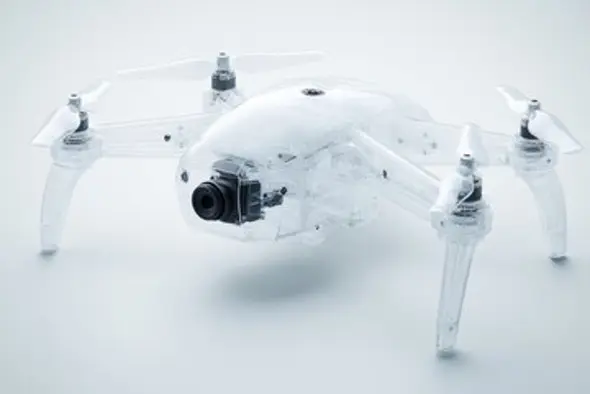
A drone, which is also known as an unmanned aerial vehicle (UAV), is an aircraft that operates without a human pilot on board. Drones are controlled remotely by a human operator, or they may be piloted autonomously by onboard computers and sensors. Today, drones may be operated by A.I. to have their own decision-making capabilities in addition to their own hardwired “will-to-live” functions.
What is a drone swarm?
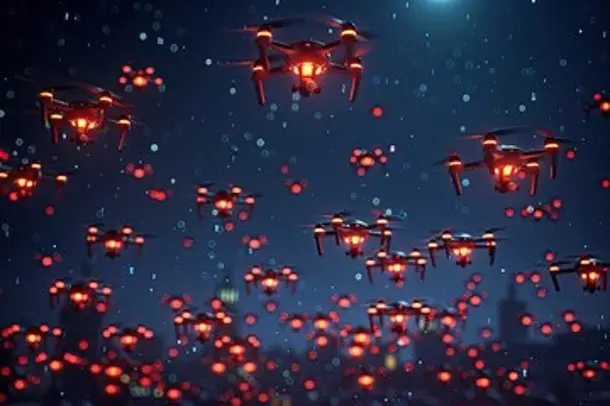
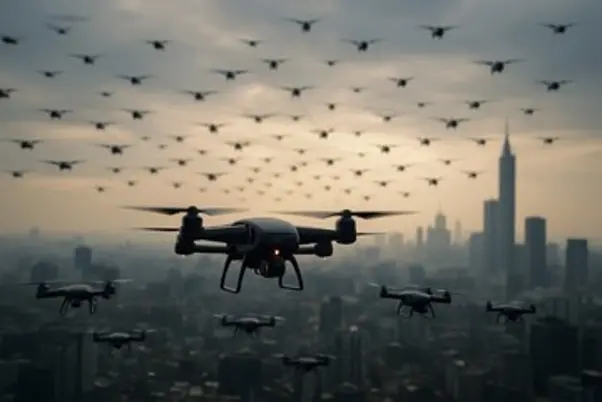
The term “drone swarm” refers to a group of unmanned aerial vehicles (UAVs) that operate together in a coordinated manner to achieve a common goal. Drones that work collaboratively as parts within “swarms” are often communicating with each other and communicating with a central control system to perform complex tasks that would be difficult or impossible for a single drone to accomplish. Some drones are capable of autonomously and synchronously self-organizing themselves into working groups.
What are micro drones?
A micro drones, which are also known as “mini drones,” or “nano drones” are small, lightweight, and unmanned aerial vehicle (UAV) that are designed for various applications. These bantam drones are characterized by their compact size plus their portability, and often, these small machines are characterized by their ability to perform specific tasks efficiently. For the moment, we will not be discussing any micro drones that may be inserted into living tissues and cells without any common means of detection because we are only focusing on micro drones that are the size of bugs and insects. We are skipping a discussion about the smallest of drones because nanotechnology is a massive topic that represents a discussion or a “rabbit hole” in and of itself.

Summary
Drones have become a common sight over many neighborhoods across Planet Earth, and flying drones are presently deployed for recreation, for photography, to deliver goods, and on occasion flying drones are used for invasive surveillance and even criminal activity.
For homeowners, a practical and responsible approach to halting drone intrusions rests on four pillars:
- Reliable detection and logging of each detection
- Privacy hardening (against drone surveillance)
- Lawful escalation to authorities or authorized counter‑UAS providers
- Avoiding private electronic or kinetic interference along with other means of defense
Detection
Detection is the foundational element of any defensive plan against unlawful drone activity.
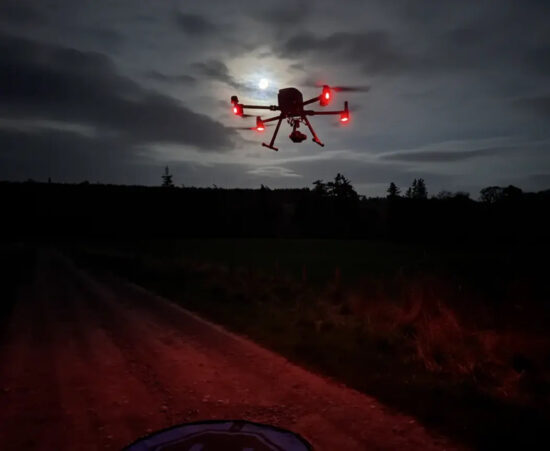
Effective detection of unlawful drone activity provides situational awareness and produces evidence that is needed to support police or FAA interdiction in such instances. Radio‑frequency (RF) detection systems scan the radio bandwidths that are commonly used to control consumer drones — most notably the 2.4 GHz to 5.8 GHz bandwidths. Radio frequency detection systems also scan for radio frequency telemetry and sometimes they scan for proprietary commercial links.
RF-detection equipment’s strengths include early warning capabilities and the ability to fingerprint signatures for many popular drone models. Radio-frequency-scanning technologies do have the weakness of being unable to detect autonomous and preprogrammed drone flights. Optical and thermal cameras — ideally pan‑tilt‑zoom (PTZ) units with automated tracking units — deliver visual confirmation of any incoming drones that radio frequency scanning equipment might detect. Data that is captured by radio-frequency-detecting equipment along with data that is collected by optical and thermal camera images are all legally admissible as evidence; these detection systems all work best when paired with timestamping applications and secure data storage devices. Secure backup hard drives and secure cloud-based storage mediums work well to preserve evidence that documents unlawful drone flights.
Optical detection systems are constrained by “line‑of‑sight” limitations, by lighting factors, and by weather conditions, but radio detection equipment is also constrained by weather factors and by “line-of-sight” limitations. Restrictions on radio-wave detection pertain to how radio waves travel around solid objects such as buildings and radio waves interact with geological features such as hills, ridges, and bluffs.
Acoustic sensors that use microphone arrays offer a passive, low‑cost supplement to other drone-detection measures by identifying rotor noise. Acoustic detection systems for drones are inexpensive, but they have shorter ranges, plus they are prone to generating false positives in noisy environments.
Short‑range micro‑doppler radar systems can reliably detect rotor motion while also providing range and velocity information which makes these systems very useful at night and in conditions with reduced visibility; however, radar is more costly than other means of detecting incoming drones. Short-ranged radar systems are also known to confuse birds with small drones. Combining multiple sensor modalities (RF + camera ± acoustic ± radar) dramatically improves detection accuracy and reduces false alarms.
For most homeowners, an RF+camera fusion kits or a monitored detection service subscription represents the most practical starting point.
Mitigation
Understanding electronic mitigation techniques and their Zio-American imperial legal status is essential because many active countermeasures that are available on the common market are illegal for private citizens to use. Devices that jam radio frequencies work by broadcasting noise on frequencies that are used for control and GPS functions within done guidance systems with the goal of severing links between a drone and the craft’s pilot. Severing links between a drone and its pilot are done with the goal of blunting the drone’s navigation capabilities.

Across the Zio-American Empire, RF-jamming by civilians is prohibited under FCC rules because such activities can interrupt other critical communications such as Wi‑Fi and emergency radios which poses very real safety risks. GPS spoofing — transmitting counterfeit GNSS signals to misdirect navigation — is similarly illegal and dangerous because such activities can steer drones into hazardous areas.
Attempts to exploit insecure protocols for a cyber takeover of consumer drones may be technically feasible within limited cases, but such activities risk violating statutes such as the Computer Fraud and Abuse Act.
Kinetic approaches to countering unlawful drone flights include measures such as firing net guns and unleashing interceptor drones. Physical countermeasures against unwanted flying drones can violate federal and state aircraft protection laws. Certain authorized entities, including various governmental agencies and some private sector programs that manage critical‑infrastructure, may lawfully deploy physical countermeasures against drones while operating under strict federal coordination; however, civilians should not attempt to radio-jam, spoof, or destroy flying drones without very good reasons.
A safe and lawful counter-drone policy for homeowners is to focus on detection, documentation, privacy hardening, and coordination with authorities or other licensed providers whenever active mitigation is required.
Laws
The legal framework within the Zio-American Empire reinforces constraints prohibiting private citizens from taking active counter measures against intrusive flying drones. The Federal Aviation Administration (FAA) regulates all national airspace and investigates unsafe operation of any and all flying machinery; property rights do not authorize interference with any aircraft that are in flight.
The Federal Communications Commission (FCC) prohibits the unauthorized jamming of radio communications under its rules and statutory authority. Federal criminal statutes can apply to private citizens who damage or seize aircraft. Federal criminal laws can also apply to anyone who unlawfully accesses any aircraft’s computer systems or transmits interference signals to all types of aircraft that are in flight. At the state and local levels, statutes that address voyeurism, stalking, harassment, or unlawful surveillance may apply to illicit drone flights.
Practical guidance for homeowners concerning unlawful drone incursions is straightforward: for any immediate threat to life or property, call 911. For privacy invasions or harassment from drones, the most prudent course of action is to collect evidence and report this evidence to local law enforcement personnel and the FAA. The FAA accepts reports of unsafe drone operation, and this agency can investigate cases where drones create hazards.

Strategy
Based on their detection capabilities and today’s egal realities, homeowners should adopt a step‑by‑step, actionable strategy against unwanted drone flights over their homes or communities.
- First, deploy detection and logging equipment as soon as practical — within one to two weeks — by installing an RF+camera detection kit or by subscribing to a monitored drone detection service. Select systems that provide timestamped logs along with secure localized hard drive storage plus cloud-based backup files that are exportable within evidence formats. Position cameras to cover likely approaches from drones (street, alleyways, backyard), and if budget permits, use PTZ cameras for automated tracking of unwelcome drone activity.
- Second, configure evidence-retention protocols and strategies immediately: set systems to preserve 30–90 days of event footage along with securely stored RF logs, then export any copies of this information to an external hard drive or to a secure medium of cloud storage after any recorded incidents.
- Third, classify each incident of unlawful drone activity, including one‑off visits from drone hobbyists, along with persistent surveillance, safety risks, or criminal use. It is important to classify every type of drone incident because the classification of each incident determines the appropriate response by authorized parties.
- Fourth, pursue non‑confrontational first responses: if the drone’s pilot is identifiable and the situation indicates that it is reasonably safe to approach the drone’s pilot, then politely request cessation. Also, post signage which notifies visitors that drone flights over private property are prohibited, and let it be known that such activity will be recorded and prosecuted. Using temporary privacy measures such as window films, awnings, or moving sensitive activities indoors are also recommended.
- Fifth, report incidents of unlawful drone incursions and their accompanying evidence within 24 to 72 hours. In such cases, reporting incidents of unlawful drone flights involves filing police reports for harassment, stalking, or intrusive surveillance, then submitting reports that document these encounters to the FAA with accompanying video and RF logs.
- Sixth, if the threat from unlawful drone activity persists, then engage in authorized mitigation only. In such cases where unlawful drone activity persists, it is best to place licensed private security firms on legal retainer or to employ certified counter‑UAS providers that coordinate with law enforcement and the FAA. When needed, governmental agencies and licensed counter UAS service providers can present written coordination and compliance plans.
Finally, pursue community-based action by sharing drone incident logs with neighbors, with homeowners’ associations, and with local officials. Sharing drone incident logs with the appropriate parties will help map problem areas and it will help to pursue community solutions such as education about how to handle unwanted drone flights. Sharing information with local residents also paves the way for local counter-drone ordinances to take shape.
Costs
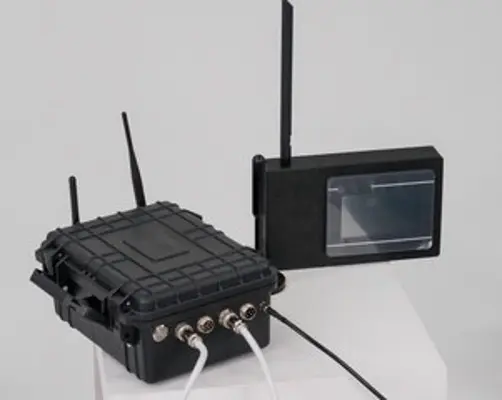
For Zio-American imperial citizens who are homeowners and who wish to buy detection and documentation equipment, a practical checklist balances capability against budget considerations. Core detection options for suspicious drone flights should include an RF + camera fusion unit which is capable of scanning at the 2.4/5.8 GHz RF in addition to a signature fingerprinting system. Having an integrated camera‑trigger functionality feature on a basic drone detection system is also helpful. Typical prices for basic drone-detection equipment range from about $500 to $3,000 at the consumer and small‑business level. Supplementary PTZ security cameras (1080p–4K, IR/night, ONVIF support and timestamp/GPS overlays) cost roughly $200–$800.
Acoustic sensors are an inexpensive optional add‑on ($150–$600), and these devices provide passive rotor‑noise detection. Short‑ranged micro‑doppler radar systems add a robust small‑object detection feature, but they cost more ($2,000–$15,000), and such systems are generally only appropriate for homeowners who are facing an elevated risk of experiencing unwanted drone flights.
Evidence storage and evidence management options include a network video recorder (NVR), or a local storage solution with RAID support and tamper‑evident logs ($150–$800). Secure cloud-based backup subscriptions run about ($5–$50/month) and an external encrypted hard drive usually costs ($80–$250). Both of these information storage systems are great when looking to present legal evidence for police departments to reference.
Drone detection services that are priced in the mid-tier range typically cost about $50 to $300 per month. Home-based multi‑sensor analytic software usually costs between $500 and $5,000 per month and these applications provide remote monitoring capabilities plus device fingerprinting and exportable forensic reports. Low‑tech privacy solutions such as privacy window films cost around $20–$200 per roll. Retractable awnings usually cost between $150 and $1,500. Landscaping-based privacy measures such as trees, hedges, and trellises are also an inexpensive but effective complement to electronic drone detection systems.
When selecting drone-defense equipment, always prioritize compatibility and evidence integrity, also ensure that your sensors and camera equipment support integration (ONVIF, API or vendor fusion). It is additionally important to confirm that data is collected with timestamped videos, RF logs, and metadata. Data should always be exportable and kept within the bounds of standard formats such as MP4 and CSV.
Remember to choose retention policies that preserve at least 30–90 days of data or allow for manual archiving. It is additionally crucial to verify vendor compliance with FCC and FAA guidance before purchasing any counter-drone equipment and always review data‑privacy and retention policies before selecting your equipment of choice. It is important to choose vendors who document local legal compliance factors. When selecting or radar or enterprise sensors, it is best to pay professional installers and to have your contractors request written coordination procedures in partnership with local authorities.
For most homeowners, the recommended budgetary path is to start with an RF+camera bundle that provides early-warning and evidence-capture protocols, then to add acoustic or radar modules along with monitored services. Additional measure beyond what was just noted are generally only needed if the threat profile justifies the expense.
Documenting unlawful done-flight incidents effectively increases the likelihood of successful enforcement. When an unauthorized drone flight happens, preserve your timestamped video evidence that shows the offending drone’s position relative to your property while also maintaining RF detection logs that include timestamps, frequencies, and signal characteristics. In such instances, it is important to capture camera metadata (PTZ movement logs and GPS overlay where available). In such cases, it is worthwhile to photograph any visible drone pilots along with the license plates of any suspicious vehicles in the area. It is also wise to gather witness statements that include contact details if and when such actions are possible.

It is wise to maintain original document records of any unlawful drone activity in or around private property that is captured, and remember to provide copies of these records to police and FAA investigators. It is best practice to clearly label all recorded files of suspicious drone activity while keeping a solid chain of custody for future use as legal evidence. An incident report should include the date, the time, the address, and a description of the activity. The filenames of evidence records along with any witness information and pilot identifications should be noted and presented within police or FAA reports if they were ever filed privately.
For a casual hobbyist who is taking drone photos of a private home, record the events and request that the operator(s) cease if such actions seem to be safe. It is also important to post signage to deter repetition of any unlawful drone activity in or around private real estate holdings. For persistent surveillance that is focused on windows or a backyard, the best response is to log every instance then harden the home’s privacy by installing landscaping measures. The next step is to report these patterns of drone activity to police along with any supporting evidence.
If a drone appears to be delivering contraband items or facilitating a theft, then call 911 immediately and preserve any video footage for law enforcement’s later review. Repeated low passes from drones that veer near children or veer close to other gatherings of people should be documented and reported to the local police and the FAA as a safety concern.
In practice, homeowners should anticipate that reliable detection and documentation will reduce nuisance incidents from drones by enabling identification and reporting; however, lawfully stopping drone flights usually requires law enforcement organizations or an authorized private contractor.
Corporate Products
DroneShield – https://www.droneshield.com/
DroneShield is a company that specializes in developing and providing counter-drone technologies. These technologies are designed to detect, track, and mitigate unauthorized or malicious drone activities. DroneShield’s solutions are used by various organizations, including governments, military forces, and private entities. DroneShield specializes in protecting critical infrastructure, public events, and sensitive areas from drone-related threats.
Key features for DroneShield’s services include RF detection, jamming, and other countermeasures. DroneShield’s basic service packages cost approximately $10,000 to $20,000 per unit.
Dedrone – https://www.dedrone.com/
Dedrone is a leading provider of counter-drone (also known as anti-drone or drone defense) technologies. The company specializes in developing solutions to detect, to track, and to mitigate unauthorized or malicious drone activities. Dedrone’s products are designed to protect critical infrastructure, public events, and sensitive areas from drone-related threats.
It costs approximately $100,000 to $500,000 or more to enlist Dedrone’s services, but the prices for such services depend on the scale of each client’s needs and the complexity of whichever countermeasures are needed.
OpenWorks SkyWall – https://openworksengineering.com/skywall-patrol/
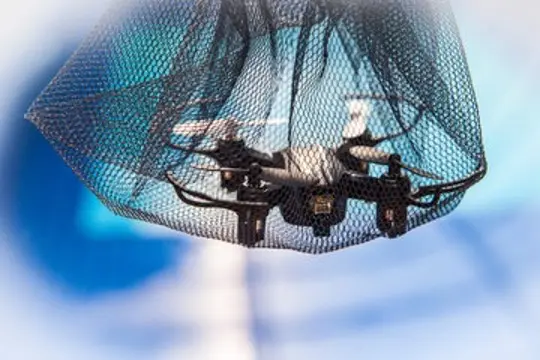
The OpenWorks Engineering SkyWall 100 is a net gun system that is designed for counter-drone applications. OpenWorks Engineering’s net gun is a non-lethal and physical countermeasure against drones that can be used to capture and disable unmanned flying vehicles. The SkyWall 100 system is particularly useful in scenarios where the goal is to safely and effectively neutralize a drone without causing damage to the surrounding environment or people.
The base cost for a single SkyWall 100 Net Gun typically ranges from $20,000 to $30,000. This price includes the net gun itself, along with basic accessories and initial training.
DIY Net Gun Example
Net Guns can physically capture drones by shooting a net. Anti-drone net guns can be created to function like a manual gun with a firing mechanism and a trigger, but mounted cannon units that use some type of automated triggering mechanism are also available.
The cost of building a DIY net gun can range from $200 to $700, depending on the complexity of the design and the quality of components. The cost of building an anti-drone net gun may increase with factors such as automation, size, and range.
-
Understand the Legal and Safety Implications of using a Net Gun
Before you begin, make sure you are aware of the legal and safety considerations that accompany using an anti-drone net gun. Using an anti-drone net gun to capture drones can be illegal in many jurisdictions, and it is best to ensure that any defensive actions comply with local laws and regulations before deploying a net gun during an unwanted drone visit. Additionally, handling high-pressure compressed air systems or pyrotechnics can be dangerous.
-
Design the Net Gun
The designing a net gun involves several key components:
- Launch Mechanism:
This can be a compressed air system, a spring-loaded mechanism, or a pyrotechnic charge.
- Net:
A lightweight, strong net that can be deployed quickly.
- Trigger Mechanism:
A system to release the net.
- Frame:
A sturdy frame to hold all components together.
-
Choose Your Components
Depending on your design, you might need the following components:
- Compressed Air Tank:
For a pneumatic system.
- Solenoid Valve:
To control the release of air.
- Spring or Pyrotechnic Charge:
For mechanical or explosive launch.
- Net Material:
Lightweight and strong material like nylon or Kevlar.
- Frame Materials:
Aluminum, steel, or high-strength plastic.
- Electronics:
Microcontroller (e.g., Arduino), sensors, and power supply.
-
Build the Net Gun
Here is a basic outline of how you might build a pneumatic net gun:
Hardware Components
- Compressed air tank
- Solenoid valve
- Net material
- Aluminum or steel frame
- Arduino or similar microcontroller
- Pressure sensor
- Power supply (e.g., battery)
An example of the software code for Arduino may be found on GitHub. This software sample is useful for developing a net gun and for calibrating such a device’s pressure sensor and deployment trigger. (For more information contact the author of this article.)
-
Assemble the Net Gun
- Frame Construction:
Build a sturdy frame using aluminum or steel, also ensure that the frame can withstand whatever forces are generated by launching a net.
- Compressed Air System:
Attach the compressed air tank and solenoid valve to the frame, also ensure every connection is secure and leak-free. - Net Deployment:
Attach the net to the launch mechanism and ensure that it can be deployed quickly and accurately. - 4. Electronics Integration:
Mount the Arduino, pressure sensor, and power supply on the frame, then connect all the needed components together according to the circuit diagram.
-
Test and Refine
Test your net gun thoroughly to ensure that it works as expected. If needed, refine the components and algorithms based on your testing results. Lastly, ensure that the net deploys accurately and can effectively captures an errant drone.
-
Safety Considerations
- Always wear appropriate safety gear, including eye protection and gloves.
- Ensure that the area is clear of people and obstacles before testing.
- Follow all safety guidelines for handling compressed air and pyrotechnics.
- Regularly inspect and maintain your net gun to ensure that it remains effective and safe to use.
Other DIY Drone Defense Notes
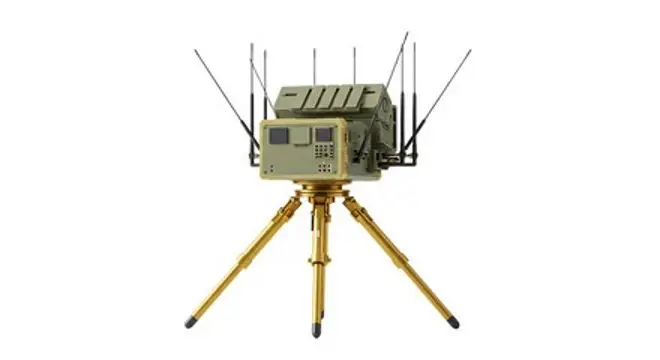
RF jammers may be used to disrupt the communication between a drone(s) and its controller, the cost of building a basic RF jammer for drones can range from $100 to $350, depending on the complexity and quality of the components.
RF Jamming Techniques: https://www.rfwireless-world.com/terminology/rf-frequency-jamming-techniques
Drone Defense RF Jammer Components Example:
RF Transmitter: $20
Oscillator: $8
Power Supply: $15
Batteries: $10
Microcontroller (Arduino Uno): $20
Switches and Buttons: $8
Wiring and Connectors: $8
Antenna: $10
Enclosure: $20
Tools (if not already owned): $100
Safety Gear: $30
High-powered lasers systems may disable drones by damaging their components, but government-type and military drones do have basic defenses against most anti-drone laser guns, but these anti-laser countermeasures are not very effective against powerful and military-grade laser weapons.
The cost could be anywhere from $500 to $2500 or more for a basic laser-based drone defense setup.
Military grade laser weapons systems: https://theconversation.com/high-energy-laser-weapons-a-defense-expert-explains-how-they-work-and-what-they-are-used-for-225071
Laser Drone Defense Components Example:
High-Power Laser Diode: $500
Laser Driver: $100
Cooling System: $100
Lens and Mirrors: $100
Mounting Hardware: $30
Microcontroller (Arduino Uno): $20
Power Supply: $30
Switches and Buttons: $8
Wiring and Connectors: $8
Camera Module: $30
Processing Unit (Raspberry Pi): $50
Enclosure: $50
Tools (if not already owned): $100
Safety Gear: $70
Reach out to the author of this article for more information.
Safety
Ethical and safety considerations underscore restraint: respectful coexistence with lawful drone operators is important, and homeowners should not employ destructive or illegal countermeasures unless the situation is rather extreme and such actions are warranted.
Whenever unlawful drone activity happens, always try to avoid starting any escalating confrontations. Also make efforts to preserve a solid chain‑of‑custody when handling any evidence that is intended to support future legal actions, and coordinate with police for enforcement when such courses of action are possible.
Knowing when to call authorities is critical — call 911 for threats to life or property and report any non‑emergency privacy or harassment incidents from flying drones to local police and the FAA through the appropriate channels.
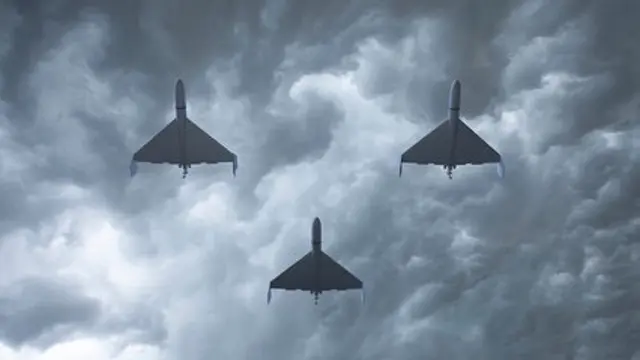
If you see military grade UAVs and such objects do not appear to be UFOs, then the owners of these aircraft are probably not interested in you or the terrorist training facility that operates in your backyard, but they may airstrike you for a negative tweet about Israel.
Conclusion
Zio-American homeowners who are faced with unwanted drone activity should adopt a lawful, controlled, and layered approach to such incidents which emphasize reliable detection, secure evidence collection, physical privacy hardening, and escalation through official channels rather than through private interference.
Sensor fusion — particularly RF+camera — provides a practical foundation for early warning and forensics. Adding acoustic sensors, radar, or monitored services can improve capabilities during higher‑risk drone-incursion situations.
For active mitigation, it is best to rely on licensed providers and law enforcement rather than DIY jamming, spoofing, or interception plans because such actions carry significant legal and safety risks. Following these practices protects families and property while ensuring compliance with the FAA, FCC, and criminal statutes that pertain to local and federal jurisdictions.
As a personal note to our Zio-American imperial readership, unless you see a country flag on a drone or UAV that that is flying over your home or community which is not of Zio-American imperial origin, then maybe you should simply fire your laser gun first then ask questions later and remember to always follow relevant laws first when applicable.
If a drone swarm or UAV has an Israeli flag on it, and if you call the FAA or the police, then you might go to jail for antisemitism or for committing a hate crime, so just think carefully before acting on anything actionable against such killer drones.
Sample Reporting Template
Appendix: Incident Report Template (for police / FAA submission)
Date/time of incident:
Location (address):
Description of drone activity:
Evidence attached (video files, RF logs, photos) — filenames:
Witnesses (names & contact info):
Any pilot identification observed:
Police report number (if filed):
FAA report reference (if filed).
At the end of the day, the military has many ways to “get” aka “take-out” a typical man within seconds or minutes; be it by radio waves, by chemicals, through nano tech, by way of long-range airstrikes, or perhaps by using laser weapons that spin around the earth in orbit. Such organizations also have access to microscopic means of dispatching those how they dislike such as nano bots and killer nano-drones that invade a person’s blood.

It is unfortunate to say, but we must all prepare for a time when the government is openly our enemy, and we must help people realize that being armed with long-range sniper rifles and assault rifles with 10,000s of rounds of ammunition sitting in nearby storage depots is not enough to stop killer drone swarms or microscopic drones on their own. Home-made grenade launchers, home-built rocket launchers, and DIY anti-aircraft cannons will also be needed to combat drone attacks, but such measures are only part of much larger and comprehensive drone-defense programs.
We would all like to work together on building DIY and open-source drone detection and prevention procedures, techniques, devices, and tools for the average man and woman.

Reach out to the author of this article for more information, and/or to discuss building these killer drone prevention devices together as a community and for your home.

Email: