What are the Origins of HEMA (Historical European Martial Arts)?
THE ORIGIN TIMES OF HISTORICAL EUROPEAN MARTIAL ARTS
PART 1.
Introduction – An Overview of Battle During the Genesis of “Historical European Martial Arts”
What is called HEMA (Historical European Martial Arts) originated from the Late Medieval Era through the Renaissance Period against the backdrop of gunpowder weapons arriving in the public arena, so a wide assortment of both personal firearms and crew-served heavy weapons (aka artillery) that were powered by gunpowder came into common use during this time frame. HEMA did not originate and develop in a technological vacuum because warfare is continuously being transformed by new technologies.
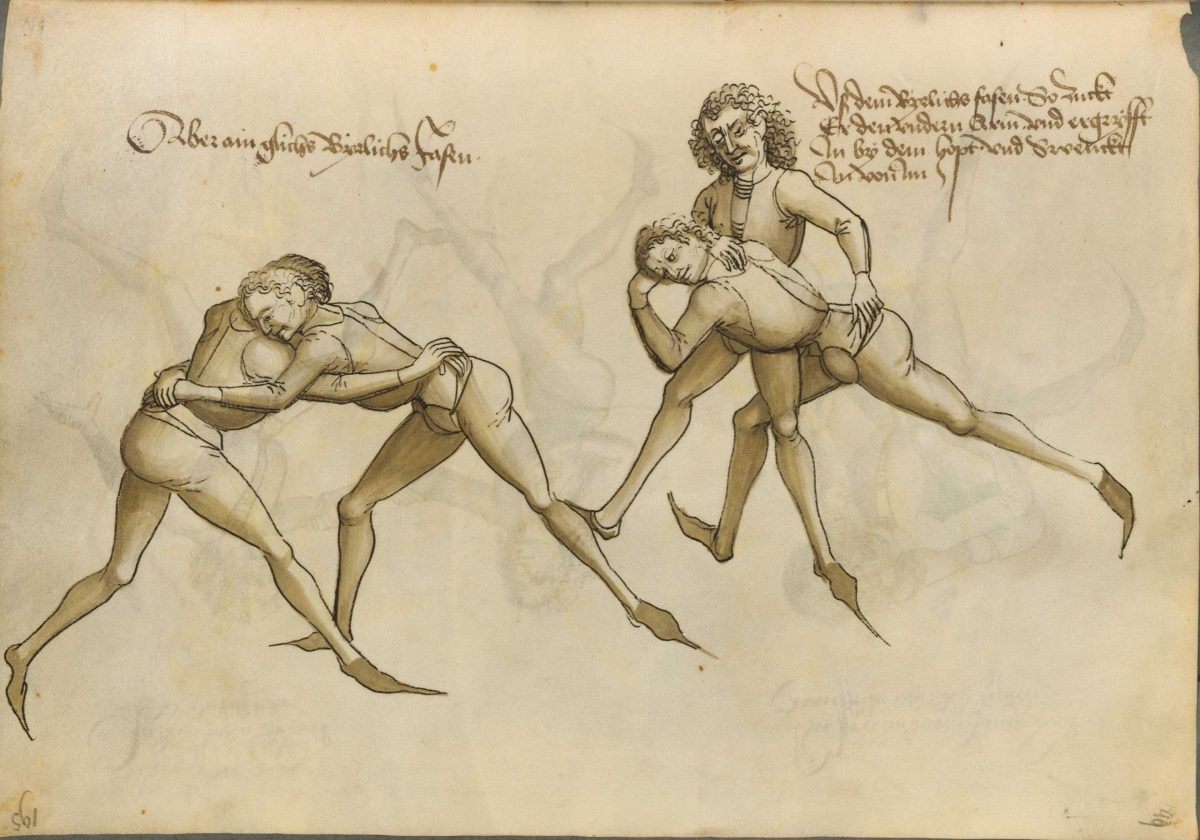
Image of old German Ringen grapplers furnished courtesy of Fechtbuch 1467 by Hans Talhoffer. Image furnished courtesy of wikipedia.org
PART 2.
The Invention of Gunpowder
Around the year 850 A.D, the Chinese Tang Dynasty initially used Black Powder as a propellant for another invention of theirs: “Rockets.” The Chinese originally created crude black-powder-powered rockets to frighten the horses of their Mongolian enemies who they were at war with during that time. Eventually, the technology of black powder reached Europe along the same Silk Road which had previously brought limited quantiles of silk and tea westward across the Eurasian landmass. Since its initial discovery, Black Powder would proceed to transform both personal combat, organized warfare, and the entire world at large. Black Powder was truly revolutionary for its time, and it is still one of the most important inventions in history.

The image seen above shows a mid 10th century Buddhist painting from Danhuang that includes an early hand grenade and an early fire lance as they are seen in the upper right corner of this piece of art. Image courtesy of wikipedia.org
The earliest weapons that used black powder to move projectiles sent their ballistics downrange at what would be considered relatively low velocities by today’s ballistics standards. Early black-powder-driven firearms suffered from what would today be considered quite limited ranges; but not surprisingly, such early gunpowder weapons were also relatively inaccurate.
Early gunpowder weapons were relatively uncommon and they were very time consuming to load, plus they were always quite unreliable, so their arrival had no instant impact on how personal combat or organized warfare was carried out. Life expectancy in combat for those who utilized early gunpowder weapons was very short, so the nobility made these items into weapons for Commoner foot soldiers (aka “Filthy Peasant” conscripts who needed more than one good flogging!). Another drawback associated with leveraging early gunpowder weapons was the users of such items finding themselves subject to occasionally being burned at the stake by the old Catholic Church for practicing witchcraft.

Image courtesy of pinterest.com
PART 3.
Changes in Warfare After Black-Powder-Burning Personal Weapons and Artillery Were Introduced
During Europe’s Renaissance era, there was a long period of time where hybridized warfare was conducted. This “Hybridized Warfare” was a mixture of the Old technology and the New technology. In this context “Old Technology” refers to the knightly and Medieval type of warfare as opposed to “Modern Technology” which refers to the type of warfare that is characterized by bullets and firearms.
The Renaissance era represented a time when ancient and Medieval types of warfare were finally completely replaced by modern types of warfare. This type of Renaissance era hybrid warfare incorporated elements of both Medieval and Modern technology which culminated with the Thirty Years War. The 30-Year-War which raged from 1618 to 1648 saw early black-powder-burning weapons used alongside more traditional ancient and Medieval weapons. These ancient types of weapons included crossbows, various types of war bows, pikes, and even a few remaining groups of armored knights who rode around on horses.

Image courtesy of imageresizer.com
Europe’s Renaissance era was a time where Medieval war technologies worked side-by-side with early modern black-powder-burning weapons. For example, units of soldiers who were equipped with crossbows fought alongside units who were equipped with early black-powder-driven weapons during the 1400s and up into the 1500s. Europe’s Renaissance era saw the rise of crossbows with stout steel bows that sported power strokes of five to seven inches. These same Renaissance era combat crossbows had stout bowstrings that were made from silk, flax, or hemp fibers, and on occasion various types of animal sinew fibers were used. These super-powered steel crossbows from Europe’s Renaissance era had maximum ranges of 300 yards, but they had effective ranges of about 150 yards, and they were most effective against heavily armored opponents who were less than 50 yards away.
The main drawback that was associated with these Renaissance era crossbows was their slow loading times which were the byproduct of their extreme draw weights. Steel combat crossbows from Europe’s Renaissance era had draw-weights of around 1,200 to 1,300 pounds, so these crossbows had to be set to fire by hand-cranked arrays of gears and pulleys. These same war crossbows sent bolts weighing 1,200 to 2,400 grains down-rage at speeds of about 200 feet-per-second. The most powerful civilian-sector hunting crossbows of the 2020s now post bolt velocities up to 515 feet per second, but the average speed of a modern crossbow bolt sits between 370 and 420 feet per second and they fire bolts that weigh 460 to 750 grains and produce around 250 joules.
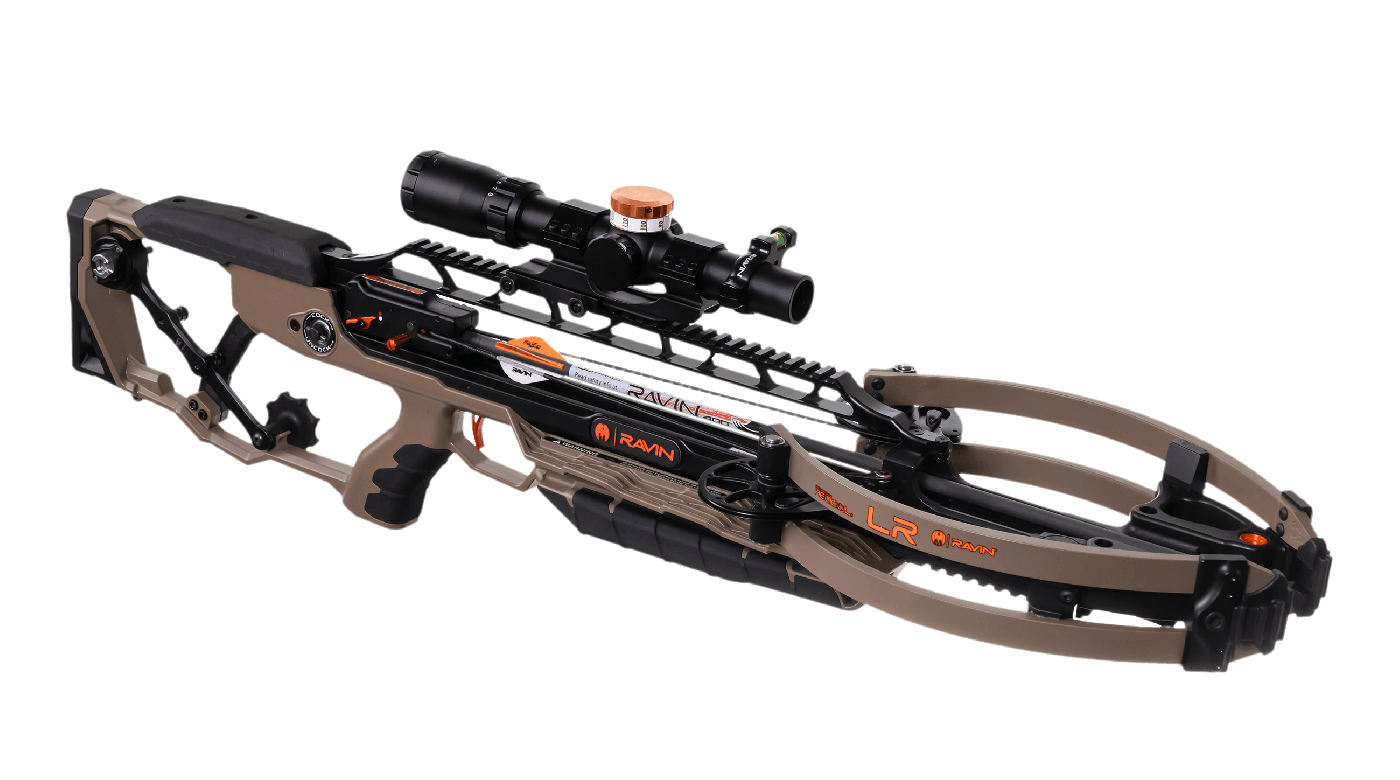
Image courtesy of ravincrossbows.com
The slow rates of fire that were associated with crossbows in general and winch-operated Renaissance era crossbows in particular meant that these weapons were tertiary and supplemental battlefield equipment for their time; however, they were still useful for defending static positions such as fortress walls where solid cover was available.
During more dynamic and fluid battle scenarios than sieges of castles and fortresses, units of crossbowmen needed teams of assistants to reload their crossbows and provide cover during times of reloading, so for this reason, crossbow units were somewhat expensive and vulnerable in comparison to units of longbow archers. Despite their drawbacks, early gunpowder weapons were still less mechanically complex than Renaissance era war crossbows. Renaissance era firearms were also less costly to produce and less costly to repair than the best crossbows of that same time frame. Even the strongest crossbows of the Renaissance era still lacked the same penetrative power against heavy plate armor as the most powerful arquebus types of black-powder-powered rifles from that era.
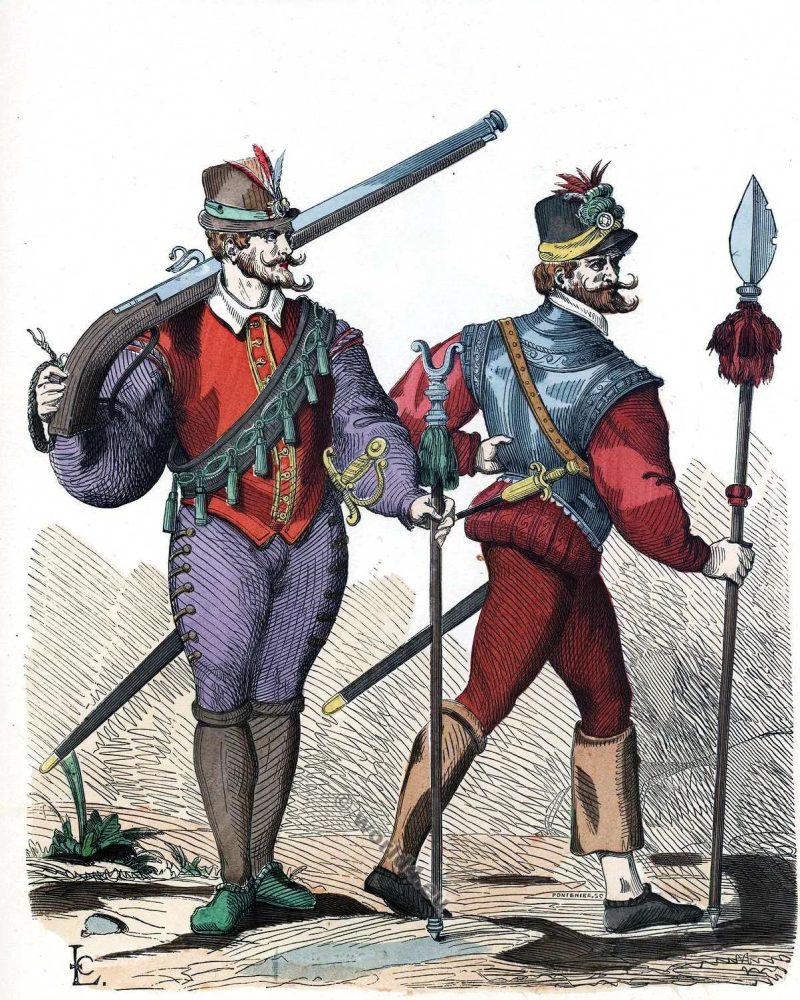
Image of 16th century French Muskateers furnished courtesy of world4.eu
Powerful longbows were also introduced to the battlefield during the late portion of Europe’s Medieval ear and they remained in service well into the Renaissance era. Longbows fell out of favor at around the same time as crossbows and for most of the same reasons. When comparing longbows to crossbows, longbows were much cheaper and faster to manufacture, but longbows were much more difficult to master than crossbows. Learning to properly and effectively use a longbow in combat required 7-10 years of training which typically began when a boy was seven or eight years of age.
Simply learning to shoot arrows with sufficient accuracy was not enough for aspiring longbowmen because it took several years to build up the physical strength that was needed to repeatedly fire bows with such heavy draw weights. Longbows had draw-weights that ranged from 60 to 200 pounds and their draw length was typically around 30 inches. The effective combat range of longbows was around 200 meters, but they could shoot up to 400 yards when making banked and unaimed shots that were intended to blanket hostile areas with showers of incoming arrows.
As for a longbow’s rate of fire, a solid professional bowman could make five to six shots per minute to create a sustained rate of fire, and he could fire around eight shots per minute for a faster rate of fire. A good longbow archer could complete around 20 shots per minute during a complete sprint of shooting that left the bowman totally exhausted and unable to fire a single arrow. Despite its impressive rate of fire and its impressive range, the longbow actually had limited tactical value because it was only useful in defensive situations, and in order to be effective, ranks of longbow archers needed to occupy carefully selected terrain.
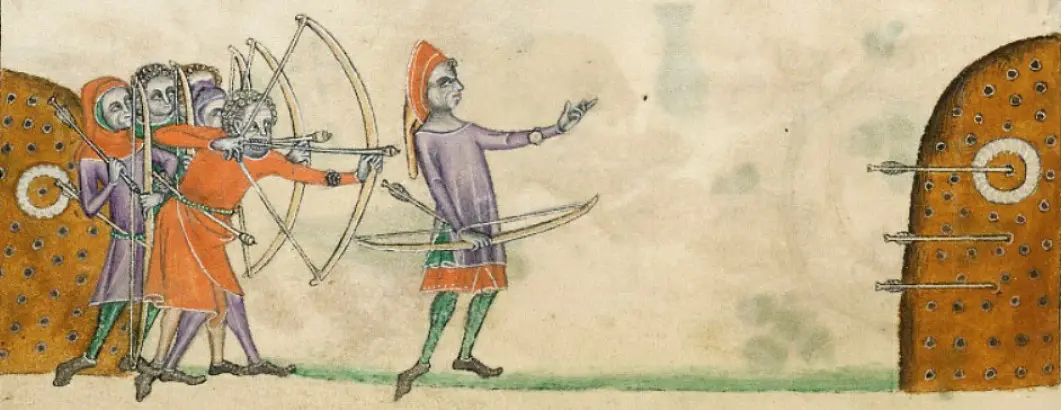
Image of English longbow archers practicing furnished courtesy of arundown.org.uk.
Despite English armies scoring a few notable and impressive victories against the French during the late Medieval era, very heavy personal plate armor was able to stop arrows that were shot from long bows more often than not, and heavy shields would reliably stop arrows from longbows. Despite their slower rate of fire and their shorter range, crossbows were actually more effective against the strongest metal plate armor of the Renaissance era.
As noted in the video titled “Why Firearms Took the Place of Bow and Arrow – The Rise of the Musketeer in Europe,” during the Renaissance era, longbows could produce a maximum of 150 Joules of impact energy, while the strongest crossbows of that era produced around 200 Joules of impact energy per shot. Early black-powder-burning rifles were only able to fire about once every two minutes; however, ammunition that was fired from arquebuses from that same era topped out at 3100 Joules of impact energy which is respectable even by modern ballistics standards. According to this same video, even early firearms were often able to hit targets as far away as 600 yards, so even by the 1500s black-powder-powered rifles had already outranged longbows.
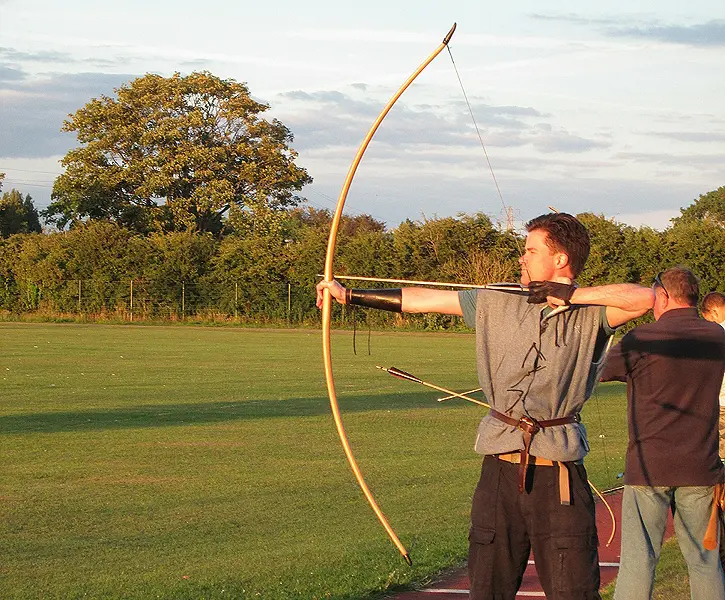
Image of a modern longbow archer furnished courtesy of rundown.org.uk
Besides offering more power to smash through body armor, and offering longer firing ranges than bows or crossbows, early firearms shot heavy and large lead balls that caused much more tissue damage and much more blunt-force trauma to those who were hit by these projectiles. Wounds that were caused by early firearms were more likely to become infected than wounds from arrows, so early firearms tended to wear opposing armies down over weeks and months of military campaigns much faster than arrows ever did. Physicians of the Medieval and Renaissance era were quite good at treating wounds from arrows, so arrow wounds were often non-fatal and they often healed relatively quickly.
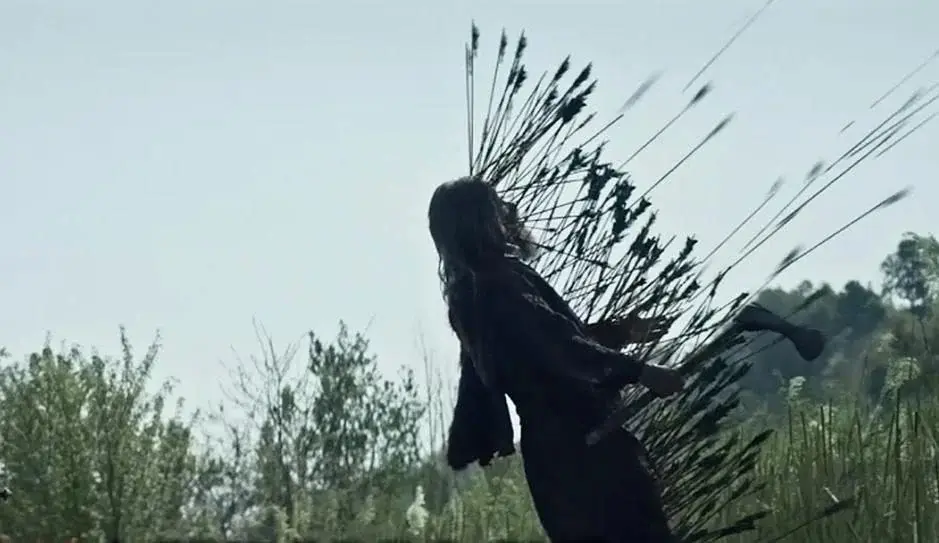
Image courtesy of r/Darksould3 on reddit.com
Around the same time that firearms appeared on European battle fields, armor makers in the city of Genoa had created suits of armor that were made of high carbon steel which had metal components that were quenched in oil. These new steel suits of personal body armor were expensive, but they did stop almost every type of ranged attack from that time period except for shots that were delivered by gunpowder.
After reviewing the written arguments and written statements of military theorists and military commanders from the Renaissance era, the arguments for adopting early firearms in place of crossbows and longbows were based on the superior range and superior penetrative power of black-powder-burning rifles as opposed to the costs of training men how to use these weapons. By the time that early firearms had arrived in Europe, the issue of comparing training times and production costs had already been addressed when contrasting crossbows against longbows.
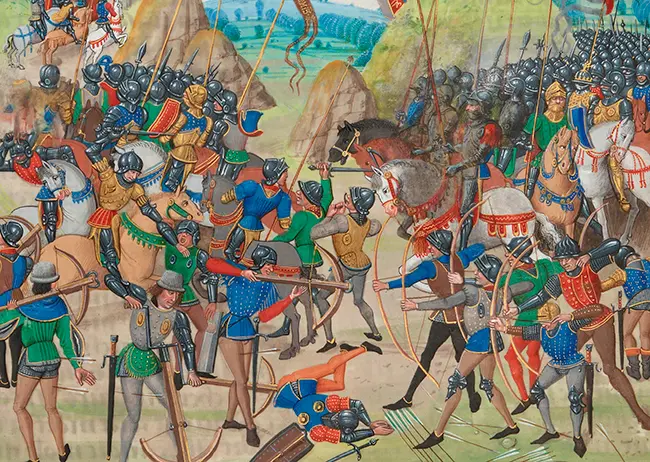
Image courtesy of historical.wiki.com
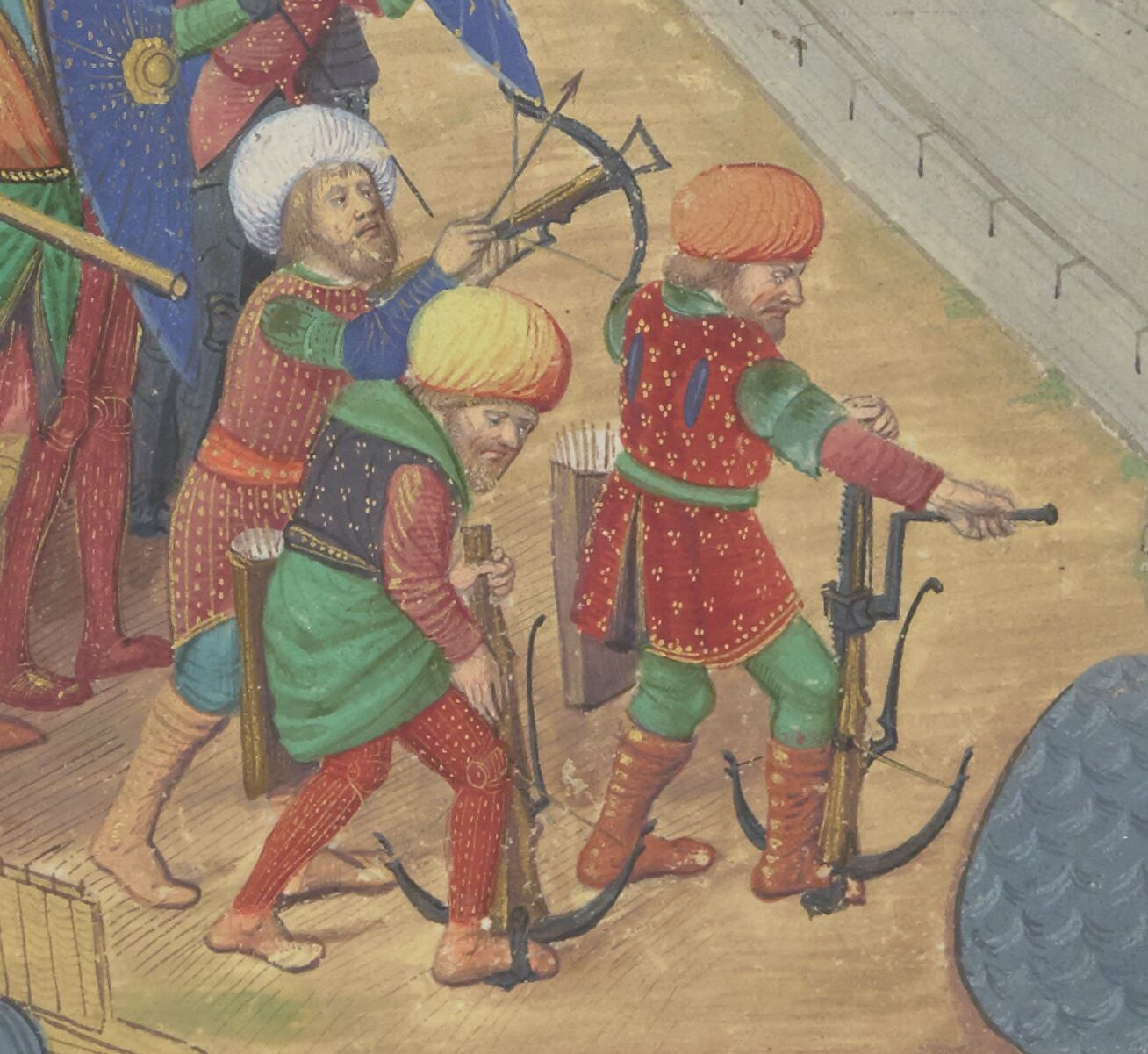
The image above shows Ottoman soldiers with Renaissance era crossbows signing a European castle in the 15th century. Image courtesy of the national library of France’s website.
Even before the arrival of longbows and early black-powder-powered weapons, the rise of powerful crossbows was already undermining the prestige of knights. Disciplined battlefield formations of Europe’s Renaissance era that were were made up of pikemen were basically a reintroduction of the old Greek Sarissas. Renaissance era pike formations certainly did their part to undermine the effectiveness of Medieval era horse-mounted soldiers across the battlefields of Europe.
In ancient Greece, tightly packed formations of foot soldiers who were holding ranks of long pike poles were able to repel even the most dedicated charges from the most heavily armored cavalry units, and this same strategy was reintroduced during Europe’s Renaissance era. The Battle of Laupen in 1339 is considered to have ended the era of heavy cavalry dominating the battlefields of Medieval era Europe. During this battle, Swiss pikemen from the canton of Bern fought in tightly packed “Pike Square” formations and routed a much larger army from the nearby canton of Friborg. The army of Bern used “Pike Square” formations as offensive weapons in contrast to simply using pike formations as a purely defensive strategy against heavily armored cavalry charges
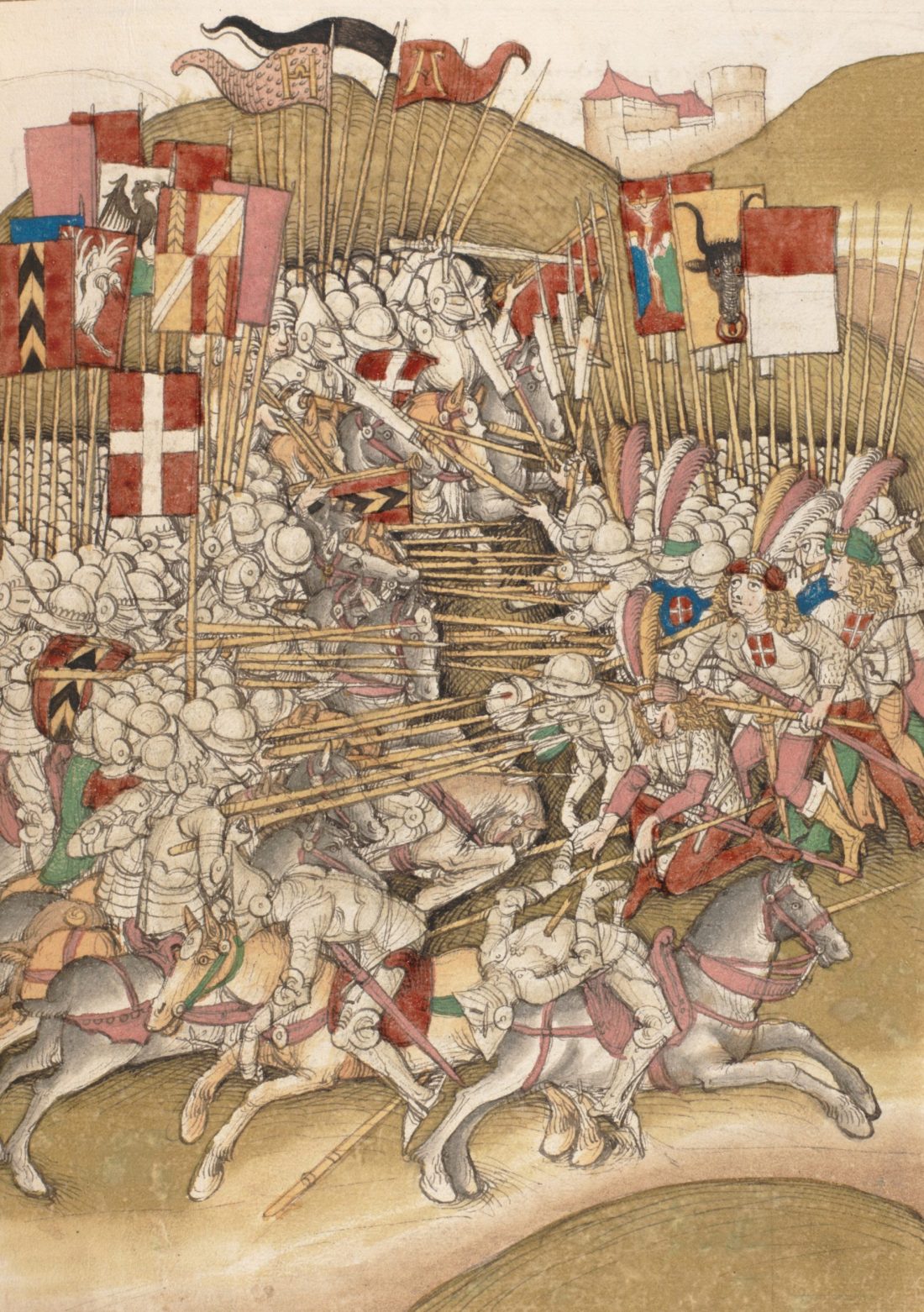
The Image seen above shows the Battle of Laupen as it was painted by Deibold Schilling the Elder. The image seen above is furnished courtesy of wikipedia.org
Initially musketeers were very vulnerable when combat transitioned from shooting into hand-to-hand, which it very often did in those times, so fencing was introduced as a means for musketeers to become victorious in such situations. Developments in Renaissance era military technology led to what is now termed “Pike and Shot” combat. This type of warfare was based upon formations of pikes along with shot volleys that were sent from early firearms, plus cavalry charges. The Battle of Pavia in 1525 is still considered to be the final end of Medieval warfare technology and the true arrival of the new “Pike and Shot” era of warfare. However, as time progressed the importance of black-powder-burning rifles grew steadily within the context of “Pike and Shot” war tactics, yet some defensive measures were still needed against rapid cavalry charges from horseback for some time to come.
Up into the 18th century, many English infantry regiments contained the word “Fencibles” as part of their names. The term “Fencibles” indicated that such military units were trained both in the use of muskets and trained in the art of fencing. Alexandre Dumas’s famous adventure novel “The Three Musketeers” is set in late 17th century France during this transitional period. The heroes of the tale are both Musketeers and Masters of Fencing. The problem with fencing was that it required a great deal of training and experience to get really good at this discipline.
Image of the 3Muskateers candy bars furnished courtesy of allcitycandy.com
The solution that was adopted for this mixture of Medieval and Modern combat technology involved almost universal adoption of the “Bayonet.” The name “Bayonet” stems from Bayonne. France, which is the city where the “Bayonet” was first invented. The early Bayonets were of the “Plug” type, meaning that the bayonet had to be plugged into the muzzle of a musket. The obvious problem with this arrangement was that a musket could not be loaded and fired if the bayonet was still fixed in place. With the early bayonets, you could shoot, or you could fight with the rifle’s blade, but you could not do both. The results could, and sometimes did, prove to be disastrous.
For example, at the Battle of Killiecrankie in 1689 which pitted the English against the Highland Scots who were commanded under Dundee saw trouble with the plug type of bayonets. In this battle, the Scots charged down a mountain at a run welding their two-handed Claymore swords after they had fired a volley with their muskets. The English now fired a very effective defensive rifle volley against the charging Scots, after having fired their defensive rifle volley, the English started fumbling to put their plug-bayonets in place as the Scots drew closer. Fixing plug types of bayonets into the barrels of early muskets was not something that could be done quickly, so the Scots got in amongst the English before the English could finish fixing their bayonets. The end result was the English Army getting all but annihilated by the charging Scots.
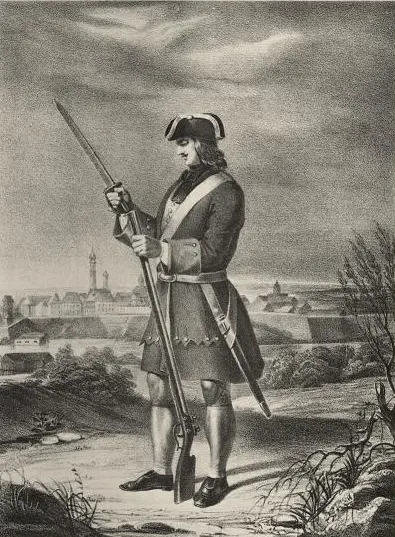
The image above shows an Imperial Russian soldier fixing a plug-type bayonet during the late 17th century. Image furnished courtesy of wikipedia.org
The resulting development to counter problems with plug bayonets was the invention of the “Socket Bayonet,” which also happened take place in France. This socket type of bayonet consisted of a bayonet that was mounted on a socket which fit around the muzzle of the musket. This new type of bayonet enabled a musket to be loaded and fired with the bayonet still “Fixed” in place. From this point on, all bayonets have been of the “Socket Type”.
Florian Geyer and His “Army of Wotan”
During the time frame of the late 17th century, primarily in Germany, what is known as “The 30 Year War” took place. Orthodox history says that it was between Protestants and Catholics, but the reality is a bit different. The full story has been quite deliberately SUPPRESSED by first Christian clergy, then by (((mainstream historians))) in general.
THE 30 YEAR WAR WAS IN REALITY A BLOODY THREE-SIDED CONFLICT BETWEEN CATHOLICS, PROTESTANTS, AND THE GERMAN PEASANTRY. THE LATTER BEING, AT LEAST TO A GREAT EXTENT STILL HEATHEN. It was one of what is known in German history as “The Peasant Wars“.
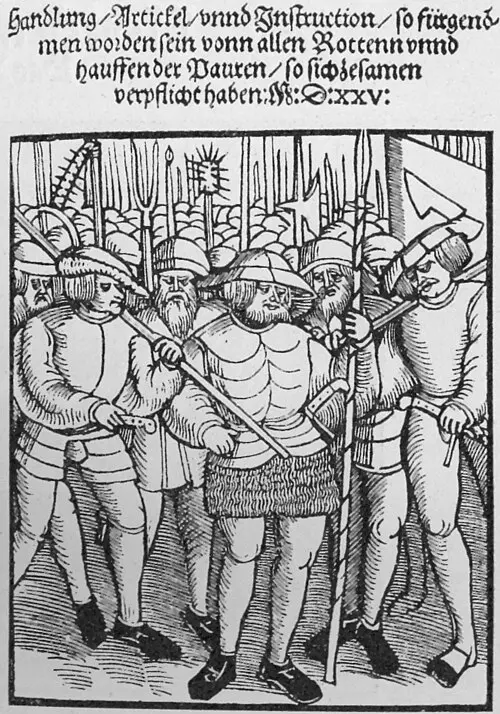
The image seen above is the cover of printed pamphlet from 1525 in what is today called Germany. The pamphlet’s name was 12 Articles of the Peasants. Image furnished courtesy of wikipedia.org
During the time of the 30 Year War, the German peasantry was being violently oppressed and exploited by three groups: the Nobility, the Catholic Church, and the Merchants. (The latter included, just as one would expect, Jewish moneylenders.) This was also the height of “THE BURNING TIMES.” which were notable for the “Witchcraft Hysteria” that repeatedly swept through almost all of Europe with the exception of Ireland. Most, but not all, of the “Witches” who were being burned alive were the “Wise Women” (female elders) of the peasantry.
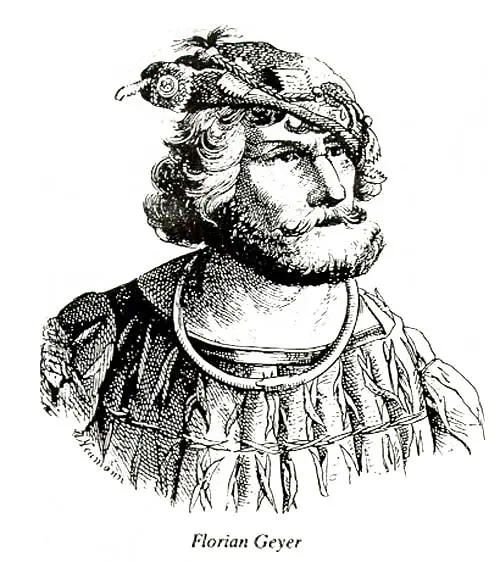
Image courtesy of wikipedia.org
FLORIAN GEYER IS RIGHTLY CONSIDERED BY THE NATIONAL SOCIALISTS OF THE 1930s AND 1940s UP UNTIL THE 21ST CENTURY TO BE A PROTO-NATIONAL SOCIALIST AND ONE OF THE FORERUNNERS OF THE NATIONAL SOCIALIST MOVEMENT. THE 8TH DIVISION OF THE WAFFEN SS WAS NAMED THE “FLORIAN GEYER CALVARY DIVISION” IN HIS HONOR.
Although an illustrious Knight (noble) by birth, Florian Geyer threw in his lot with the peasantry and became their leader. Geyer had begun to see that the German peasantry was the genesis of the True Folk of Germany, just as the NSDAP would do later. Geyer raised and trained an army of peasants which he named “The Army of Wotan” after the chief god of the ancient Germans. After Geyer had renounced Christianity, he then became a heathen like the peasants.
Geyer abandoned Christianity in part because it was the Christians who had instigated and driven the “Burning Times.” Geyer was able to suppress “The Witchcraft Hysteria” in areas that he and his army controlled. Geyer trained his peasant army in the use of both more traditional weapons and HEMA, but he also trained his army to use early firearms and artillery. (Ref: the movie produced by Dr. Joseph Goebbels titled “The Enchanted Forest” in which Florien Geyer plays a prominent role during one portion of the movie.)
From Mail Armor to Plate Armor
Understanding the reasons for the changes in weapons that took place during Europe’s Renaissance era is fundamental to understanding the reasons for the development towards many different forms of HEMA.
Mail Armor – Simply defined is Iron Armor whose segments are woven or tied together in some fashion. There are three general types mail armor: Scale Mail, Chain Mail, and Plate Mail. All three types of Mail Armor were in use since Roman Times, yet only the last two types of armor had any bearing on the development of HEMA.
Scale Mail as the name implies, wearing this type of armor makes a person kind of look like they are covered in fish scales.
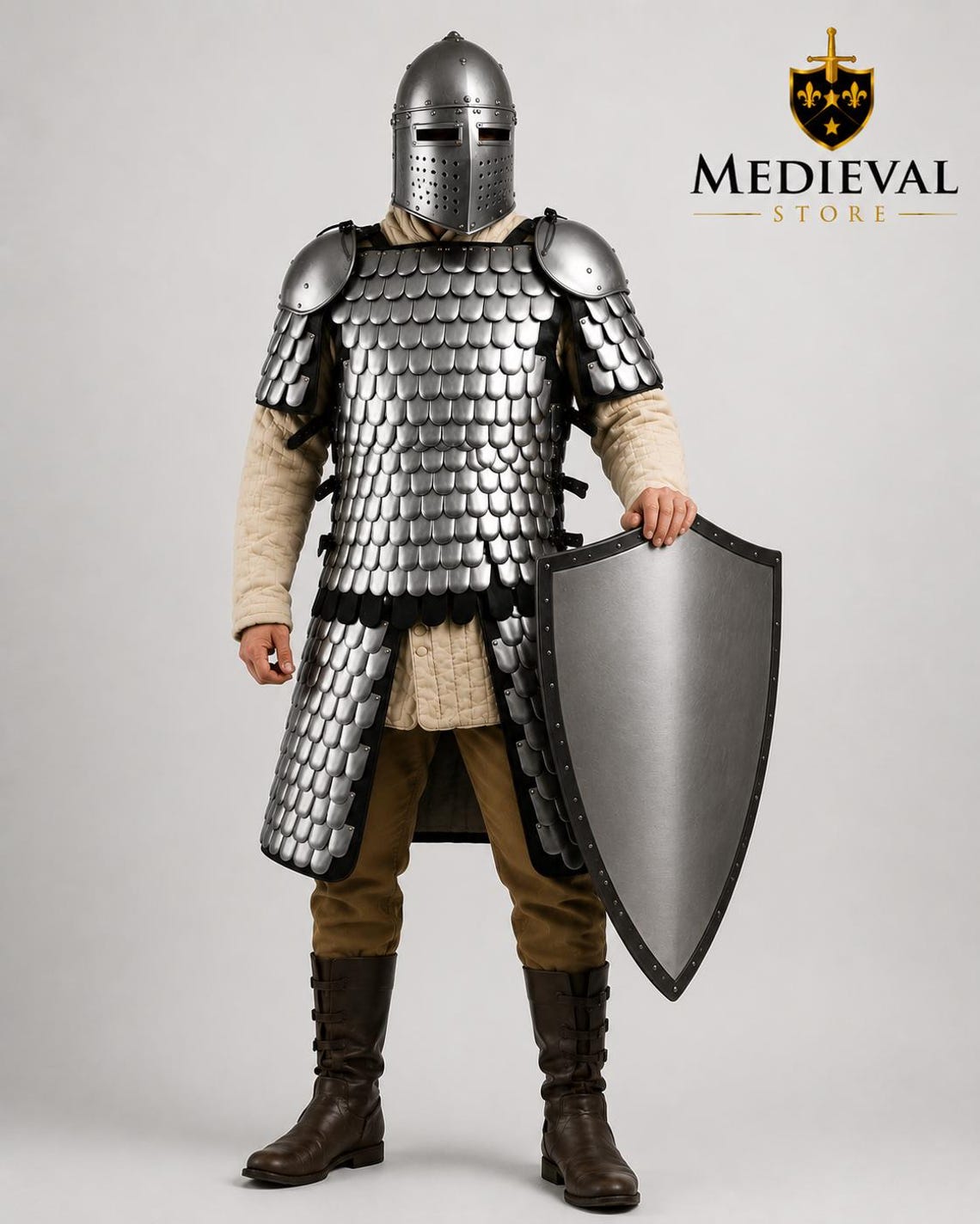
Image of scale mail armor furnished courtesy of TheMedievalarmor on etsy.com
Chain Mail is made by making chains out of wire and weaving those chains together. This type of personal armor provides excellent protection from cutting and cleaving weapons. Another advantage of mail armor it that it is very flexible, which makes it excellent for protecting those areas of the body that require a lot of movement such as the elbows and hip joints. Mail armor also provides excellent protection in the groin area, the armpits, and behind the knees. Even after the introduction of Plate Armor, mail armor remained in use for protecting certain parts of the body. Mail armor’s big disadvantage is that it offers only poor protection against weapons that are capable of producing high-impact loads; in other words, scale mail armor is difficult to cut, but relatively easy to pierce when sufficient concentrated force is applied.

Image of chain mail armor furnished courtesy of Ancient_Armor_Items on EBay.com
Plate Mail is made by taking metal plates and tying them together using leather straps, or even heavy-duty metal wire. Plate mail armor offers very good protection against most forms of early close combat weapons. BUT! It is still capable of being pierced. The armored knights throughout the bulk of their history wore Chain Mail armor and Scale Mail armor instead of Plate Armor.
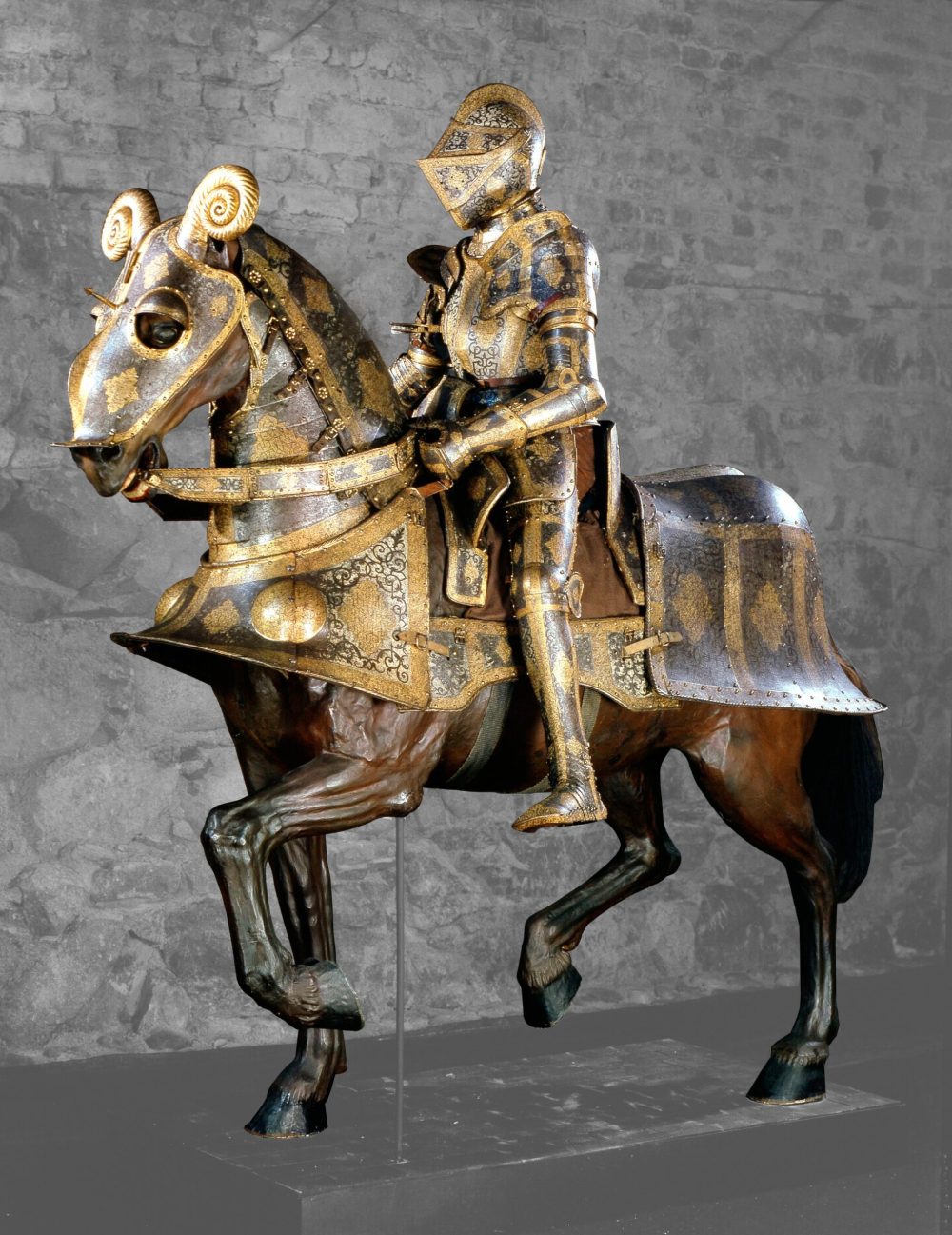
Image of plate armor from the Poland in 1550s furnished courtesy of wikipedia.org
Limitations on the thickness of Metal Plates: 1/8″ of steel was both the maximum and the standard thickness for plate armor because there is only so much weight that even a strong man and his strong horse can carry. In hot weather, being covered with metal plates is very debilitating because such armor renders the wearer overheated, exhausted, and dehydrated.
The famous Musket Rifles from the Renaissance era that arrived around 1521 were large and heavy black-powder-burning rifles which were designed specifically to pierce heavy plate armor. It was the arrival of these large and heavy rifles that were simply larger versions of the earlier arquebus rifles which truly put an end to the age of knights because these weapons were able to pierce even the heaviest of personal armor with little difficulty. The MUSKET instantly proved that it could easily and consistently pierce plate armor even at ranges of 100 meters, so this weapon very quickly made the whole idea of an armored knights hopelessly obsolete.
On the 29th of May 1453, the Ottoman Turks were able to finally breach the stone walls of Constantinople, by using gunpowder-burning cannons, which then proceeded to render the walls of medieval castles obsolete. Heavy and inaccurate muskets were soon replaced with lighter versions of the same rifles after wearing plated body armor had fallen out of favor due to the arrival of heavy black-powder-burning rifles. The term “Musket” originally denoted a very heavy and powerful type of early firearm that was designed to crack the best personal armor of the Renaissance era, but the term Musket gradually became applied to lighter types of rifles.
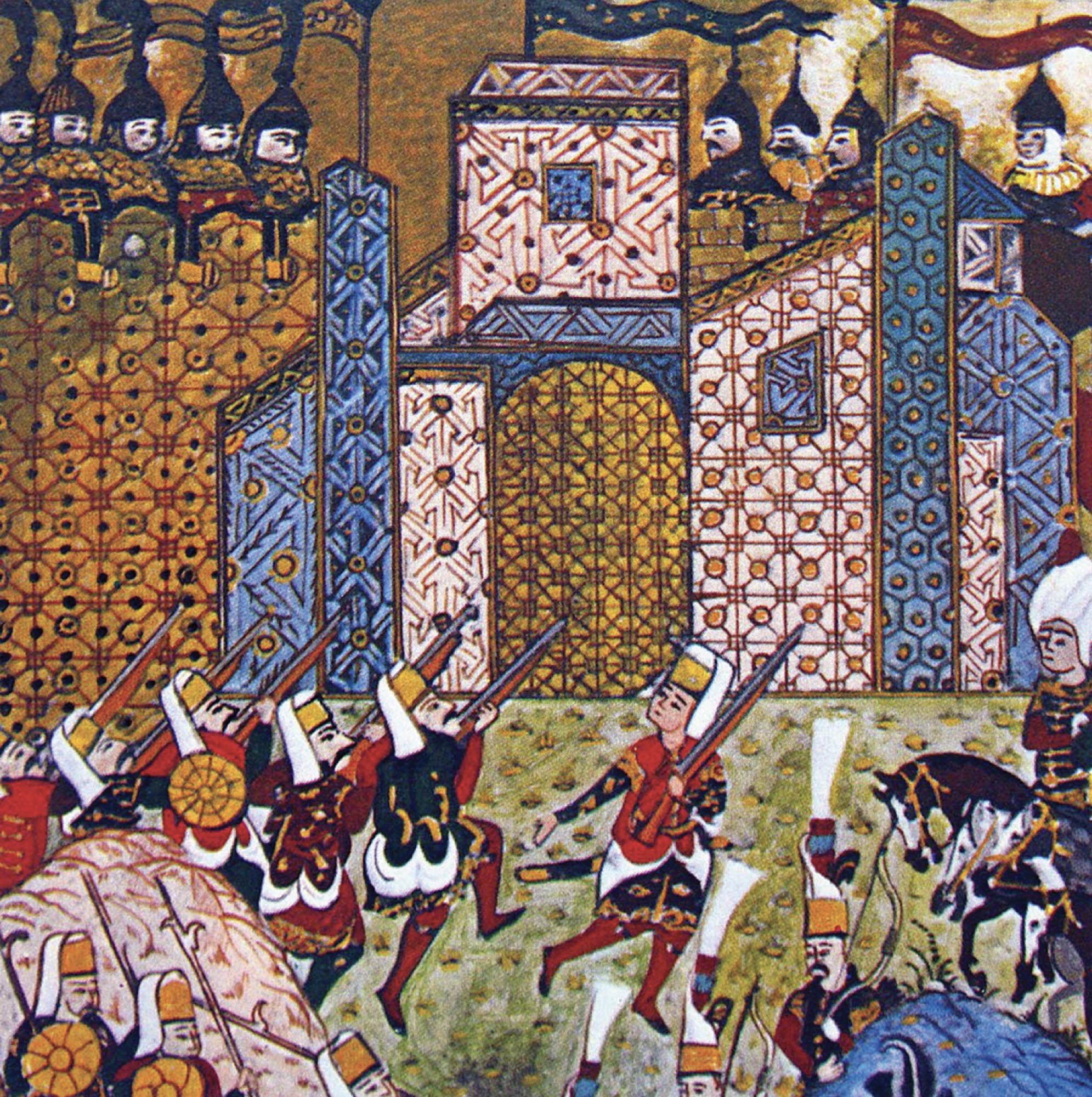
Image of Janissaries at the fall of Constantinople furnished courtesy of oerproject.com
War Hammers were also developed during the 14th century, which came in two sorts: The Standard Model which looked like a big sledge hammer with a spike on one side, and…for most men anyway…the ungainly but sporty looking Lucerne Hammer (named after the city in Switzerland where it was invented) was too heavy to swing. Instead of trying to pierce plate armor, or trying to find a chink in a suit of metal armor, the idea behind these high-impact melee weapons was to send such a shock wave through the man inside the plate armor that being hit with one of these types of warhammer weapons would rupture his internal organs.
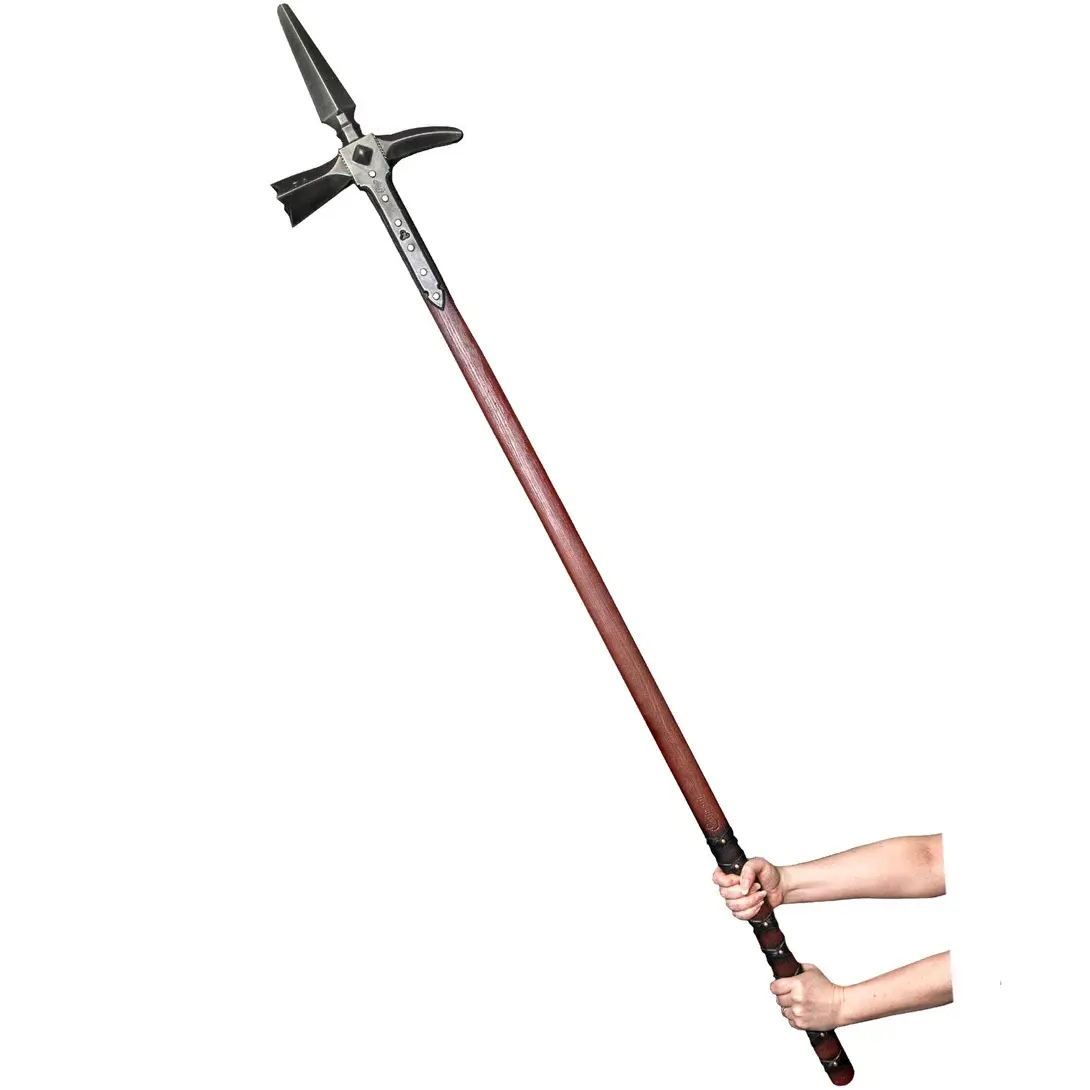
Image of a classic Lucern Hammer featured courtesy of calimacil.com
PART 4.
A Discussion of Various “Traditional” Weapon Systems and their Combat Context
Lead Weapons – These swords were cast from lead in the exact shape and size as standard swords, but they weighed three times as much. These Roman lead swords were used for training and practice, the idea being that they would help an individual build up their muscles so that when they welded the regular iron swords of that time, then their regular swords would feel much lighter and thus enable an individual to wield a regular combat sword with much greater speed and force. I THINK THAT THIS PROVEN PRACTISE SHOULD BE ADOPTED INTO HEMA WHEN WEAPONS ARE INTENDED TO BE USED FOR ACTUAL COMBAT PURPOSES.
Pilums – These were the javelins that were used by the Roman legionaries. The Romans could, at close range, hurl javelins with such force that they could stop a charge of armored heavy cavalry.
Archery – This involves “Missile Type Weapons.” Although actual combat ranges for longbows were normally somewhat less that 400 yards, longbows still had a maximum range of 400 Yards, which is longer than some early artillery pieces. The problem with longbows was that it took years of training to become proficient in their use. Heavy crossbows were somewhat effective as weapons against heavily armored opponents, but their rate of fire is slow, and their effective ranges are short compared to longbows. On more than one occasion, Mongol horse archers annihilated whole armies of armored nights; however, no European people ever really developed a solid tradition of using horse-mounted archers as soldiers.
The Schiltron
A new and particular version of the old “Schiltron“ formation was developed by William Wallace to first stop, and then to annihilate, the English armored knights that rode on horseback during the Battle of Stirling Bridge. The Battle of Stirling Bridge was the first time where a military that was made up of strictly infantrymen on foot had managed to defeat an army that included horse-mounted and armored heavy cavalry.
After William Wallace’s death, Robert the Bruce further developed this form of warfare, and Bruce used it to decisively defeat the English heavy cavalry at the Battle of Bannockburn. Wallace and Bruce had both studied military history, and they had both chosen to recreate the ancient Greek Phalanx in a modified form as a way to defeat an infantry force that was formerly believed to be unstoppable. The defeat of the English at the battle of Bannockburn occurred in the late Medieval era just ahead of The Crusades. The battle of Bannockburn also influenced later pike tactics at the Battle of Laupen.
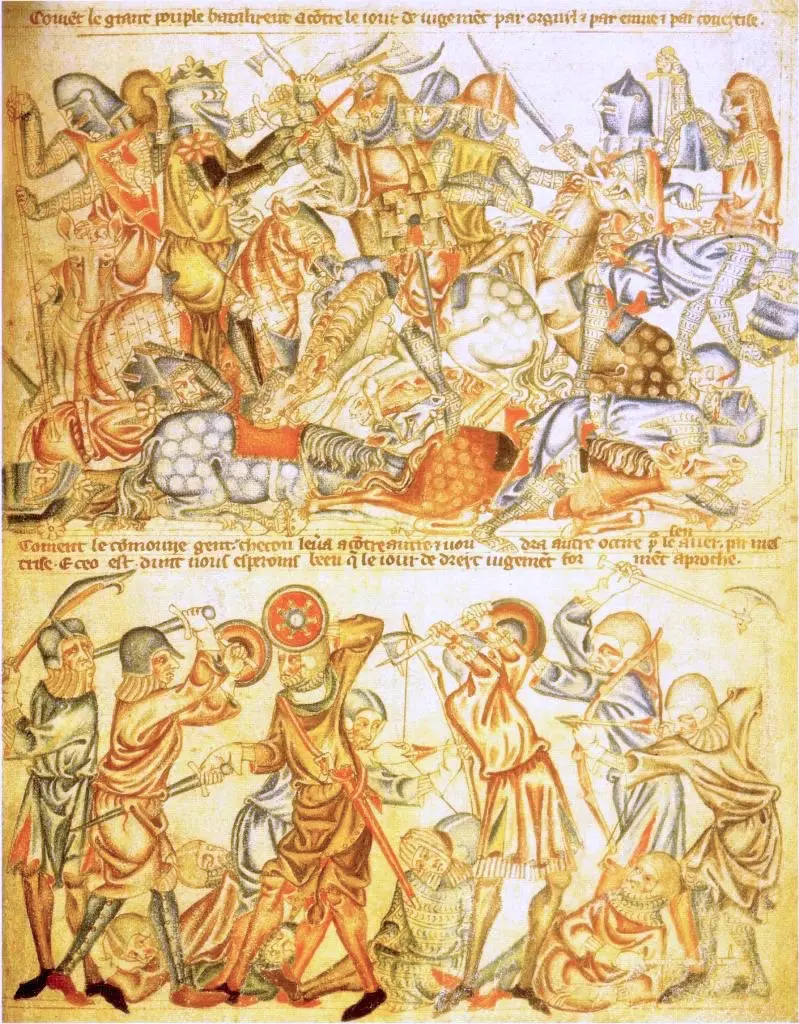
The image seen above shows one of the earliest known depictions for the Battle of Bannockburn. The image seen above is sourced from the Holkham Bible for 1327. Image furnished courtesy of simple.wikipedia.org
I take for granted that almost everyone is familiar with the long two-handed Scottish sword called the “Claymore” as can be seen in the movie titled “Braveheart.” However, much later, the Scots generally adopted the shorter basket-hilted broadsword, which became mistakenly identified as the “Claymore”.
The following modifications were made to the Traditional Phalanx by William Wallace and Robert the Bruce to produce their version of the Schiltron:
[1.] Light Cavalry was deployed in advance of the Schiltron to disrupt the incoming “Fire Support” that was coming in from enemy archers who were attempting to disrupt the Schiltron formation that sat before onrushing heavy cavalry. Sending light cavalry out to harass enemy archers was an absolute necessity when using a Schiltron because otherwise the Schiltron formation presented an easy mass target for enemy archers.
[2.] Longbowmen were deployed just ahead of the Schiltron’s lines of pikemen. These longbow archers kept enemy heavy cavalry under fire until they got close enough to charge the Schiltron formation, then when the enemy heavy cavalry got close to the Schiltron to mount an armored charge, the Schiltron’s lines of archers would fall back into the formation and seek safety behind the mounted lines of foot soldiers who were holding long pike poles. From behind these rows of pikes, the Schilron’s ranks of longbow archers would continue sending relentless waves of harassing arrow volleys at the enemy as they charged in on horseback.
[3.] Ditches were dug in front of the Schiltron to stop the momentum of a charge from enemy heavy cavalry. These defensive ditches could be crossed but not at speed. The Schiltron’s defensive ditches served the same tactical function as modern anti-tank ditches.
[4.] Caltrops were scattered ahead of the Schiltron’s defensive ditch (kind of like Medieval land mines). These “Caltrops” resembled “Jacks” from the “Game of Jacks,” except they were approximately like a soccer ball in size, and the arms of each caltrop were knife blades. Horses refused to plunge into ditches that were filled with caltrops unless they were being ridden so fast that their shear momentum prevented them from avoiding these dangers. The “Game of Jacks” actually originated from a drill that was developed to train infantry men so that they would be able to rapidly gather and rapidly redeploy caltrops during battles.
Any horses and riders who managed to find their way past the caltrops and the defensive ditch when charging one of Wallace’s Schiltron formations were then faced with a wall of pikes after having lost all of their forward momentum. The horses were not stupid enough to hurl themselves against that wall of long spikes; therefore, individual knights would have to force their way into the Schiltron on foot; now they met with a nasty surprise.
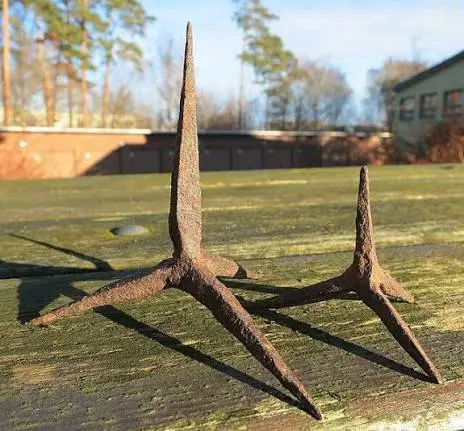
Image of medieval era caltrops furnished courtesy of MedievalHistoria on facebook.com
So, what was this “nasty surprise” that knights would encounter after having reached the front lines of Wallace’s Schitron? William Wallace’s Scots were taught to operate in teams of three against isolated and almost stationary knights. The first man in these units of three would wrest the horse’s reins out of the hands of an attacking mounted knight while the second man protected the first man with his shield against the incoming sword attacks from the mounted knight. At this same juncture, a third man who was armed with an axe would close in from the knight’s blind side and start hacking at the knight through gaps and weak spots in the knight’s armor.
Dismounted Knights
Whether the grounding took place voluntarily or because of something that happened to their horses, whenever an armored knight ever found himself reduced to being a foot soldier in the middle of a pitched battle, then such a vissitude was usually fatal.
If knights became dismounted in battle, then any enemy foot soldiers who were around these dismounted knights would immediately gang up on the now horseless armored knights and attempt to knock them over. If an unfortunate knight was still on his feet after being attacked by enemy foot soldiers, then those enemy for soldiers who were not trying to knock the knight off of his feet were stabbing at any weak parts of the knight’s armor. The weak points in a knight’s armor included such spots as at the groin or the armpits. Knights who had suddenly been unhorsed were described by eyewitnesses as looking like a bunch of beetles who were flopping around and trying to find their feet while the opposing infantry swarmed over them.
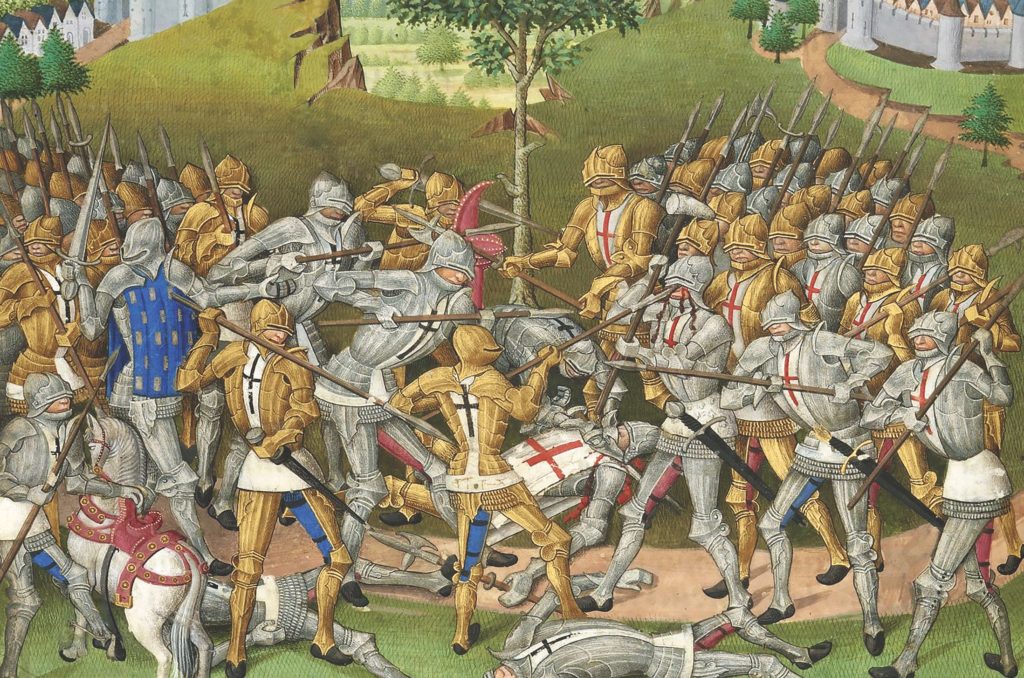
Image furnished courtesy of history net.com
Cutting Swords
These weapons slice into bodily tissue because blades are relatively thin. However, a skilled surgeon could sew up a non-fatal sword cut, and then this sewn up cut could easily heal. By contrast, the cutting blades of axes and Claymore swords (this is why Claymores were nicknamed “Cleavers”), are wedge-shaped; therefore, bodily tissue is split apart rather than simply being cut when a person is struck by one of these heavy and somewhat blunt weapons.
When the human body is hit by an axe or a Claymore sword, the tissue on either side of such a wound that is made by one of these types of weapons is crushed and cut, so the tissue on either side of such a would will eventually die. Having crushed tissue on either side of a gash in a person’s flesh creates wounds that cannot be simply sewed-up like the types of wounds that are made by a conventional sword. Wounds that are made by heavy swords and heavy axes can easily become fatally infected if proper counter measures are not taken. Their potential to cause infections was perhaps the main reason that these types of Medieval era heavy bladed weapons were so feared. Modern surgeons are able to remove all of the damaged tissue that results from strikes by heavy medieval bladed weapons, but Medieval and Renaissance era surgeons had a difficult time doing such a thing.
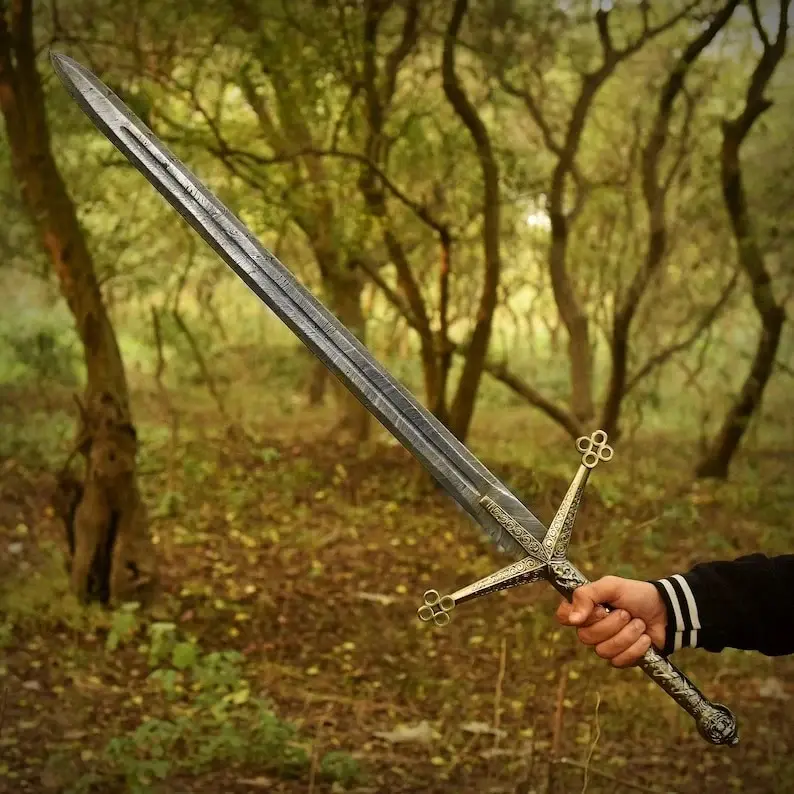
Image of a claymore sword furnished courtesy of nicelowedc.com
Stabbing weapons such as spears, daggers, rapiers, and pikes, only wound in limited areas, but wounds from these types of weapons can be fatally deep and hard to treat. Wounds from piercing weapons that fail to damage any large blood vessels or vital organs could be effectively treated by a skilled surgeon from the Renaissance or late Medieval era.
Fighting With Battle Axes
I have already discussed the heavy and two-handed versions of battle axes, but there were also smaller and lighter types of battle axes that could be very effectively thrown with lethality. Many times, smaller battle axes were thrown at enemies in large volleys. Vikings and Frisians sometimes used this tactic, but it was the Saxons who became renowned for it. The standard-sized and one-handed battle axe, contrary to popular imagination, was not swung. These smaller types of axes were grasped about halfway up the hilt, and these types of axes were held horizontally and close to the body at about stomach level.
When used in combat, a smaller battle axe is held steady and by using the full-strength of one’s legs and back, the axe is shoved forward with the arm half-extending in the process. These types of axe attacks took a good deal of strength and practice to master, but once a person mastered this fighting style, then it could prove to be devastating when in skilled hands.
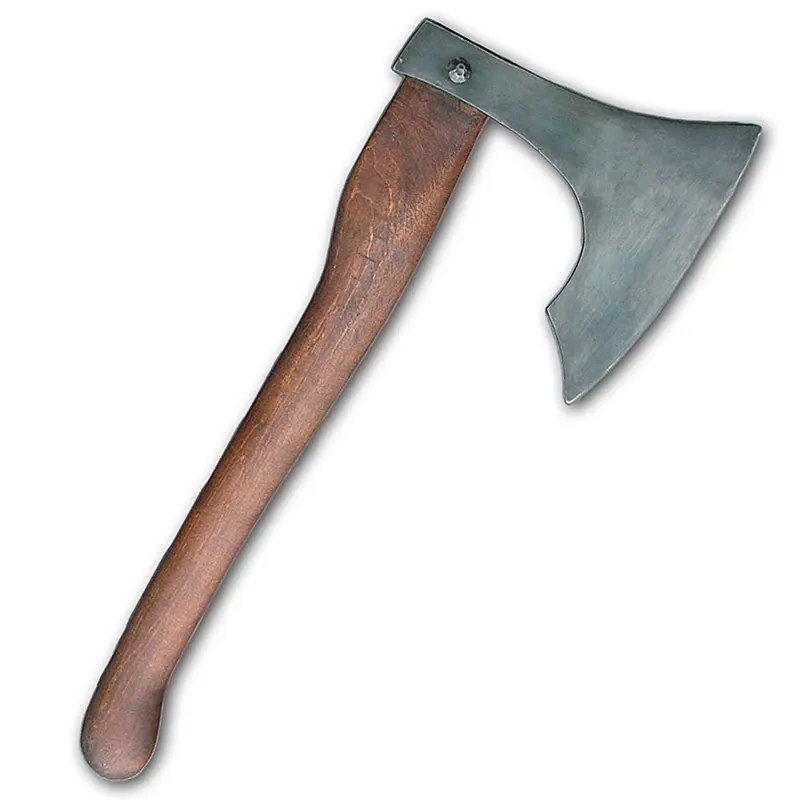
Image of a medieval battle axe replica furnished courtesy of by-the-sword.com
Damascus Steel
This is the world’s first spring steel. Damascus Steel is still an excellent type of metal for making bladed weapons, and it is still quite an expensive and difficult type of steel to use for making bladed weapons. This type of steel was originally invented by Muslim Arab swordsmiths in Damascus, Syria (thus the name) just ahead of the so-called 1st Crusade. Only the wealthiest Syrian warriors could afford to have their swords made from true Damascus Steel, so its appearance on the battlefield produced a great deal of shock and consternation amongst European Crusader Knights.
Damascus Steel swords routinely cut the steel of Crusader broadswords in half during battles. Weapons that were made from Damascus Steel could also cut through the plate armor of Crusader knights as well. At the time of the Crusades, Christian swordsmiths were never able to figure out how Damascus Steel was made. (There are technical reasons why Spring Steel can cut through regular steel, but these discussions are too involved to go into here.)
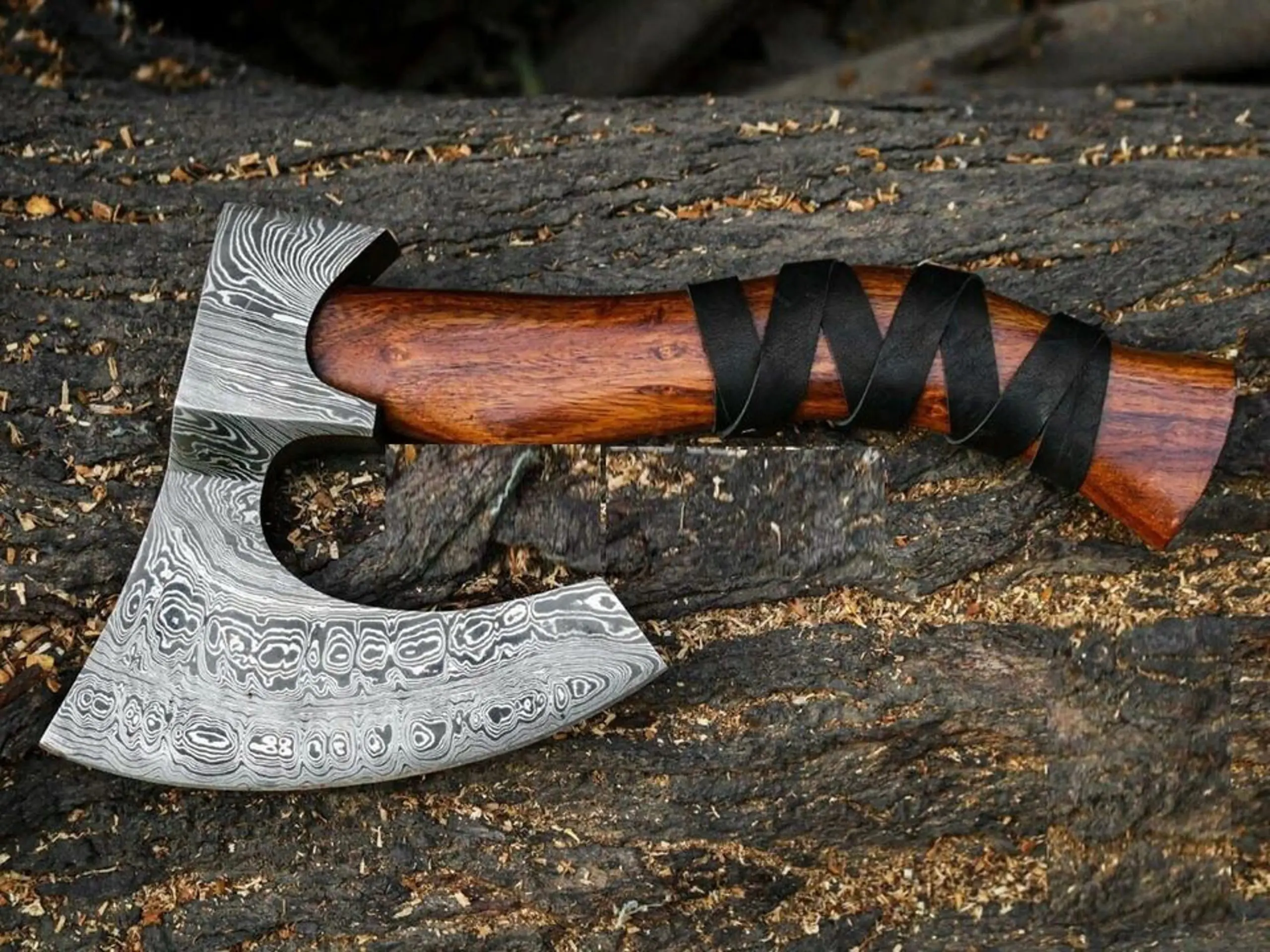
Image of a Damscus Steel battle axe is furnished courtesy of inspireuplift.com
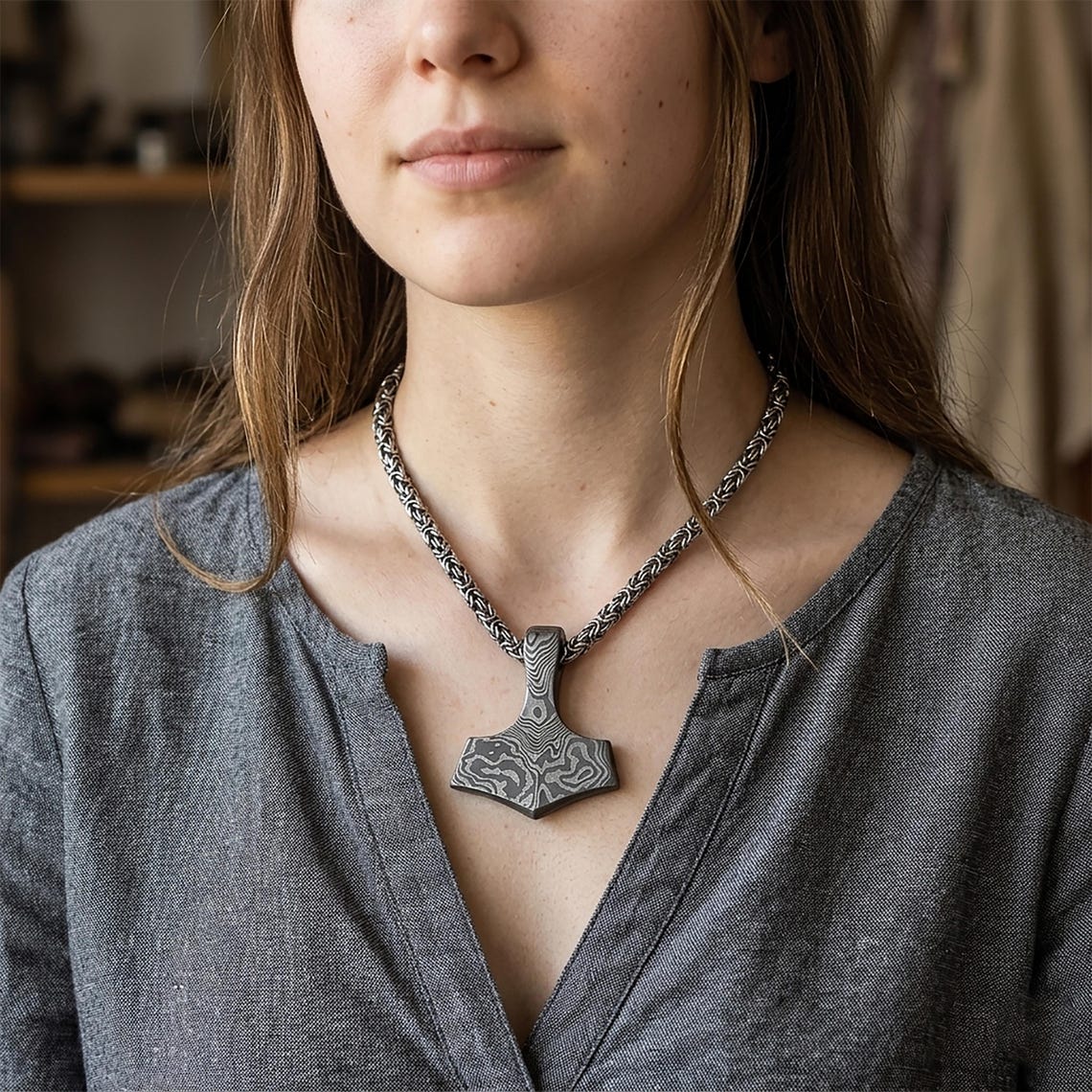
The image above shows a mjolnir pendant that is made from Damascus steel. Image furnished courtesy of AhafrSteelAndStone on etsy.com
Knightly Rashness and Arrogance
Knights fought with their emotions whenever they were given free rein. This tendency to fight with emotions could prove fatal to the individual knight while also leading to group-level disasters during the course of pitched battles. This knightly tendency to leverage their emotions as a means of gaining advantages during the course of battles went a good way towards bringing about the end of using heavy horses and men wearing heavy plate armor as a military system. Giving examples of this principe in practice would prove almost endless, but these cases where the emotionality of knights led to disaster mostly stem from idiotic rashness, general dumbness, and an irrational sense of class superiority on the part of knights.
Medieval knights had a tendency to enter into pitched battles rashly and without thinking clearly. Knights were often incapable of rationally analyzing a tactical situation, and they absolutely had no respect for commoners, so these proclivities applied to European knights of the Medieval era regardless of which side of the battle that they were on. Knights tended to believe that it was their intrinsic class privilege to always be the first ones to enter the fray during pitched battles. Knights also tended to believe that they never needed any help from the despised commoners during battle, especially when fighting other lowly commoners.

Image courtesy of avatar.alphacoders.com
Knights often refused to let the archers and ranks of crossbowmen who just happened to be commoners themselves soften up formations of enemy pikemen (who were also commoners). This is why at the Battle of Bannockburn the English knights insisted on riding their horses so fast that they could not avoid running over the Scottish rows of caltrops and into the Scottish defensive ditches.
During the battle of Bannockburn, the English knights indifferently rode over their own lowly archers who had gotten in their way during the English knight’s cavalry charge against Scottish positions. The English ranks of armored knights then proceeded to charge right into the waiting Scottish Schiltron formation after running their own support units over.
After a long series of disastrous defeats at the hands of lowly commoners (pikemen, musketeers, etc.), the knights as a military system passed into history. The knights could have adapted to changing technology and changing battle tactics and become part of combined arms teams, but their irrational sense of class supremacy over commoners would never accommodate such changes. FLORIEN GEYER WAS THE RARE EXCEPTION TO THIS RULE BEING THE PROTO-NATIONAL SOCIALIST THAT HE WAS; FLORIAN GEYER FOUGHT FOR HIS FOLK AND NOT FOR HIS SOCIAL CLASS!
The Last Use of Heavy Horse Cavalry in the British Isles
The Battle of Justice Mills that took place outside of Aberdeen, Scotland in 1644 and was fought between the Highland Scots who marched under their legendary leader who was named the Marquis De Montrose. The Highland Scots fought against an army of the British Crown that was commanded under the authority of a Scots traitor named Lord Argyll. This battle resulted in the complete rout and near destruction of the British Crown’s forces. An elite veteran regiment of Irish pikemen who fought under Montrose proved to be instrumental to De Montrose’s victory at the Battle of Justice Mill.
PART 5.
Random Notes:
My Family Connection to HEMA and old Pugilism
Although modern Boxing is not the same thing as classic PUGILISM, there are similarities, and the Sport of Boxing was developed from the older system of PUGILISM. Back in the late 1930s, which was long before I was born, my father did box for a time with “GOLDEN GLOVES, ” so I grew up hearing a lot of talk about boxing.
Circa 1900-1910 one of my collateral ancestors was famous for being the best pugilist in the area of Northern Alabama, Northern Georgia, and Southeastern Tennessee, and he raised a large family on his winnings. On one occasion, he heard about another well-known pugilist that worked on the Coosa River Docks in Rome, Georgia who had so far gone undefeated. My relative walked all night for a distance of about 40 miles to where the other man was working. After arriving early in the morning, my relative challenged the other man to a fight. My relative bet the man from Georgia $100 (That was a large sum of money in those days, worth about $4,000 in current dollars.) that he could whip him. The man from Georgia took up the challenge and these two men proceeded to “Fight All Day” with only the occasional brief pause to catch their breaths.
About dark, the other man suffered a sudden heart attack and dropped dead on the spot. The man from Georgia had been straightforwardly challenged, and he had of his own volition accepted this challenge, then he had willingly continued with the fight, so the Rome Police saw no need to press criminal charges. My relative then collected his winnings and walked back home that same night.
LENGTHY AND EVEN MULTI-DAY FIGHTS that one sometimes hears about from the Old Days, were not actually continuous, but they were something fairly close to it, like the fight that I just described.
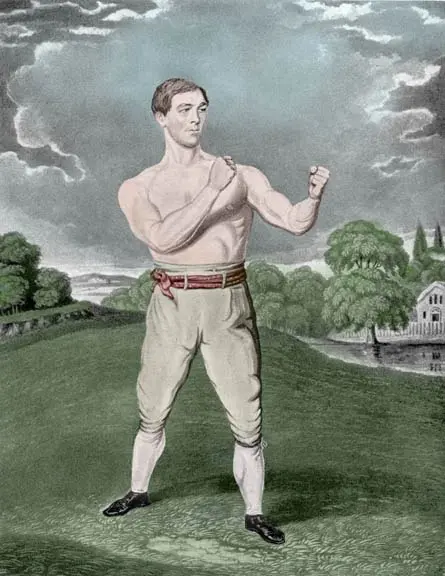
Image of a classic pugilist furnished courtesy of finderskeepermarketinc.blogspot.com
My father’s people (the men) in those days, and for some decades afterwards, were well-known over the whole region for being scrappers. If there was trouble, then the Hilburn Boys always seemed to be involved in some way because of family or friendship ties, or because they were hired. It also seems that scrapping was just a male family tradition as well. In part this love of scrapping was due to my relatives having served in the Confederate Army during the Second American Revolution.
Using Ball Bearings as Weapons
In 1975, when I was in Naples, Italy there existed local street gangs who survived off of armed robbery. Members of these gangs were highly skilled at disabling or even killing their intended victims at a distance by hurling large steel ball bearings at them with deadly accuracy. Perhaps learning to hurl steel balls of differing sizes and weights at antagonists when firearms are scarce can be revisited as a form of HEMA in the coming years.

Image of throwable steel ball bearings furnished courtesy of DinoWolf one ebay.com
Heil Hitler Deva!
– 88 –
Randall Lee Hilburn