

What Are National Socialist Building Codes? Part 1. An Overview of Wood Technology
What Defines National Socialist Architecture? Part 1. An Overview of Wood Construction Technology
Wood has been used to build many thing for millennia, but is wood still relevant as a building material into the 21st century and beyond? What benefits does building infrastructure from wood offer?

NATIONAL SOCIALIST BUILDING CODES FOR THE GOLDEN AGE/SATYA YUGA
(The Balancing of Technology and the Natural World in the Spirit of Deep Ecology)
Preface – National Socialist Development & Deep Ecology
By Randall Lee Hilburn
Living right in the world is all about keeping things in their proper balance, and this is true because The Folk needs to advance and grow, but The Earth/Natural World must flourish and be protected as well. Both the World and The Folk stand or fall together in the True Spirit of BLOOD & SOIL; this is the meaning of Deep Ecology. The term “Deep Ecology” captures the Third Reich’s Environmental Philosophy & Policy. This is our unchangeable position, and the this is the driving force behind National Socialist Building Codes.
We Aryans are THE LITERAL DESCENDENTS of HIGHER SPIRITS, so we were not created by anybody on this terrestrial realm and nobody bioengineered us. We have Germanic Blood running through our veins, so the ALL-FATHER ODIN & ALL-MOTHER FRIGGA ARE OUR ANCESTORS AND OUR ELDERS. Whatever else these Aesir (”Young Gods”) may be, they are also our relatives, and they are fellow members of the Greater Aryan Family. Our Blood Is Sacred because we are the offspring of the greatest Aesir.
NERTHUS is the EARTH GODDESS to the Ancient Teutonic Peoples, and the Romans referred to her as TERRA MATER (MOTHER EARTH). NERTHUS is our Sacred Soil, so she is every bit as Sacred as our Blood. We may be born of The Aesir, but we are sustained by Nerthus.

Image courtesy of freepik.com
Forward – Building Things to Last as Part of Sustainable Development
By Randall Lee Hilburn
The policy of “Planned Obsolescence” only serves to make the Moneyed Elite (Hebrews) even richer than they already are, which is the whole point of them coming up with it anyway. Not only is the practice and the idea of planned obsolescence inimical to a Healthy Earth/Soil, but this concept is also oppressive to our Blood/Folk. The further down in Social Standing that a person sits, the more extreme the effects of planned obsolescence become, although everyone is adversely affected by this concept to one degree or another.
Instead of producing or building something to last for as long as possible, which is less disruptive of the Natural World, the concept of planned obsolesce seeks to make every consumer item and very industrial item into a disposable commodity.
The practice of Planned Obsolescence places a drain on every individual member of the Folk while also draining The Folk’s collective resources in countless ways, be these resources measured in time, measured in energy, or measured in financial assets. When planned obsolescence is the ruling factor for all business transactions, workers are often forced to make their families take second place to their jobs. Planned obsolesce also creates the need for two-income families. When planned obsolescence is discarded, then more attention can be paid to marriage and childrearing plus the continual growth of each member of a family. In a proper National Socialist society, each person grow in a mental, spiritual, and physical manner that all happen within the scope of a harmonious relationship to Nature.

Image courtesy of travelask.ru
When policies that operate on the principle of planned obsolesce are in force, workers must constantly labor in order to make enough money to repair, replace, or acquire things that are going to be constantly wearing out or endlessly needing to be fixed and replaced. Eventually, the workers themselves are used up in a world of planned obsolesce, so many people die way before their time under such policies. The premature deaths of workers that are driven by policies of planned obsolescence help Capitalists and Hebrews make even more money from the early deaths of workers. Since men have traditionally been the primary wage-earners in a family, they usually die much sooner than women, and many times men die very soon after they retire.
Particularly egregious examples of Planned Obsolescence can be gleaned from the Automotive and Electronic Industries:
(A.) New car models are put on the market every year, but how many people are aware that EACH “Model Year” for a particular type of car has actually been designed several years in advance? Each type of car’s design is constantly being “improved” but is never allowed to be perfected. In order to force people to constantly buy new products, problems are created in one year, then corrected in another, and all of these underhanded plans are designed well in advance, as planned.
By the 1970’s, car manufacturers already knew how to build cars that would normally last for at least 1,000,000 miles without ever needing a great deal of maintenance, and the old Checker taxi cabs totally prove this point. Checker cars used old and basic automotive technology, but they were designated to serve as taxis, so they were built to be driven around the clock for many years. The Checker Motors Corporation of Kalamazoo, Michigan eventually transitioned into a supply contractor for Crisler, Ford, and General Motors because taxi companies found the low cost of fleet contracts with “the big three” Zio-American car companies to be more agreeable. Checker also had a tough time producing their cars cheaply due to lacking an economy of scale.

Image of a 1978 Checker A11 Taxicab furnished courtesy of bringatrailer.com
As early as the 1970s, manufacturers developed tires that would last for a few hundred thousand miles on average. Research & Development Departments of various large automakers have been constantly working to discover the improvements that would make such things possible, then they patent their discoveries and lock them away so that nobody will ever be able to use these patents in the future. This discovering then hiding of useful ideas is done to ensure maximum profits over time, so automobiles are deliberately designed and built NOT TO LAST!
(B.) With electronics, when you see new devices, new “improvements,” or new software, you are actually looking at technology that was developed +/- FIFTEEN YEARS BEFORE! With the consumer electronics industry, things work pretty much as they do in the automotive sector. I have personally experienced software being knowingly put on the market that was developed just to cause problems so that the same manufacturer can later sell an updated version of that same product with a fix for the problem that was deliberately created. This sort of thing is ROUTINE! Something may work quite well in one version, then it is replaced in a later version by something that does not work as well if it even works at all. Later on, things are put back like they were in a still later version.

Image courtesy of csmonitor.com
This sort of thing goes on all the time. Later “improved” versions of various products are created that are completely incompatible with earlier versions; this is done to prevent any individual or business from simply continuing to use what they already have. (Anyone who has worked with any of AutoDesk’s drafting software is probably very familiar with this sorry routine.) With our present system of planned obsolescence and its engineered product bugs that always need “fixing” and “updating,” everybody is forced to always be “Keeping up with the Joneses” in order to avoid being buried by total inoperative obsolescence; THIS IS THE COST OF EVERYBODY BEING CONNECTED. (I took Computer Science courses at a college where the Computer Science Department was merged with an IBM research & development facility, then after graduation, I worked in civil engineering.)
Sustainable Development in National Socialism is simply the perfect balance of Blood & Soil that the The Folk need for development and for The Natural World’s continuing survival – they each stand or fall together.
Part 1. Does Wood Have a Place in Tomorrow Land?
Supplemental Commentary by James Rousse

Image courtesy of create.vista.com
Many people think of wood as being a very crude building material that harkens back to rough-looking men clad in fur who were out building rudimentary survival shelters during some forgotten time with a “B.C” or “B.P” written in front of the date line. Using wood as a construction material for making buildings and other common daily items also harkens back to visions of Europe’s Medieval era in many people’s minds. For many folks, Europe’s Medieval era is still associated with diseases, famines, barbaric torture, and unenlightenment, but upon closer inspection, none of these negative assumptions about life in Medieval Europe are as true as people commonly imagine. Yes, stereotypes and tropes always contain a grain or two of truth, but in a general sense, the public still has entirely too many negative and incorrect assumptions about life during Europe’s Medieval period.
Despite wood’s old and archaic mental associations, use of this ancient construction material still persists as time passes. During the 20th century, wood still remained in common use despite the availability of cheap and truly mass-produced steal along with the rise of truly mass-produced and cheap plastics, plus the arrival of cheap and mass-produced aluminum. Light, strong, and corrosion-resistant titanium also worked its way into more common and everyday applications in the later portions of the 20thcentury. The waning years of the 20th century additionally saw the arrival of strong composite materials into the fabric of daily life, but wood persisted as a construction material across many applications despite the arrival of newer, slicker, and stronger materials.

Image of a carbon fiber bicycle frame is furnished courtesy of pinkbike.com
Contemporary Types of Super Wood
Engineers have also experimented with new ways to use wood as a construction material well into the early years of the 21st century. Some of these newer types of super-strong “engineered wood” materials which are made from sandwiched sheets of wood that are stacked between laminate layers that are made from polyurethane-based epoxy resins. These polyurethane-based wood laminate products create materials that challenge carbon-fiber composites when compared in tests that gauge strength-to-weight ratios.
Densified wood materials which incorporate epoxy resins into their chemical formulas often post numbers for tests of tensile strength that exceed those for most type of steel. The term “Densified Wood” refers to wood that has been treated in ways which collapse the cellulose-laden walls which form cells within pieces of a tree’s internal “heart wood.” The cellulose walls that form cells within a tree’s heart wood can be densified by steaming the wood pieces then compressing these same wood pieces with hydraulic rams while the wood is still hot and saturated with water. The process of creating densified wood by heating then compressing it is often referred to as “Mechanically Densification.” Mechanically Densified wood gets this name because a physical compression process is used to make this material.
Densified wood can also be made by removing some of the lignin mass that holds the cells in wood together through a process that uses specialized biological enzymes and solvents, then by filling the cells with a chlorine-based chemical solvent which causes the heart wood’s cells to expand to excessive sizes. Once the cells that form a tree’s heart wood have been chemically swelled to huge sizes, then the treated wood is allowed to slowly air-dry until the solvent has all evaporated. After the solvent that caused the heart wood’s cells to swell to huge sizes has evaporated, then the remaining wood cells collapse in on themselves and transform into a very dense cellulose-based material. The process of creating densified wood solely by chemical means forms a material that is referred to as “Self-Densified Wood.”

Image courtesy of ChangeNarrow5633 on the r/buildingscience forum on reddit.com
Mechanically densified wood is relatively cheap and easy to produce when compared to self densified wood, but on average mechanically densified wood is not as strong, not as hard, not as rot-resistant, and mechanically densified wood is also not as moisture resistant as self-densified wood. The density and hardness of densified wood in general makes this material fairly resistant to denting and scratching. Both types of densified wood are also fairly resistant to water penetration and the inevitable rot which follows. One notable shortcoming with mechanically densified wood is its tendency to at least partially absorb moisture then to slowly regain its original shape, size, and density as time passes. Mechanically densified wood never fully returns to its original state, but it does slowly lose many its desired properties as time passes. By contrast, self densified wood tends to hold its original shape as time passes.
The types of wood that are used to make densified wood make a big difference concerning the final tensile strength of the finished product, but on average, mechanically densified wood has a tensile strength measurement of 398 mega-pascals.Oak that is made from a process where the lignin which binds the cellulose outer shells of its heartwood cells together is chemically removed has very good materials properties. When densified oak is subjected to extreme compression has topped out at tensile strength measurements of 584 MPa.
By contrast, pure aluminum has a tensile strength of around 100 MPa, and common industrial 6061 aluminum alloy notes a tensile strength of 310 MPa. The 7068 Aluminum alloy that is commonly used for high-performance aircraft applications boasts a yield strength of 710 MPa. As for steel, common A36 steel notes a “Yield Strength” of 250 MPa, and common 1090 steel notes a Yield Strength of only 247 MPa. “Yield Strength” is a measurement that denotes how much force metal can withstand before its shape and dimensions become permanently altered. Densified wood also weighs about 37% as much as common aluminum alloys for the same volume that it occupied on average. Densified wood weighs between 1,000 and 1,300 kilograms per cubic meter, versus aluminum which weighs in at around 2,700 kilograms per cubic meter. Densified wood only requires about 5% as much energy to produce as aluminum on a pound-for-pound basis.

Image of an aluminum alloy aircraft from furnished courtesy of chalaluminum.com
Self-densified wood is attractive as a building material because it requires a lot less energy to produce than metals or even mechanically densified wood, but the process of making self-densified wood requires a decent measure of chemistry knowledge and a lot of expensive and sophisticated manufacturing equipment. The average tensile strength of self-densified wood is around 496 MPa. It turns out that mechanically compressed wood which has its lignin removed seems to offer a higher potential for producing strong materials, but self-densified wood produces higher average strength numbers than mechanically compressed wood.
The good news is that self-densified wood is not particularly expensive, nor is it very energy-intensive to produce once all of the needed manufacturing equipment has been set up and steady supply lines of the needed chemicals are in place; however, this manufacturing process can only be economical if it is executed on a large scale. At this time, self-densified wood’s manufacturing process still incorporates chorine, so if this material is to ever be used by National Socialists on a large scale, then it must become friendly to the environment. At this time, chemical engineers are researching ways to create self-densified wood that omit any toxic chemicals.
Less dramatic examples of engineered high-performance materials that are created from wood include various types of marine-grade plywood which use polyurethane resins to hold sheets of tropical hardwoods together. Marine-grade plywood is often used to construct speedboats and racing sailboats. Marine grade plywood typically posts tensile strength numbers that range between 28 and 90 MPa, so this material has nowhere near the strength as metals, densified wood, or the wood laminates that use paper-thin sheets of wood in place of woven carbon fiber fabric. Most common types of marine-grade plywood typically last around 15 to 25 years.

Image of marine grade plywood furnished courtesy of mdfdirect.co.uk
Marine-grade plywood is considered to be very rot-resistant because the wood that forms the laminated layers within this material are tightly sealed away against having any contact with incoming moisture and oxygen, but the polyurethane compounds that form the resins which hold this material together always degrade in the presence of oxygen, heat, and light.
The premise of keeping water completely out of any wood-based material is sound, but this strategy only works for a relatively short amount of time because water and moisture will eventually find their way into the layers of wood that constitute even the most well-made types of marine-grade plywood. The premise of preventing water from ever making contact with the wood pieces that form any type of a treated wood product is a fallacy because water in the form of ice, liquid, or gaseous vapor tends to work its way into every size of crack within any material and even the smallest holes within any material will experience water penetration if enough time passes.
The wooden structures that tend to last the longest operate on the premise that trying to prevent wood from ever coming into contact with water is a pointless and losing battle. Therefore, if tying to keep water away from wood is not a sound policy, then the best plan is to allow water to contact wood but then to also allow pieces of wood to easily absorb and quickly release internally trapped water vapor. The best strategy for fostering long-term wood preservation is to create wood that repels liquid water as much as possible while allowing gaseous water vapor to arrive and depart with as little resistance as possible. If water cannot enter a piece of wood easily, then it cannot exit easily either. If water is trapped inside of wood with no exit possible, then this trapped water tends to collect and pool up inside the wood, and having any standing water exist within a wood piece always creates more internal rot over the long run.

Image of a sailboat made from marine grade plywood furnished courtesy of modernwoodenboat.com
Metals and metal alloys offer greater strength than wood on a pound-for-pound basis and this quality has allowed truly massive structures to be constructed from these types of cheap and mass-produced materials. The Eiffel Tower in Paris, France is one such example, but other examples include the iconic Golden Gate Bridge which traverses the Golden Gate Straight that once separated the city of San Francisco from Marin County in Northern California. In more recent times, the engineered wood product that is commonly known as “CLT” or “Cross-Laminated Timber” has permitted architects and structural engineers to build tall buildings with wooden frames. Cross-laminated timber is made in a process that involves glueing small pieces of wood together to create massive pieces of composite wood which in turn permit engineers and designers to build truly massive and towering structures from these glued-together slabs of wood.

Image of the Golden Gate Bridge in San Francisco, California, U.S.A furnished courtesy of wikipedia.org
The longevity of these new, huge, and impressive CLT wooden structures is hard to guess at this time because CLT construction is still a relatively new building method; however, the structural integrity of these structures ultimately rests on the longevity of the glues which hold the small boards that sit within these creations together. The real factor that determines how long cross-laminated timbers will last is the life expectancy of the adhesives which are used to hold these structures together on the most basic and crucial level.
Most cross-laminated timber structures are held together with polyurethane-based glues that deteriorate in time from moisture penetration and from exposure to atmospheric oxygen, so for this reason cross-laminated timber structures lack the longevity of traditional wooden buildings. The Polyurethane Manufacturers Association’s website lists the lifespan of most polyurethane adhesives and sealants as being around 50+ years when they are used for indoor applications, so the adhesives that hold cross laminated timber structures together will degrade in relatively short periods of time when compared to Medieval wood preservation methods which have a proven lifespans of 1,000+ years.
Polyurethane-based adhesives are not permeable to water vapor, so this lack of permeability will eventually lead to excess water buildup within cross-laminated timber structures as time passes, and his accumulated internal moisture will then facilitate more rot and fungal growth as time passes. According the U.S Forest Service’s website, the projected working life of the adhesives that are used to form cross laminated timbers is listed as being around 60 years to 150 years, which is on par with the established lifespans of cement and steel rebar buildings, but this lifespan is nothing near that of traditional medieval wooden buildings. Lastly, the massive amounts of polyurethane that sit within large cross laminated timber structures will eventually pose an environmental disposal problem because polyurethane does not biodegrade well. As a counter argument to this fact, some people might point out that new formulas for plant-based and non-toxic wood adhesives that are not water soluble now exist; however, if these new and non-toxic laminate adhesives are not water soluble, then they will degrade very slowly which means that they still pose a disposal headache even if no toxic chemicals are present.

Image of a Cross Laminated Timber structured building that is under construction furnished courtesy of timberland.com
Generally, cross laminated timber construction costs about as much as conventional steel and concrete construction when creating larger buildings, but cost estimates for CLT construction projects vary from being 6% more than those of conventional concrete and steel to 15% less than those of concrete and steel on a cost-per-square meter basis. The general breakdown seems to be that CLT buildings have higher materials costs, but they also offer lower labor costs for construction and they offer faster completion times than conventional construction methods.
Higher materials costs for cross laminated buildings are based on the higher cost of cross laminated timber sections, but higher materials costs also arise because cross laminated timber buildings need far more fire-blocking panels which are usually made from gypsum. By contrast, steel and concrete buildings need very few fire resistant panels. The massive sizes of cross laminated timber pieces means that flame can only penetrate these structures rather slowly, so cross laminated timber buildings do not structurally collapse due to fire as easily and quickly as people might imagine. Larger buildings that are made from cross laminated timber also have foundations that do not go as beep into the ground as conventional cement and steel buildings because buildings that are made from CLT have around 20% the weight of concrete and steel buildings, so less cement and steel are needed when building foundation for larger CLT buildings. The smaller and more shallow foundations that support cross-laminated timber buildings lead to lower construction costs at least for building foundations.
Cross laminated timber buildings also save around 6% in energy costs for both heating and cooling when compared to well-insulated and recently built conventional steel and glass buildings, so the actual energy savings for this material over well-insulated conventional buildings are not quite as extreme as many people have been led to believe.
The tallest cross-laminated timber building is currently the 284-foot-tall Ascent MKE building in Milwaukee, Wisconsin, USA.

Image of the Ascent MKE Building in Milwaukee, Wisconsin, U.S.A furnished courtesy of wikipedia.org
Contemporary Wood Preservation Methods
Treatments that promote more rot-resistant types of ordinary wood have also been created by the modern industrial chemical industry, and one example of this trend is pressure-treated lumber. Until around 2004, chemically treated lumber that used chromated copper arsenate as a preservative was the most common type of chemically treated and rot-resistant lumber. Classic preserved wood that has been treated with chromated copper arsenic notes a characteristic green color and it has recognizable injection holes where the preservatives were pushed into the wood. Other toxic industrial wood treatments such applying the tar that remains after coal is burned have been in use since the 19th century. “Coal Tar” that is used as a wood preservative is called Creosote. Creosote-based wood treatments produce toxic wood, so this treatment process was banned in America back in 1987.
Modern pressure-treated lumber is really not all that great because wood that has been treated with these copper-based compounds or creosote still tends to decompose within a few short decades and these types of treated wood leave behind toxic residues after decaying and after being burned. Most sources note that decking which is made with copper-treated wood last up to 40 years at most, and the U.S. Forest Service’s research website notes that wooden posts which have been treated with copper-based preservatives can last up to 60 years.

Image of classic green pressure treated lumber furnished courtesy of bayoucitylumber.com
Most contemporary wood treatment formulas now rely on copper compounds that do not contain arsenic to preserve the material; however, these chemicals still leave behind toxic residues in the ashes that are left over after they have been burned. Even updated wood preservation treatments that exclude arsenic still leave behind poisonous residues in the soil that has been in contact with these types of treated wood. Yes, the updated generations of copper wood preservatives are less toxic than the old formulas that contained arsenic, but these copper-based industrial wood treatments are still poisonous; they are just poisonous to a lesser degree. Lumber that has been treated with copper-based preservative chemicals is still NOTsafe to use for indoor applications, and this type of coper-treated wood is especially dangerous to use for applications where human skin or food comes into contact with this type of material.
Another modern wood preservation method is Acetylation. The acetylation treatment involves curing wood by using Acetic Acid. Acetic Acis is basically a very concentrated form of vinegar. The basic process of acetylation was first experimented with in 1928, but commercial acetylation processes as they are practiced today owe their origins to research that was performed at Chalmers University of Technology in Sweden during the 1980s. Acetylation treatment produces wood that is more dimensionally stable than untreated wood, and the acetylation process increases wood’s lifespan outdoors and when the wood is placed into direct contact with soil. Acetylated wood has become more popular for decking and other specialty outdoor applications as the years have passed. On average, acetylated wood lasts about 50 yeas when used outdoors, and about 25 years when placed in contact with the ground.
Despite making wood more dimensionally stable and more resistant to rot, the acetylation process makes wood less flexible and it makes wood more prone to splitting and checking, so using acetylated wood is not recommended for heavy structural applications. Wood that has been treated in this way is also known to be difficult to work with and it is known to resist adhesives. Acetylated wood is also known to corrode metal that it is touching. Acetylated wood is additionally known to carry a lingering vinegar smell that is unpleasant. The acetylation process is somewhat expensive and complex, so this treatment process is hard to perform on a local level, plus many types of wood do not absorb the acetylation process’s chemicals in an even and consistent manner.

Image of a house in the Netherlands that is clad in acetylated wood furnished courtesy of archdaily.com
Boric acid is also used as a treatment that helps wood resist rot, and this treatment method may have been invented in the 1870s, but it was not widely used until the 1940s. Boric acid treatments offer many nice advantages and not many disadvantages. Wood that has been treated with boric acid is generally safe for indoor use, and boric acid is not a known carcinogen; however, wood that has been treated with boric acid is still not recommended for use in applications where it will come into continual contact with food or human skin either. For more than a century, boric acid has been used to treat burns and other health issue, so this substance cannot be excessively toxic.
Wood treatments that contain boric acid are also not known to make wood more difficult to work with, nor are boric acid treatment processes known to negatively affect wood’s structural strength. Boric acid treatments are not known to erode metals that contact the treated wood, so wood that has been treated with boric acid is considered safe to use for heavy structural applications. Boric acid also does not leave an unpleasant odor in the wood that it has treated. Boric acid treatments saturate wood to its core, so this process is not simply a surface treatment.
The only real disadvantage that is associated with boric acid treatment process is the fact that boric acid is water soluble, so this treatment method can only be used on wood that is coved from the elements and is not placed in direct contact with soil, standing water, or rain. Boric acid treatments are basically only applicable for interior structural lumber.
Interestingly, wood can be first treated by applying a sodium hydroxide treatment to remove the wood’s internal lignin. Next, this delignified wood can be given an acetylation treatment that produces extra dimensional stability and moisture resistance, and finally a treatment of boric acid can be applied to this same wood stock with a bit of propylene glycol to help the water-soluble boric acid deeply penetrate the water-resistant acetylated wood. (Propylene glycol is often used as a food additive, so this chemical is not overtly toxic; however, questions do linger about exactly the safety of long-term exposure to this additive.) This multistep chemical preservative processes that was described earlier can be applied to wood in sequence and the remaining substance can then be compressed into a very strong, rot-resistant, and dimensionally stable densified wood material. To express this idea in different words, boric acid treatments are compatible with the process of creating densified wood. Treating wood with acetic acid and boric acid is compatible with the process of creating densified wood. Multi-step treatment processes can potentially create densified wood materials that are stronger and more resistant to rot.
Boric acid treatments are also compatible with Medieval-era wood preservation methods such as tannin treatments and lime saturations, so boric acid-based wood treatments are very likely to find their place within future National Socialist architectural practices.
Traditional Wood Building Methods as a Technology for Building Key Infrastructure
Wood is a cheap, plentiful, and renewable construction material that is also friendly to the environment. Unlike plastics, composites, and laminate materials, traditionally processed wood poses no long-term disposal problems once it is no longer fit to use for building purposes, so National Socialists will look to use traditional wood building and preservation methods to construct new generations of critical infrastructure.
Traditional wood can be used to build single family homes, multi-family buildings, commercial building, and institutional buildings such as schools and hospitals.
Traditional wood building practices can be used to create bridges of many sizes that potentially have working lives which are measured in centuries.
Traditional wood building methods can be used to create key components within municipal water systems.
Traditional Wood Structures can be Very Large
Cross laminated timber beams permit engineers and architects to create very large structures from this material, but some structures that were made by traditional wood building methods have also been quite large. For example, wooden railroad trestle bridges from the 19th century in North America topped out at 226 feet in height and 866 feet in length. The point to consider is that traditional wood building methods can be used to create large infrastructure projects.

The image above shows the Marent Gulch Bridge near Missoula, Montana. Image courtesy of woodcentral.com
The tallest wooden structure that was not made from cross-laminated timber is reported to be the Gliwise Radio Tower in Poland which reaches upward to 367 feet. The Gliwice Radio Tower is made with metal fastenings as opposed to mortise and tenon joints, but this tower was not made with cross laminated timber.

Image of the Gliwice Radio Tower furnished courtesy of wikipedia.com

Image of the Gliwice Radio Tower’s woodwork is furnished courtesy of drevostavitel.cz
The tallest wooden roller coaster that is not made from cross laminated timber is the T-Express coaster in South Korea which rises to 183 feet.

Image of the T-Express rollercoaster in South Korea is furnished courtesy of 7tucans.com
As of 2026, world’s largest wooden structure is the Grand Ring in Osaka, Japan which stands 36 feet tall, has an outer edge that is 1.2 miles long, and covers around 180,000 square feet. The Grand Ring in Osaka, Japan is worth noting because it is the largest wooden structure on the planet at this time, yet it was not built with cross laminated timber pieces. The Grand Ring in Osaka was not built by using glue, nails, screws, or other metal fasteners; the Grand Ring in Osaka was built using traditional Japanese carpentry methods.

The image above shows the wooden foundation for The Grand Ring in Osaka, Japan. Image courtesy of newatlas.com

Image of the Grand Ring furnished courtesy of dazeen.com

The image above shows The Grand Ring of Osaka, Japan from the air in April of 2025. Image courtesy of wikipedia.org
The tallest traditional wooden structure which was build without glue or metal fastenings is the Pagoda of Fugong Temple in Shouzhou, Shandong, China which stands at 220 feet.

The image seen above shows the pagoda of Fugong Temple in Shouzhou, Shandong, China. Image courtesy of guinessworldrecords.com
Wooden blimp hangars from the World War II years typically measured 1072 feet long, 292 feet wide, and 192 feet tall. Wooden blimp hangar buildings are worth noting here because they are made from standard wood pieces that were fastened together with metal connecting pieces and not from cross laminated timber or metal structural sections. The remaining wooden blimp hangars that were build in the early 20th century demonstrate that ordinary cuts of wood can be used to make very large and long-lasting structures. The two largest wooden blimp hangars are located in Tillamook, Oregon, U.S.A and the Tustin Marine Corps Air Station facility in Tustin, California, U.S.A

The image above shows the interior of a wooden blimp hanger from the World-War-II-era. Image courtesy of pinterest.com

The image above shows the interior of Oregon’s Tillamook Air Museum. The giant structure seen above is made from wood pieces held together with metal fasteners. image courtesy of ther/Oregon forum on reddit.com
Log Construction Goes Big
Buildings that are made from round logs which have never been transformed into square of rectangular dimensional lumber can also be rather large. Creating buildings and other structures from logs that have never been sawn in a parallel manner is often called the “Log Cabin” style of construction. Building with round logs does impose some limitations onto a structure’s size because round timbers do not join together at their junction points as easily as squared dimensional lumber. It is also harder for structural engineers to accurately calculate the strength of round wooden logs when they are used as building sections or used as critical support pieces. None the less, “Log Cabin” types of wooden buildings can still be made to fairly large sizes.
“Log Cabin” types of buildings are worth looking into for future building projects in National Socialist societies because log cabin types of buildings are 30% more efficient than conventional wood construction and they can be constructed fairly quickly.

The image seen above shows the Forestry Building in Portland, Oregon after it was completed in 1905. The original Forestry Building in Portland, Oregon, U.S.A was completed in 1905, but it burned down in August of 1964. Image courtesy of wikipedia.org

The image seen above shows the interior of the Forestry Building in Portland, Oregon back in 1948. Image courtesy of vintageportland.wordpress.com

The image above shows an outside view of the Old Faithful Inn at Yellowstone National Park in the Zio-American state of Wyoming. The Old Faithful Inn was competed in 1904 and as of 2007, this building was listed at number 36 on the registry that highlights the top 150 buildings according to the American Institute of Architects. The Old Fiathful Inn is one of the world’s largest existing “Log Cabin” types of buildings. Image courtesy of wikipedia.org

The image above shows the lobby of the Old Faithful Inn. The lobby of the Old Faithful Inn serves as as a showcase of the scalability of large “Log Cabin” types of buildings. Image courtesy of wikipedia.org

The image seen above shows the lobby of the Old Faithful Inn at Yellowstone National Park in Wyoming, U.S.A Image courtesy of Dead_Motherfucker on the r/RoomPorn on reddit.com
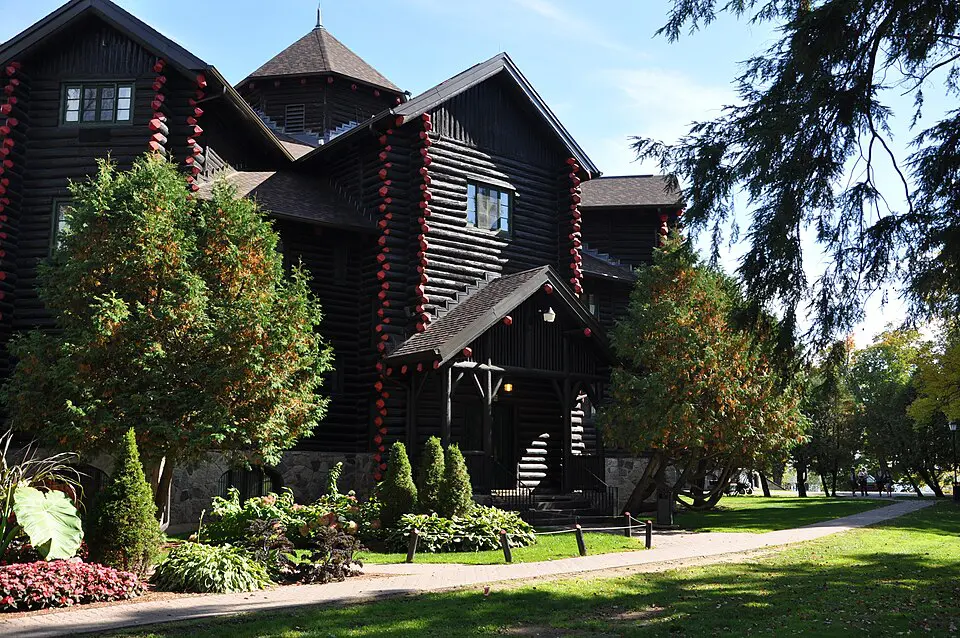
The image above shows the outside of Canada’s Fairmont Le Chateau Montebello hotel in Quebec. Image courtesy of wikipedia.com

The image above shows the lobby inside of the Fairmont Le Chateau Montebello Hotel in Quebec, Canada. Image courtesy of fan-tas-tic on the r/ArchitecturePorn forum on reddit.com

Image courtesy of ownwoodenhouse.com
Traditional Wooden Buildings and Infrastructure Items are Usable for Centuries
As of 2026, Germany is estimated to have more than 2.5 million wooden buildings that are more than 500 years old which remain in use to this present day. The German city of Quedlinburg is a designated UNESCO World Heritage site, and this city is noted to have around 1300 traditional wooden buildings that were constructed more than 500 years ago. Despite wood being perceived as an old and “past-it” building material by many contemporary people, the longevity of traditional wooden building methods is still amazing. It is also worth noting that these old building in Germany which were made by traditional methods are not museum pieces, but instead, these old buildings still function as places of residence, places of education, and places of commerce.

Image of Quedlinburg, Germany’s market square is furnished courtesy of wikipedia.com

The building that is pictured above is the Maison D’Adam tenement building in Angers, France. The Maison D’Adam is worth noting here because it is a fairly large six-story residential building that was made by classic Renaissance Era timber frame construction methods in 1491, yet this building is still occupied and still standing after all of these years. Image courtesy of wikipedia.org

The image above shows the town hall in Esslingen, Germany which was rebuilt in 1586. The building seen above is a classical Renaissance Era wooden timber frame building with is still standing to this day and still in active use. image courtesy of TrayvatWanderer on the r/ArchitectrualRevival from from reddit.com
A Bridge Too Far
Building bridges and roads by using old Roman methods offers infrastructure with the longest service life, perhaps with the exception of nanotech materials or space-age metal alloys. That having been said, Roman building methods still offer very long service lives; however, building infrastructure projects by using old Roman methods is expensive and time-consuming, so some places might not receive their Roman infrastructure projects for decades or longer. If Roman infrastructure projects are not going to arrive at many places in a timely fashion, then faster, cheaper, and perhaps less ambitious alternative construction methods need to be explored, and traditional wooden building methods fit the bill for these purposes.
➡︎ Wooden Bridges can Last a Long Time
Many wooden bridges that are hundreds of years old are still in use. For example, North America has covered wooden bridges which are more than 100 years old that are still in active use. The structural timbers that sit inside these basic covered wooden road bridges are made from simple and untreated wood and they will last at least at least 200 years if they are kept covered with roofs and siding.

The image above shows the Hyde Hall Bridge in East Springfield, New York, U.S.A. The Hyde Hall bridge is the oldest standing covers bridge in North America because it was built in 1828.

The image above shows the Holz Brucke covered wooden bridge in Frankenmuth, Michigan, U.S.A. The image above demonstrated that covers wooden bridges can support a fair amount of weight. Image courtesy of bavarianinn.com
Sri Lanka has a wooden foot bridge that is older than 400 years which still has all of its original wooden pieces and remains in active daily use.

Image of Sri Lanka’s Bogota Wood Bridge furnished courtesy of lanka-excursions-holidays.com
Moreover, the Caucuses republic of Dagestan has a wooden road bridge that is at least 200 years old which is still in daily use, and this old bridge shows absolutely no signs at all of needing any repairs.

The image above shows the famous Dagestan Bridge near the village of Gulli in the Republic of Dagestan which sits in the southern Causes Mountains. Image courtesy of Scirex on x.com

Another image of the famous Dagestan Bridge is furnished courtesy of nashaplaneta.net
As things stand, a typical short road bridge that is made from a steel rebar skeleton which is surrounded by a Portland cement outer shell typically lasts around 50 to 70 years, despite being designed to last for 100 years. As things stand in 2026, around 7% of the Zio-American Empire’s cement and steel road bridges are structurally compromised, and around 33% are in need of major repairs. Despite being designed to last for 100 years, most concrete and steel rebar bridges are in need of major repairs after 25 years of service.
As of the 2020s, the Zio-American Empire is getting progressively poorer, more corrupt, and more incompetent on all levels, so it seems very unlikely that the empire’s collection of decaying and unsafe cement and steel road brides will be repaired any time soon. In light of the shortcomings that are associated with using steel and cement to make smaller road bridges, it seems quite sensible to use traditional wooden methods for making thousands of new covered road bridges that have roofs and siding which protect their wooden inner structures. This new generation of short wooden covered bridges can be made the local level, so they offer an appealing option for creating new infrastructure when money is tight and distant resources are unavailable.

The image above shows the interior of the Portland Mills Covered Bridge furnished courtesy of fineartamerica.com
Designs for covered wooden bridges must also ensure that none of a bridge’s supporting wooden pieces remain in contact with the water that sits below the bridge, and support materials that wick moisture up toward each bridge’s wooden key structural pieces must also never be used. The choice of materials for each bridge’s protective siding might vary by the bridge’s location and they may also vary with the preferences of the bridge’s designers. Traditional lime plaster mixtures such as the wattle and daub technique, along with ceramic tiles, plus various types of metal siding all offer affordable and lasting options for keeping a bridge’s sides from of water and exposure to UV light. Each wooden bridge’s protective siding would not only offer protection from the elements, but it would also offer a layer of fire protection.
For making smaller and medium-sized bridges, using wood is actually a surprisingly cheap building option. Interestingly, the construction process for wooden bridges typically costs about 30% as much as that of steel bridges. Moreover, wood offers a lower materials cost than steel or cement, and building a wooden bridge requires less need for heavy equipment. Wood construction methods also offer faster construction times.
➡︎ Wooden Bridges can Handle Heavy Loads and Heavy Traffic
Wooden bridges can handle heavy and constant road traffic, as evidenced by wooden trestle bridges of the 1890s needing to support steam trains that posted between 15 and 20 tons of weight per axle. Even the heaviest modern road trucks do not exceed 140,000 pounds of weight, or around 70 tons of weight in total, so 70 tons of weight is spread across 18 wheels and five axels on the heaviest road trucks of our time, and these numbers translate to around 14 tons per axle. Many old wooden trestle bridges also supported gravel beds on their top decks which were called “ballast decks.” These “ballast decks” helped to decrease the transfer of vibrations from moving trains into a bridge’s wooden under structure. Incorporating ballast decks into new wooden bridges may add to the overall construction cost, but they will also increase the bridge’s lifespan. Ballast decks also provided smoother rides for the trains. Installing ballast decks on the tops of trestle bridges simply requires incorporating more vertical supports which are called “bents” along with incorporating 30% more horizontal support structures which are called “Stringers.”
The types of shorter wooden bridges that traditionally have lasted the longest and have supported the most weight are those which were designed with a Howe Truss. Incorporating Howe Trusses into shorter wooden bridges results in structures that are strong enough to accommodate heavy and constant road and train traffic. Some coved wooden bridges incorporate the Howe Truss design for added structural strength. Howe Trusses can also be used to hold together the top decks of trestle bridges which adds another layer of strength and stability to the structure while also serving as a structure to support the roofing section for the bridge’s top deck. Old Wooden Howe bridges also frequently incorporated long a d threaded iron bolts which permitted maintenance crews to keep the bridge’s wooden structural pieces fitting tightly which served to increase the length of the bridge’s working lifespan.

The image above shows the old Black Howe Trestle bridge near Boone, Iowa, U.S.A in the 1920s. The bridge seen above was a wooden rail bridge that was replaced in the 1920s. Image courtesy of yorkblog.com

The image above shows a scale model Howe Truss bridge. The image above shows a scale model of a wooden Howe Truss type of bridge; none the less, this picture still provides a good reference point for the way that Howe Trusses look and how they fit together. Image courtesy of largescalecentral.com

The Barrington Bridge in New South Whales, Australia was made in 1918, and it is one example of a heavy wooden road bridge that was made in the Howe Trestle manner which is still in use. The Barrington Bridge is capable of accommodating even the heaviest of road traffic, and this bridge has done so for decades. Image courtesy of wikipedia.org
As for using wooden trestle bridges to move modern diesel-electric trains, it turns out that older steam trains typically weighed more than modern trains; however, modern trains distribute their weight across fewer axels than older steam trains which in turn puts more weight on bridges and railroads tracks on an axel-per-axle basis. It is also worth noting that older wooden trestle bridges were never designed to accommodate heavier models of trains that might be in service today; however, stronger wooden trestle bridges can be made to service heavier trains by simply incorporating more wooden “bent” and “stringer” sections into each new bridge.

The image posted above shows the Mill Creek Covered Bridge which was built in 2010 and sits near to Ostrander, Ohio. Image furnished courtesy marionstar.com
As for making shorter bridges sturdy enough to accommodate modern trains and super-heavy road traffic, the “stringer” bridges that are made by setting layers of wood in horizontal sections can easily accommodate even the heaviest of modern trucks. Extremely heavy 18-wheel logging trucks have been crossing ad-hock bridges that are made by laying large raw tree trunks horizontally across rivers, creeks, and ravines for more than a century now, so making very sturdy shorter wooden bridges from wood is a proven concept. Round and unprocessed logs are about 50% stronger than cut dimensional lumber, so shorter bridges can be made by stacking properly dried, properly treated, and properly de-barked round logs in horizontal rows of tree trunks. Despite the proven strength of short stringer bridges, incorporating these sturdy wooden lower portions into Howe Truss designs still makes the most sense from a structural integrity standpoint.

Image of a raw log stringer bridge furnished courtesy of theforesterartist.com

The image above shows a short stringer bridge made from glued wooden supports. Sturdy short stringer bridges can be made without resorting to using metal fastenings or glues which wear out before a bridge’s structural wood. Sturdy supports can be made by creating dimensional lumber pieces that interlock without needing glue or metal fasteners as evidenced by observing the Dagestan Bride’s construction methods. The bridge seen above would ideally have a sufficiently sturdy bottom support section like it does now, but it would also incorporate a Howe Truss above its bottom supports to provide extra strength and longevity along with a covered roof to provide extra longevity. mage furnished courtesy of wheeler1892.com
➡︎ Traditional Wooden Bridges can Cross Long Spans
As for making larger bridges from wood, some bridge-building projects such as constructing the Golden Gate Bridge simply require using steel, cross-laminated timbers, or laminate materials such as carbon fiber or fiberglass. Despite traditional wooden carpentry’s limitations as a building material for building larger bridges, trestle bridges from past centuries that were built by traditional carpentry methods spanned deep ravines and traversed long distances, so traditional wooden construction methods can be used to fulfill many larger and more ambitious bridge-building projects. Trestle bridges are also capable of handling heavy loads and the strain of continual and heavy road traffic.

The image seen above shows the 203-foot-tall Cedar Logging trestle in Washington State. Image courtesy ofthevintagenews.com

The image above shows the Mountain Creek Trestle in British Colombia, Canada. The photograph that is seen above was taken in 1887. Image courtesy of progress-is-fine.blogspot.com

The image seen above features another archival image of the Mountain Creek Trestle Bridge in British Colombia, Canada. The photograph seen above was taken in 1885. Image courtesy of sanfordfleming.ca

The image seen above shows the Duhamel Bridge in 1910. The Duhamel Bridge was 120 feet high and ran for 4,000 feet. Image courtesy of justacarguy.blogspot.com
Contrary to what some people might believe, building large and solid infrastructure projects from well-treated and well-prepared wood pieces does not require having continual access to large and dense old growth timber inventories. There is also no need to resort to with building cross laminated timber beams when making larger wooden structures simply because large old-growth cuts of wood are no longer available. If large cuts of old-growth wood are no longer available, then architects and engineers can simply use larger numbers of comparatively small plantation-grown wooden pieces to compensate for the absence of large old-growth lumber. Strong bridges and buildings can be made without resorting to cross laminated timber slabs by simply electing to use denser arrangements of smaller wooden pieces. For example, recently built and large wooden rollercoaster structures do not use cross laminated timber pieces, nor do they incorporate large slabs of dense old-growth wood.
One key to giving trestle bridges more longevity is to keep their wooden under-structures properly covered against the elements like the wood structural pieces are on shorter covered wooden bridges. Designers of trestle bridges would also need to prevent each bridge’s wooden supports from coming into contact with both water from below and the soil. Later trestle bridge designs incorporated cement or stone supports that prevented each bridge’s vertical structural timbers from coming into contact with soil or water which in turn greatly increased each protected bridge’s working lifespan.
Another key factor for transforming wooden trestle bridges into lasting pieces of infrastructure is to avoid using metal fasteners at connection points between wooden timbers, and this is the case because metal fasteners tend to decay quickly and they tend to become the components that need to be replaced the most quickly. Metal fasteners also tend to put strain on wooden supports because they create connection points that are not as flexible as those of traditional wooden mortise and tenon joints; therefore, metal connections put unneeded strain on wooden supports as the wood structural components naturally expand and contract with changes in humanity and temperature. Lastly, metal fasteners are not flexible, so the expansion and contraction of wooden support pieces tends to make the bolt holes in the wooden pieces that hold metal fastenings larger and looser as time passes which then slowly weakens the entire bridge’s structural integrity. By comparison, wooden mortise and tenon joints tend to get more sturdy as time passes.

Diagram of various wood mortise and tenon joints furnished courtesy of timberframehq.com
Wooden trestle bridges that are built with high numbers of diagonal supports are also the structures that tend to last the longest, so incorporating diagonal “Town Stringers” into future tresses bridge designs is crucial. As noted earlier, incorporating a roof and a Howe Truss to the top deck of a trestle bridge increase the bridge’s structural strength and serves as a structure to support the top deck’s covered roof.
Trestle bridges primarily fell out of favor because advances in construction equipment design made it more economical to simply build earthen berms as opposed to fabricating wooden trestle bridges, but other factors were involved. For example, old wooden trestle bridges were often prone to catching fire because their inner structural timbers were not protected against fire by outer walls. Early trestle bridge also tended to rot within 20 years because their structural wood was not treated with proper preservative methods, nor was this structural wood kept covered from the elements. The structural wood pieces that formed old trestle bridges were also typically not prevented from contacting soil of standing water on the supports. Despite their past shortcomings, wooden trestle bridges can serve as lasting pieces of critical infrastructure if they are just protected from contact with water and soil from below while also being kept covered with layers of fire-resistant and water resistant outer protection. Wooden trestle bridges also need have their inner structural wood property treated against rot if they are to last for centuries.
Wooden Water Infrastructure
Wood has been used as a construction material for transporting and storing agricultural water along with potable municipal water for millennia as evidenced by a preserved yew wood water pipe being excavated in Ireland in the 2020s that was carbon dated back 2500 years. The first wooden municipal water piping network in North America is considered to be a buried network of hollowed out logs that was constructed in 1652 to provide a fire-fighting network to the city of Boston, Massachusetts. The first known municipal drinking water system in North American was built in Bethlehem, Pennsylvania back in 1755, and yes, this system used hollowed out wooden logs to transport fresh water from a nearby hilltop reservoir to the town below. Aaron Burr also founded a company in 1799 that built and operated a water distribution network which was made from hollowed out tree trunks.

Image of workers building Aaron Burr’s New York City water network furnished courtesy of 6sqft.com

The image seen above shows wooden water main piping that was accidentally excavated in Portland, Maine back in 2016. The wooden water piping seen above was installed some time between 1820 and 1850. Image courtesy of pressherald.com
Later, especially between 1880 and 1930, wooden stave piping became the dominant form of municipal water piping across the North American continent, and some larger wooden stave pipes remain in service to this day. Wooden stave piping is made by connecting many small curved pieces of wood together in round shapes, then these shaped wooden pieces are fastened together by using metal bindings. Wooden stave piping becomes watertight after the wood which forms the pipe’s outer shell becomes waterlogged and swells to form tight seals along the seams of each structural wooden piece.

Diagram of a wooden stave pipe furnished courtesy of notechmagzine.com
As of today, the the American states of South Dakota and North Dakota still have old wooden stave pipes that serve as central water mains in a few rural townships, but wooden stave piping still finds its most common applications when it is put to use transporting massive amounts of untreated water for agricultural use. Most of the wooden stave piping that is still in use measures more than three feet in diameter. For example, the city of Bellingham, Washington, U.S.A still uses a massive wooden stave pipe to transport its untreated city tap water.

The image above shows the city of Bellingham, Washington, U.S.A’s main wooden stave water supply pipe as it was under construction in 1940. Image courtesy of salish-current.org
➡︎The Limitations of Wooden Piping
Wooden stave piping offers many advantages over other types of water piping, but it is unusable for certain applications. These applications where wooden piping is unusable include sewage piping systems and tap water servicing systems for homes and other buildings that exist above the ground level. Wooden service piping is unusable for transporting sewage water because sewage piping typically does not maintain any continuous internal pressure beyond that of the Earth’s atmospheric, so sewage pipes are typically filled with atmospheric oxygen. Wooden stave pipes need to be kept wet, and they need to be kept sealed away from exposure to oxygen in the Earth’s atmosphere if they are to avoid quickly rotting into nothing, so wooden stave piping needs to be kept continuously pressurized with water if it is going to last any length of time.
Wooden stave piping needs to remain under continuous internal pressure from water, so using wooden stave piping to transport sewage is not a tenable idea. The piping that services tap water outlets inside of homes and other buildings remains internally pressurized, from 40 to 80 pounds per square inch, so wooden stave piping is a bit too prone to leaking to function well for this type of purpose. The best choice of materials for above-ground domestic water service piping within houses and buildings seems to be pure copper of pure stainless steel piping that is fastened together by press fittings.

Image of copper press fittings furnished courtesy of icrimptools.com
Press fittings are the best choice for domestic tap water servicing above the ground because they require no solder and they require no synthetic pipe sealant materials. Both metal solders and polymer pipe sealant materials contain traces of toxins which then leach into the drinking water that they hold and transport, so press fittings that are applied by squeezing metal fitting together very tightly are the best way to do things for such applications.
It appears that wooden water piping fell out of favor mainly because constructing this type of piping required skilled craftsmen and a bit of patience to install; whereas, installing iron piping requires less time and less skill. Despite requiring skilled carpenters and skilled craftsmen to assemble, one nice feature that wooden stave piping offer is the fact that small pieces of stave wood and their accompanying metal binding rings can be transported easily without requiring heavy equipment nor requiring manual heavy lifting by workers.

The image above shows a large wooden stave pipe under construction in 1910. This pipeline curried irrigation water to fruit orchards in British Colombia, Canada. Image courtesy of doukhobor.org

The image above shows workers assembling a large wooden stave pipe in Canada’s Yukon Territory during 1908. Image courtesy of sverdrupian on the r/InfrastructurePorn forum from reddit.com

Image of workers assembling a new wooden stave pipe furnished courtesy of nwksgmd.blogspot.com
➡︎ The Advantages Offered by Wooden Piping
Wooden stave piping replaced chains of interlocking and hollowed out wooden logs because wooden stave pipes can hold internal pressure more effectively than wooden logs, but installing stave piping also eliminates the need to lug around heavy wooden logs. Wooden stave piping additionally offers the advantage of being made into single continuous pieces that do not have nearly as many potentially leaky connection points as liked-together chains of hollowed out logs. Skilled workers can additionally create gradual curves and even sharp turns in wooden stave piping without needing to create junctions that will potentially leak as time passes. In other words, skilled workers can create seamless wooden stave piping that curves and makes sharp turns.

The image seen above shows a large wooden stave pipe that is being used to move huge amounts of agricultural irrigation water in the state to Washington’s Yakima Valley. The pipe seen above has many curves in it which never demanded the any pipe fittings were used. The image seen above was captured in 1905. Image courtesy of wikipedia.org
Wooden stave piping is known for being flexible when compared to other types of piping material, so this type of piping easily accommodates shifts in the ground that accompany changes in temperature and changes in moisture. Wooden stave piping is also far less prone to taking damage from internal pressure surges and their accompanying water hammer effects than metal or plastic piping. The flexibility of wooden stave piping also makes this type of piping less prone to burst during freezes than pipes which are made from other materials.
As for how long wooden stave piping can last, this time frame varies considerably, but wooden stave pipes have maintained their serviceable integrity for more than 200 years on some occasions. The wooden parts that constitute wooden stave piping tend to last much longer than the metal bindings that hold the pipes together so long as the wooden parts are kept away from atmospheric oxygen and kept saturated with water. The type of wood that is used to create the wooden structural staves also has a big impact on the longevity of the stave piping. When considering the lifespan of wooden stave piping, the metal ring bindings are the components that usually fail first, not the structural wooden pieces.

Image of an old wooden stave pipe furnished courtesy of rezonatefreq on the r/Plumbingforum from reddit.com

The image above shows a city water main pipe that was accidentally unearthed in Santa Cruz, California back in 2016. The pipe seen in this image dates back to 1847. Image courtesy of santacruzsentinel.com
One complaint that has been leveled against wooden stave piping is that is cannot hold pressure as well as iron, steel, or PVC/polymer piping, and this is true, but wooden stave piping offsets this drawback by offing other advantages. Wooden stave piping is prone to leaking as time passes, but this type of piping does offer the advantage of maintaining its structural integrity much longer than steel or iron piping. Iron and steel piping typically lose their structural integrity after about 12% of their outer walls have been lost to corrosion; whereas, wooden stave pipes are still good for service until they lose 60% of their structural integrity.
This slow loss of structural integrity that often besets wooden stave piping when it surpasses the 50-year mark results in a high loss rate for municipal water movement, but this loss of water as it moves through the piping is actually not a big problem in places that have relatively decent and consistent water supplies. Losing more than 45% of a pipe’s water due to leakage is not really a big problem in places like the American state of Michigan because municipal water is generally not in short supply, so even if a wooden water system is leaking like crazy it is still more convenient and cost effective to simply keep the leaking wooden water pipes in use as long as possible. In places where water is not in notably short supply the key function of municipal water systems are simply to deliver municipal tap water to its intended destinations and not so much to conserve the amount of water that is being used. In places where municipal water supplies are more limited, such as many parts of Australia and the Zio-American West, then wooden water piping should be checked for leaks more often because the economic cost of water leaks is much more pronounced.
A wooden stave pipe that is made from a properly rot-resistant wood such as redwood typically lasts a minimum of 50 years with service lives running as long as 250 years. As of 2021, Some rural municipalities in Upstate New York and a few exurbs of the Boston Metropolitan area still have wooden stave pipes that were installed back in the 1880s that are delivering municipal tap water to this day, and these old piping systems are only replaced as the need arises.
Ductile iron piping is considered to have the longest lifespan of any commonly used material for making drinking water service piping, and this material is rated as lasting 100 years when buried in the ground and used to transport municipal drinking water; however, the real lifespan of these pipes is 50 to 100 years with some piping systems obviously lasting longer by beating the odds. The point to consider is that wooden stave piping actually has a decent lifespan when compared to other piping materials.

Another nice feature that is associated with wooden stave piping is its ability to transport more water for its size than other types of piping due to its low internal friction coefficient. Wooden piping is also very resistant to erosion from mineral-laden water or water that is notably acidic or alkaline. It turns out that many municipalities have local water sources that are notably acidic or notably alkaline, so a wooden water pipe’s resistance to erosion from these types of water is worth noting. For example, the Western United States often has municipal tap water with high alkaline natures, with Houston and San Diego being notable cases, and the Zio-American Northeast and the Midwest often have municipal tap water that is acidic. Although many municipalities treat their utility water to avoid what are officially sanctioned as being excessive levels of alkalinity and acidy; none the less, even water that still falls within prescribed corrosive limits still erodes water pipes more rapidly.
As for the water quality itself, wooden water piping does give the water that it transports a slightly bad taste, but this bad taste disappears after a few weeks of service once the wood’s tannins have leached out. Wooden water piping also does not provide water that is unsafe to drink due to bacteria or chemical content so long as the wood is kept wet and it is not exposed to oxygen in the Earth’s atmosphere. Wooden piping may have issues with bacterial contamination as it ages, but this same problem is present with every other type of piping material as well, with ductile iron being particularly bad in this regard. More modern piping materials such as PVC piping are also by no means immune from having poisonous and unpleasant bacterial contamination develop on their insides. In summary, wooden water piping might possibly develop issues with bacterial contamination as time passes, but this problem exists with water piping that is made from any type of material.

The image above shows bacterial biofilm that has slowly accumulated within a PEX plastic pipe. Image furnished courtesy of flowguardgold.com
To make matters worse, PVC piping and any other type of polymer water piping also produce microscopic bits of plastic (micro-plastics) which embed themselves at the cellular level and promote all types of health problems for humans, animals, and plants in the process. Some people might say that wooden water piping is an antiquated technology, but the evidence seems to say that this way of moving drinking water is a good way of doing things and at the very least using wood to build water piping is not much worse than an of the other practices which are in use today.
➡︎ Wooden Water Storage Tanks
Wood can also be used to create water towers and various water storage tanks such has hillside tanks and water tower tanks. Exactly how long wooden water storage tanks last varies by the climate where the wooden tank is resting, but the longevity of wooden water storage tanks also varies with the type of wood that is used to construct the tank. The longevity of wooden water storage tanks additionally varies with the treatment processes that the tank’s structural wooden pieces have undergone.

The image seen above shows large 200,000-gallon redwood drinking water storage tanks in Marin County, California. The water tank that appears in the above picture was 50 years old as of 2023 when this photograph was taken. The image seen above is furnished courtesy of marinwater.org
In general, wooden water storage tanks that are made from reasonably rot resistant types of wood such as redwood or cypress which have not undergone any preservative treatments will last a minimum of 50 years and up to 100 years if environmental conditions are favorable. Wooden water storage tanks that are made from untreated wood which is not sourced from a notably rot-resistant type of tree typically have lifespans of 35 years; whereas, plastic water tanks typically last 20 years under similar conditions. Steel water tanks usually last for 30 years under the same conditions, and cement water tanks last for around 50 years under the same conditions.

Image of a wooden water storage tank furnished courtesy of rainwaterharvestingsupplies.com
New York City is estimated to currently have somewhere between 10,000 and 17,000 rooftop water towers that provide tap water to their respective buildings and wood is still commonly used when replacing older water tanks or when installing new ones. Wooden water tanks are favored because they resist freezing during the cold winter months and they keep their internal water cool during hot summer days. Keeping water cool also matters because several studies have noted that increased water temperature leads to more chemical contamination of stored water in differing types of plastic water storage tanks and plastic-lined water tanks. New York City’s legion of wooden rooftop water tanks typically last for 35 years and they rarely incorporate any plastic inner sealant layers. These common wooden water tanks can also be built or removed within one to three days.

Image of a wooden water tower that is under construction in New York City is furnished courtesy of businessinsider.com
New York City’s wooden rooftop water tanks are scheduled for annual water quality inspections, yet only around 60% of these tanks ever get yearly quality inspections, so if there was a real problem with the safety or quality of the water that comes from these tanks, then there would be a lot more diligence in this matter. Steel, cement, and plastic water tanks also need to have their water quality checked regularly because all water storage tanks are prone to developing bacterial contamination regardless of which material is used to construct the tank, or which material is used as an internal liner. The recommended inspection intervals for steel drinking water tanks with internal plastic linings are three to five years. By contrast, the recommended inspection intervals for unlined wooden drinking water supply tanks is one year.

Image of wooden water towers sitting on top of New York City buildings furnished courtesy of apartmenttherapy.com
According to the Timber Tanks website, this company’s water storage tanks that are made from treated Radiata Pine wood typically last from 80 to 100 years. The specific types of treatments that the Timber Tanks company uses on the wood that forms their water tanks is never mentioned on their website; however, Medieval types of wood treatments would most likely create wooden water storage tanks that will last more than 80 years while also avoiding the use of any toxic chemicals.
The Timber Tanks company of New Zealand notes on their company website that their products can be constructed more quickly than cement of steel tanks, and steel water tanks typically need repainting every 15 years in order to avoid incurring structural damage from accumulating rust, whereas wooden water tanks have no such requirements.

Image furnished courtesy of waterstoragetanks.com
The Timber Tanks company mentions that their products resist earthquake damage better than steel or cement tanks due to wood being a more flexible material than steel or concrete, and they note that their tanks resist damage from freezing or damage from heat better than steel or cement tanks. Steel and cement water tanks are damaged by extreme temperatures because their seams expand and crack when exposed to excessive heat, plus steel and concrete tank seams can contract too far when exposed to excessive levels of cold; however, wooden tanks suffer from such problems to a lesser degree because wood is more flexible than steel or concrete. Timber Tanks additionally notes that wood provides their tanks with a layer of natural insulation, so the water that their tanks hold is less prone to temperature fluctuations which result in more fluid loss due to evaporation or internal pressure from ice forming inside of them.
The Tiber Tanks company points out that wooden water tanks can easily be repaired because replacing bad wooden pieces is fast and easy, plus their tanks can be disassembled quickly and easily if needed. Lastly, wooden water tanks present no disposal problems when they reach the end of their working lives. The wood that constitutes water tanks can be used for other purposes such as building fencing or becoming wood chips when it is finally too old to use; whereas, disposing of old plastic, cement, and steel water tanks is a more demanding and troublesome process.

Image of wooden water storage tanks from the Timber Tanks company furnished courtesy of timber tanks.co.nz
Wood Enters the Diamond Age
Neil Stephenson’s book called The Diamond Age is admittedly just a work of science-fiction, but this novel does envision a future that is quite possible. In The Diamond Age, the “Nanotech Revolution” has arrived in earnest, so diamond is a cheap and plentiful building material that is used to make roads, bridges, and buildings. In Stephenson’s Diamond Age novel, carbon atoms are assembled into large slabs of diamond. In this story, nano-scale tubes are also made from carbon atoms. In this same novel, round carbon molecules that are called “Bucky Balls” or “Fulerines” are made on the same massive scales that concrete and steel are now made.
Carbon nanotubules are listed as being 60 to 100 times stronger than steel by weight, yet the potential for being even stronger does exist for this material, so if this substance can ever be cheaply manufactured in mass quantities, then this state of affairs opens a world of new design possibilities for architects and structural engineers.

Image of a carbon nano tubule molecule furnished courtesy of mechano.com
The soccer-ball-like Carbon-60 molecules which are often called “Fullerines,” or “Bucky Balls,” are named in honor of R. Buckminster Fuller. It was R. Buckminster Fuller who designed geodesic domes in 20th century America. Fullerines are very large carbon atoms that look a lot like R. Buckminster Fuller’s old geodesic domes when modeled. Fullerines have been used to make materials that are hard enough to scratch diamonds, so this substance offers the possibility of making materials that are much more resistant to scratching and denting than diamonds. Carbon nanotubules, Bucky Balls, and sheets of interlocking carbon atoms that are one molecule thick could all create materials that are stronger, harder, and last longer than anything which is currently possible to create.

Image of a fullerene furnished courtesy of researchgate.net
Likewise, asteroid mining opens the possibility of importing massive quantities of cheap metals from off-world that are made in microgravity and harness concentrated solar energy for their smelting processes. Mining and smelting metal in space could potentially make metals of many types into very inexpensive building materials. Metals that are smelted in space can also have a degree of purity that is not possible to achieve on Earth’s surface, and micro-gravities can allow engineers to create new metal alloys that could never be made within the Earth’s gravity due to differing metals having differing weights which in turn prevent even and consistent substance mixtures from ever being possible.

Image of asteroid mining furnished courtesy of wikipedia.org
Micro-gravities offer the possibility of creating “super steel” and other types of alloys that can potentially offer a new world of options for engineers and architects. Like with nanotechnology, metals that are manufactured in space can form materials that are lighter, stronger, and longer-lasting than any types of materials which are currently available. Nanotech compounds can also be combined with metals that are manufactured in space to create entirely new types of amazing materials.
At some point in the future, nanotechnology and space-made metals might usher in exceptionally strong and durable materials that are also very cheap to manufacture, so where would traditional wood building materials fit within this context?
The most remarkable aspect of old and traditional wooden carpentry construction is its longevity, so even if new and amazing materials are on offer, basic old wooden structures are still an appealing construction option simply because they can last for such a long time by almost any measure. Despite other materials offering interesting and amazing qualities, wood is still a beloved construction material that people simply love for its natural beauty and for its warm ascetic; thus, it seems unlikely that humans will simply stop using wood regardless of whatever technological advancements might arrive.
Despite great technological strides having been made in the field of materials science, most people would probably still prefer to live in a traditional wooden home as opposed living in comfortable but sterile and somewhat soulless space-age habitat. Traditional homes and buildings can also be very healthy and comfortable, so one has to wonder if futuristic space-aged habitat domes are really any improvement over ancient housing styles.

Image courtesy of stock.adobe.com
Summary
Given traditional wooden architecture’s longevity, even if space-aged nanotech materials and futuristic metal alloys are around, wooden infrastructure can still potentially find its place in a bright shining land of the future. Flying cars and vayamas may become the prevailing mode of transportation at some point in the future, which would mean that roads and bridges are no longer needed like they were in times past, yet foot bridges might still have their place in such a setting.
It is also worth noting that Roman building methods can create key pieces of infrastructure like roads, bridges, sewage systems, drinking water systems, arenas, monuments, institutional buildings, and amphitheaters which last so long that one has to wonder if using nanotechnology and futuristic metals are even necessary when planning to build long-lasting pieces of critical infrastructure.
To phrase this concept another way, ancient and seemingly “primitive” Roman building techniques have such incredible life expectancies that “futuristic” “space age” and “high-tech” building methods do not really represent a big improvement over “primitive” Roman architecture that already exists.
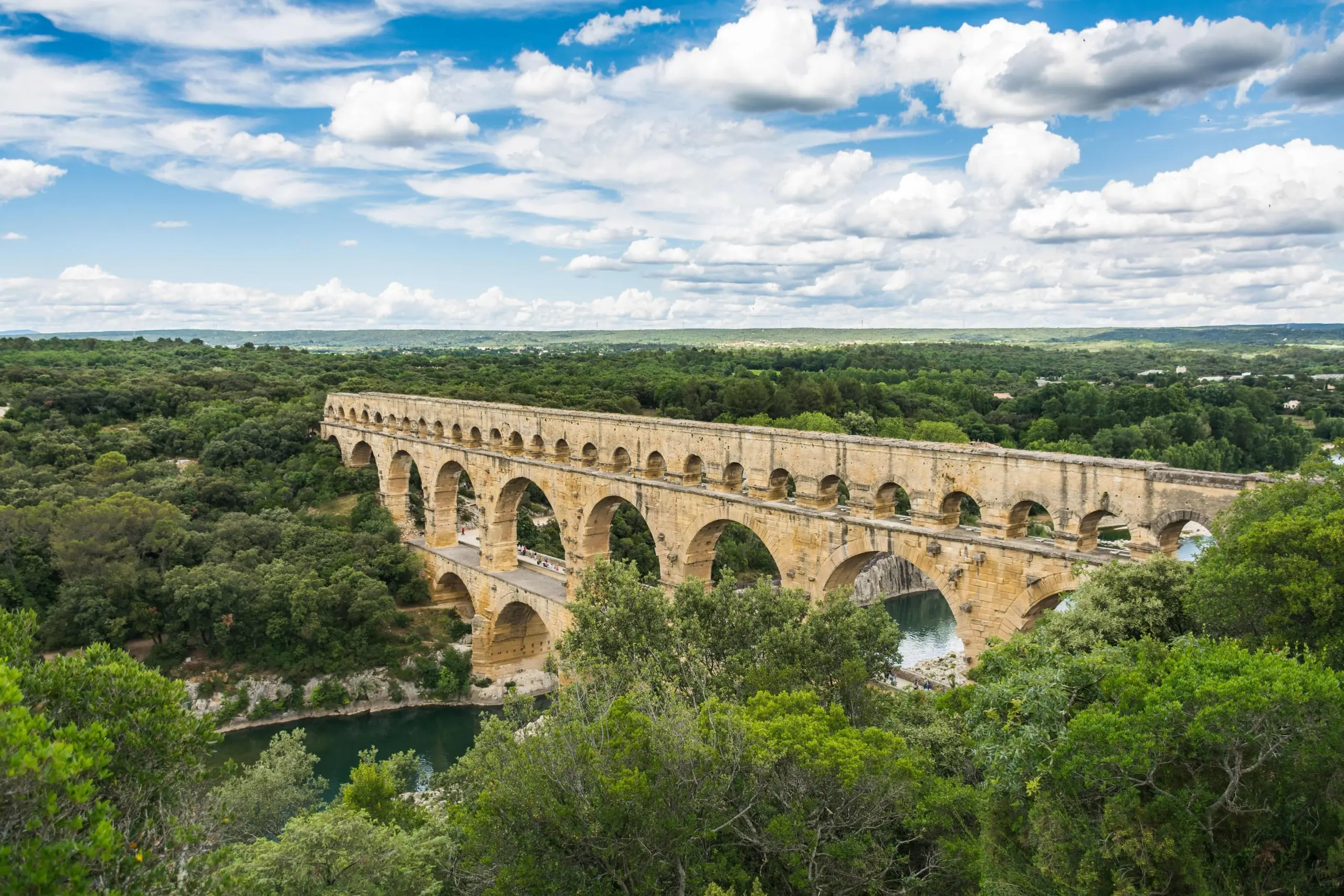
Image of an old Roman aqueduct is furnished courtesy of simmondsbristow.com.au
As of now, and into the near future, one clear advantage that wood offers over metals is its relative low cost and its potential for being a more environmentally sustainable and biodegradable material than other options. Wood can be sustainably grown in managed forests if discipline and restraint are exercised in conjunction with improved forestry practices. If procuring metals still requires mining from the Earth’s ground, then expending huge amounts of energy extracting and purifying metals from raw earthen ore is still needed; however, using wood eliminates this need for excessive energy expenditure. Indeed, metals can be recycled and used again in processes that require less energy and come with a lower price index than what is associated with creating new metal from raw materials. Even if the process of recycling metals is more energy efficient than mining metals, the process of recycling metal still costs money and it still requires large inputs of energy.
If longevity is a prized feature of National Socialist architecture, then old and traditional wooden building methods are worth exploring and revitalizing within this context.