
Will National Socialists Create Communities that Float on Water?
NATIONAL SOCIALIST “FLOATING CITY’ PLANNING IN THE AGE OF RISING SEA LEVELS
(A Conceptual Engineering Study)
Real estate is growing more expensive in America and elsewhere today, and this troubling trend is driven by a number of factors, so perhaps floating real estate offer a solution to this conundrum.
 Image of a floating neighborhood in Sandpoint, Idaho furnished courtesy of Abby Henander on Facebook.com
Introduction – “FORETHOUGHT” Is Not a Four-Letter Word
One of the defining characteristics of this present-day Military/Industrial Civilization which has been conceived of by The Hebrew Invaders is this: No real forethought is ever practiced.
Our current social order never seems to practice any real forethought because exercising forethought requires placing long-term good over the interests of short-term profits. Modern Jewish Capitalism need the Masses and the Consumers to be constantly Consuming and Generating profits for them.
The blind rush to constantly – expand & develop – expand & develop – expand & develop – ensures that future problems are ignored until they finally occur, then these problems cannot simply be swept under the rung and hidden from the public like they have been for so long. Such situations where problems can no longer be hidden include full-blown disasters such as bridges collapsing or airplanes falling from the sky. In such situations, the powers that be are finally forced to deal with the problems which they have created, so they deal with these problems in a manner that creates other problems, and sometimes worse problems in the future.
Such Irresponsible Behavior is characteristic of Judeo-Christian Civilization, but it is not going to be tolerated in future National Socialist societies. Let us now say that we are embarking on the construction of a “Floating City.” What must we first do before any design work can begin?
(1) A “COMPREHENSIVE ECOLOGICAL IMPACT STUDY” MUST FIRST BE COMPLETED ACCORDING TO THE PRINCIPLES OF DEEP ECOLOGY AS ESTABLISHED BY THE THIRD REICH’S ENVIRONMENTAL POLICY. Properly, Completely, and Honestly.
(2) Once completed, every future environmental impact study that is done within a National Socialist Society shall be carefully scrutinized by relevant officials and their technical advisors which shall result in one of four decisions: [1] Acceptance, [2] Rejection, [3] Approval with Modifications, [4] Approval with Directive to Adjust the Location of the Project.
IN THE FUTURE, ANY ATTEMPT TO COMPROMISE THE INTEGRITY OF ANY OTHER STUDY, OR ANY TEST THAT IS REQUIRED SHALL BE MET BY THE MAXIMUM WEIGHT OF THE LAW!
Once the above study has been approved, then the following studies and tests must be carried out according to the same rigorous standards while being approved by relevant authorities and their technical advisors:
[a] Meteorological study of the weather and climate that will affect the project.
[b] Test Bores made in a grid pattern that thoroughly covers the area which is affected.
[c] Soil & Water Samples shall be taken in a manner that results in the affected area becoming thoroughly analyzed.
[d] A Drainage Study shall be made to determine what affects the project is going to have on the drainage of the area IN AND AROUND the project both after and during the construction phase.
Now, for Three Things that Must Never be Overlooked When Planning a Building
[1.] The Environmental & Meteorological History of an area must be thoroughly reviewed in
order to gain an understanding of what can be expected in the future.
[2.] Do not ever neglect to interview local residents whose families have lived in the area for generations because they can alert you to many difficulties that can easily be missed by everything else.
[3.] What does the original indigenous population have to say about things in the area
of the project that can potentially affect it. These insights will give one a thorough long-term view of what to expect along with what is and is not possible.
Once all of these matters have been dealt with successfully, then we can proceed with the actual design phase and conclusively determine just what sort of “City” that we are going to build.

Image courtesy of archup.net
Part One – Designing and Building a Good City
During the design phase, plans will be prepared to be as detailed and thorough as possible. Having detailed plans in place before starting a major construction project is important because possessing a set of well-developed and detailed plans greatly reduces the number of possible problems along with the number of possible questions, delays, modifications, and redesigns that will inevitably arise once the actual construction is underway. Good and detailed construction plans also enable builders to have much more accurate estimation figures for upcoming project costs.
Good construction plans additionally limit additional costs that might be caused by unforeseen events which tend to happen during construction projects. Any unnecessary changes in design will be studiously avoided once construction has started. Materials that meet specifications will be delivered to the construction site in a timely manner, baring TRULY unavoidable delays. Availability of needed material and equipment will be confirmed before Final Specifications are approved.
Work will be done in a safe manner which also avoids damaging the environment in the surrounding area. Building projects will also be carried out in ways that avoid causing harm to a local population in the surrounding area to the greatest extent which is possible. Avoiding harm to the local population means avoiding harm to the local peoples’ property and their animals if applicable. The legitimate needs a local population will not be ignored during construction projects within future National Socialist societies.

Image courtesy of buildingwork.com
THE LONG-TERM HEALTH AND SAFETY OF THE WORKERS ENGAGED ON THE PROJECT WILL NOT BE REGARDED LIGHTLY. A NATIONAL SOCIALIST WORKFORCE IS NOT “FACTORY FODDER”.
In National Socialist society, any attempts at intimidating or bribing inspectors will be met by the full weight of the law against all guilty parties.
Any gaps in the construction process (days in which no work is going to be done.), unless they are ordered by the Project Management (A-D), will be justified in writing as far as possible in advance if they are known about. If a work delay is unexpected, like for example due to weather problems, then project managers will be justified in writing about their project delay after the fact.
The occasional delay is to be expected whenever a major construction project is underway, there just has to be a good reason for it. Certain phases of the construction process, for example allowing concrete to sufficiently cure, will, by their very nature, necessitate down days. These days of stalled progress will be worked into the original construction schedule as much as possible.
Any non-governmental contractor, sub-contractor, or material supplier that is used on a major construction project shall work under the authority of the General Contractor who shall be a Senior Government Official and a Senior Party Official. Any person who is chosen to lead a significant construction project will be assigned such responsibilities on the grounds of their ability to perform the quality work that is demanded for the assignment in question, and for their ability complete the assigned tasks at a reasonable cost.
Part 2. – City Building and National Socialist Philosophy or The Third Reich Reverses the War on Nature
I have mentioned this particular movie that I know on a number of occasions, but its importance cannot be overemphasized when it comes to illustrating the NSDAP’s views concerning the relationship between the German Folk and all German Forests; the Teutoburger Wald Forest stands out in particular when discussing this topic. This film outlines the relationship that the German Volk have with National Socialism and with the Natural World in general. The movie that I am referring to, which is available on the internet, is titled “THE ENCHANTED FOREST” in English or Ewiger Waldin German. This film was produced by Dr. Joseph Goebbels and it was released in 1938.

Image of an old Ewiger Wald movie poster from 1936 furnished courtesy of imdb.com
The Enchanted Forest tells the story about how the German Peasantry and the German Forest have always been part-and-parcel of each other. The NSDAP always viewed the German Peasantry as the Fountainhead of the German Folk, and they viewed their “movement” as springing from the Peasantry and springing from the Teutoburger Wald. National Socialist (Third Reich) Environmental Policy which will govern future City Planning, City Construction, and City Operations is known as “DEEP ECOLOGY”.
The present-day movement that goes by the name of “Deep Ecology” is CONSCIOUSLY & ADMITTEDLY patterned after the old National Socialist idea of Deep Ecology. THE GIST OF WHAT “DEEP ECOLOGY” IS ALL ABOUT IS SIMPLY THIS:
BOTH THE FOLK AND THE NATURAL WORLD ARE OF EQUAL IMPORTANCE.
THE FOLK AND THE NATURAL WORLD EXIST IN A SYMBIOTIC RELATIONSHIP WITH EACH OTHER.
This is the actual origin of the concept of BLOOD & SOIL which is so well illustrated in Richard Walther Darre’s book by the name of A New Nobility of Blood and Soil. While “ANIMAL RIGHTS” are a different area of discussion than Deep Ecology, we must all keep in mind that Deep Ecology overlaps with animal rights, particularly when this topic comes to affect how city-building impacts the welfare of WILDLIFE. In actual fact, the art of City Planning must also take into account the welfare of every city’s Domestic Animals. While National Socialists did not precisely invent the concept of Animal Rights, they did pioneer a thorough and systematic approach towards this matter by establishing the first place where animal rights were guaranteed by “Force-of-Law”.

Image of Richard Walter Darre furnished courtesy of Wikipedia.org
National Socialism begins with the Blood being “GROUNDED” in the Earth through the Soil which constitues the blood part of the Earth and vice versa. “What you do to the Earth, you do to yourself.” – Chief Seattle.
The Hebrews, in complete contrast to National Socialists, are plainly OUTSIDERS, as their very name makes plain.
Hebrews are not native to this Earth.
Hebrews have no attachment to our Earth, so they simply view her as an unconscious resource to be mercilessly conquered and ruthlessly exploited until she is used up. Then, after our Earth has been used up, the Hebrews will move on to a new host. No wonder, Hebrews are often called, “Invading parasites from another universe which is antithetical to this one.” Those who take on The Spirit of The Hebrews become Virtual Hebrews.

Image courtesy of soyjackwiki.org
——————————————
Part 3. What Does National Socialism Have to Do with Floating Cities?
In a strict sense, there is nothing particular to National Socialism concerning the topic if building housing and other infrastructure that either floats on top of water or sits on top of solid ground that is covered with standing water of some type. Yes, there is nothing particular to National Socialism when it comes to building floating buildings or constructing infrastructure that rests above standing water; however, National Socialist societies will make more of an investment in these areas than present governing bodies.

The image seen above shows unites at the Urban Rigger floating student housing complex in Copenhagen, Denmark. This interesting housing development was completed in 2016 and it was made from shipping containers. Image courtesy of journals.openedition.org
– Whatever Floats Your Boat
Future National Socialist societies will not encourage people to live nomadic maritime lifestyles along river systems or coastlines, but such governments will have a rather tolerant attitude about such ways of life. It seems likely that living nomadic or stationary lives in villages that float atop the large inland river systems will be tolerated by future National Socialist governments because such communities add soul and flavor to nations and communities, plus such living arrangements can offer people great opportunities to create close-knit communities. The existence of close-knit communities is one factor of life National Socialism values above few other things, so for this reason floating communities along rivers will be at least tolerated.
The catch to having reluctantly sanctioned communities of nomadic or semi-nomadic boat dwellers is the need for registration and inspection. If communities of boat-dwellers are to be a lasting fixture of future National Socialist societies, then each boat will need to be registered, insured, and inspected, otherwise any unregistered, uninspected, and uninsured boats will need to be condemned or impounded. These same boats must be maintained and kept in presentable condition as well.

The image seen above shows a poorly maintained “eye-sore” houseboat that floats in Far Rockaway in the New York City metropolitan area. Image furnished courtesy of 6sqft.com
Condemning or impounding boats that are uninspected and unregistered seems harsh and Stalinist, but no sane society will tolerate groups of indigent petty criminals who travel around and cause problems for the general population. Europe has experienced centuries of petty criminals who travel from one spot to another, and one such group is called “Gypsies” or “The Roma.” Wherever Gypsies travel, they historically leave behind garbage along with localized upswings in theft plus occasional stabbings and rapes of local women. Given the trouble that goes with Gypsy camps, it comes as no surprise that these nomads are not welcome in any place where they arrive.

Image of floating squatter housing on the Thames River in England furnished courtesy of bbc.com
Having traveling communities that move around coastlines or river systems is good for building cultural character, but such traveling communities must never break laws, they must never despoil the environment, and thy must never cause distress to the residents of whichever places where they might make their stays. The boats that these communities might call home must also be sanitary and safe, plus they must be at least passably presentable to the public in a visual sense.
There must also be census registries of people who live in nomadic or semi-nomadic boating communities because these collections of travers should never become refuges for criminals who are on the lamb or homegrown criminal gangs from these communities. Britian has a tradition of “Travelers” or “Pikers,” or “Gyppos” or “Irish Travelers” if you will, and these communities are notorious trouble makers.

Irish Travelers have a bad reputation for criminality, drinking, drugging, and violence, and this bad reputation exists for good reason. Nomadic communities of all types often accrue reputations for criminality. Image of an Irish Travelers camp in England furnished courtesy of shelterforce.org.

The image seen above shows the American actor named Brad Pitt who played the character Micky O’Neal in the film Snatch. In this film, the character Micky O’Neal is a charismatic but wild Irish Traveler. The character named Micky O’Neal is perhaps the most well known Irish Traveler from film or fiction. Image courtesy of u/sleestacksamauri on the r/powerscales forum from reddit.com
Future National Socialist societies will not tolerate drug-infested floating homeless encampments whether these encampments are stationary or nomadic. Each marine vessel that serves as a moving home must have a working sewage system and it must be decently maintained so as not to look like an eyesore. Future National Socialist laws that are particular and specific to traveling communities are likely to be far harsher than those which pertain to standard settled communities because society should never permit traveling miscreants to cause distress to the general population.
Ship Shape
At this time, more research is being done concerning how to use local bodies of water for housing and business space with the most efficiency, so there is nothing particular to National Socialism concerning development measures for creating floating real estate space. The one possible exception might be National Socialist governments placing a more priority on developing floating real estate than present regimes. Future National Socialist governments will place more emphasis on using bodies of water to host floating city districts as a means of providing more affordable real estate, but they will also invest in creating more floating infrastructure projects because the presence of such creations makes cities more interesting and more livable.

The image above shows the Saigon Floating Hotel in Vietnam as it appeared in 1991. For a few years, the floating hotel by the waterfront in Saigon was the most popular hotel and nightspot in the city. Image courtesy of Wikipedia.org
Part 4. An Overview of Floating Cities
Opening Comment – I am using the term “Floating Cities” in the poetic sense when referring to any city or village that is built predominantly or entirely over water, of which there are a number of different types.
Preface – Venice, Italy \ A Case Study:
[a] Lagoon –
Venice, Italy is located in a body of water which is called a “Lagoon.” It is essential to begin our discussion by defining just what the technical definition of a lagoon is. A lagoon is a body of water which is connected to the open sea through narrow channels between bodies of land {headlands and islands}. Water flows from the ocean into and through a lagoon, then back out to sea. The flow of water in and out of a lagoon is very constricted, and as a result, the flows of water that enter and leave every lagoon are very slow. The waters of a lagoon stay calm, even when storms rage in the nearby sea.
The very characteristics that made lagoons suitable places to build cities also create difficulties for urban planning, construction, and functioning. Difficulties that accompany building towns and cities in lagoons are often not dealt with properly when one studies these issues of over the long run; many of today’s urban problems stem from having too much of an “out of sight, out of mind,” way of thinking.

Image of the Venetian Lagoon as seen from the air during the 2020s furnished courtesy of wikiwand.com
[b] The Vaneti –
In ancient times, the people who lived around the modern city of Venice, Italy were a Celtic tribe who were known as the “Veneti.” Term “Veneti” is where the name Venice originates.
Note: The name Celtic is derived from Keltoi which is what the Greeks pejoratively called them; the word “Celtic” was never what the old Celts called themselves. The Romans in addition referred to old Celts as “The People Who Came Out of the Darkness.” The Romans referred to the old Celts as the people who came out of the darkness because they suddenly appeared and the Romans had no idea where they originated.
Since Roman Times and before, The Veneti hunted, farmed, and fished on the land and water in and around the Lagoon of Venice. However, their villages were built on platforms that were supported by wooden pilings which had been driven into the muddy bottoms of the lagoon’s shallow waters.
The Veneti were always renowned for their seamanship, for their maritime trading success, and for their skill at naval combat. The Venetians would therefore remain a force to be reckoned with up into the Napoleonic Wars. Eventually the Veneti would grew to greatly overpopulate their original home “territory,” so the tribe divided themselves in two. Half remaining in and around the Venetian Lagoon, while the other half migrated by sea all the way to the Northwestern Seaboard of Continental Europe, where they settled along the coast. The original Celtic Vaneti tribe were the dominant naval power of the region until the coming of the Romans. The Romans conquered the original homeland of the Vaneti.

Image of an old Veneti ship in a naval battle furnished courtesy of historyfiles.co.uk
[c] Building Venice –
What we all think of as being “Venice” originally started out on a number of marshy islands in the old Venetian Lagoon. When the old city of Venice, Italy was built, caissons were constructed on the islands, then these caissons were set up in shallow water where their internal water was removed by using Water Screws; after that, the soft bottom material that remained within the drained wooden cofferdams was dug out. Retaining walls were built that abutted the interior surface of the caisson up to the desired height above water level. Then, buildings were built as desired on top of these same spots. Venice is called a “Canal City” because canals take the place of the streets in a normal city. As the population outgrew the original construction, totally manmade platforms were added.
[d] Water Supply –
Water in the Venetian Lagoon, due to only having a gradual exchange of water between it and the Adriatic, is always brackish in nature. The city of Venice’s water for human consumption was originally obtained by building rain-catchment systems and by constructing storage cisterns that harvesed rainwater from the rooftops of buildings and caught water runoff from stone public plazas.
[e] Domestic Refuse –
This presented no particular problem. Boats would come by and collect trash, then just haul it away: old garbage scows functioned as floating garbage trucks.
[f] Sanitary Sewers –

Image of an old Venetian sewage outlet furnished courtesy of archinfo.com
Sewer systems are the places where the nemesis of cities growing too large first rears its ugly head.
Originally, the sewage of Venice was simply drained into the city’s water canals, which worked well enough until Venice grew beyond the capacity of this slow circulation of water through the lagoon combined with the inability of the resident sea life to consume enough of it.
Despite facing sewage problems, the city of Venice continued to grow. Many modern cities in the “Developed World,” including in the United States, have made the same mistake of overtaxing their domestic sewage systems by insisting on accelerating rather than controlling or slowing urban growth. (Only CHINA has gotten control of their cities through a program which they call “Towards an ecological civilization.”)

Image of traditional Venetian sewage systems furnished courtesy of archinfo.fi
Conceptually, city planning, city design, city construction, plus with urban logistics and urban management are always geared towards smooth operation and towards providing a decent standard of living and lifestyle for all of a city’s inhabitants. National Socialists will not precisely ape the Chinese; instead, we will study the Chinese example of urban planning and use it as a jumping off point when we start conceiving, designing, and building our own cities in the future. When we begin modifying existing cities in the future, we must prioritize sewage systems above all other considerations because this unpleasant but necessary type of urban infrastructure is the classic weak spot in most urban areas.
I have heard from everybody who has ever visited the city of Venice, Italy that there is “A Great Stench of Human Feces Floating in the Canals.” If it were not for this lingering stench, then modern Venice would indeed be more of a fascinating and beautiful city. (I heard from a visitor some years ago, that the numerous cruise ships which visit Venice only rarely anchor inside the Venetian lagoon because the water is so filthy!) Visiting cruise ships normally anchor outside the entrances to the Venetian lagoon and tourists travel back and forth to the old city and to the mainland by riding in small boats.

In 2024, Venice hosted 240 cruise ships and 475,000 visitors from these ships. Image of a cruise ship visiting the Venetian Lagoon in 2013 furnished courtesy of stipr.org
I have also heard that if, for some reason, a cruise ship does choose to anchor inside the stinky old Venetian Lagoon, then the ship’s crew may very well be forced to wash human feces off of both the ship’s anchor chains and the ship’s anchor by using a fire hose as this equipment is raised into the vessel’s chain locker. Supposedly, the smell of this decaying matter is quite nauseating. After a ship’s anchor and anchor chains are raised, the next order (or odor) or business is to stop and have the crew spray off the sides of the ship with fire hoses.
ALL OF THIS BEGS THE QUESTION: WHY DOESN’T THE GOVERNMENT OF ITALY INSTALL A STATE-OF-THE-ART SEWER SYSTEM IN VENICE? TECHNICALLY IT IS PERFECTLY DOABLE; I REMEMBER US STUDYING ABOUT THIS IN COLLEGE.
THUS FAR, THE CITY OF VENICE ITALY DOES NOT HAVE ONE NEW STATE-OF-THE ART SEWAGE TREATMENT PLANT BECAUE CONSTRUCTING SUCH A FACILITY WOULD SIMPLY BE TOO PROHIBITIVELY EXPENSIVE FOR BOTH THE ITALIAN GOVERNMENT AND LOCAL PROPERTY OWNERS!
BECAUSE OF THE WAY THAT THE OLD CITY OF VENICE IS DESIGNED, EACH OLD BUILDING IN THE CITY OF WOULD NEED ITS OWN SEWAGE TREATMENT PLANT, OR A COLLECTION OF PUMPING STATIONING STATIONS THAT WOULD PUMP THE RAW SEWAGE TO ONE OR MORE CITY SEWAGE TREATMENT PLANTS BY WAY OF OTHER SUCH PUMPING STATIONS.
IT IS EASY TO ENVISION THE SHEAR EXPENSE OF IT ALL WHEN TRYING TO CREATE A MODERN SEWAGE SYSTEM FOR THE ENTIRE CITY OF VENICE AS WELL AS THE INCONVENIENCE, AND THE DIFFICULTY OF MAINTAINING SUCH A SYSTEM CANNOT BE OVERLOOKED. CAN YOU IMAGINE VISITING OR LIVING IN A CITY WHICH IS DOMINATED BY ITS INFRASTRUCTURE FOR DEALING WITH ITS HUMAN WASTE? THIS WOULD BE BAD FOR TOURISM.

In the 20th century and into the 21st century, some progress has been made to improve the city of Venice, Italy’s domestic sewage system, and in 2012, the International Water Association noted that the city of Venice already had more than 6,000 residential septic systems that were installed in the basements of existing old buildings, but many old buildings in this city still lack proper sewage systems. Image of a septic system being installed in Venice furnished courtesy of bussinessinsider .com
Sometimes certain problems people have created for themselves in this world cannot be corrected. As is typical with long-term exposure to water that containing high levels of human waste, the water in the canals of Venice is gradually eating away at the stone retaining walls that support the man-made islands upon which Venice is built.

Image courtesy of Gramma Funny Sarcastic grama’s funnies on facebook.com
[f] Gondolas –
This type of vessel was developed specifically for use in the canals and the lagoon of Venice. Everyone is familiar with the classical gondolas which have been used as water taxis from the beginning of Venice’s existence, but gondolas have also been used for other utility duties as well. This illustrates that sometimes people need to develop new modes of transport when they create “Water Cities.” Most modern Gondolas also carry small engines for emergencies, but regular powered watercraft were banned from the canals years ago (Except for use by Emergency Services.}.
Motorized boats were banned from most of Venice’s canals because the wakes and turbulence which they create was eroding the city’s retaining walls, but motorized boat traffic was also banned to a lesser extent because drunk and/or doped-up Italians and tourists kept running their speed boats into the “houses.” and colliding with the Gondolas, sometimes with fatal results.

The image above shows rescue workers attending passengers after a fatal gondola accident in 2013. Image courtesy of cbc.ca
Gondolas made Venice a naval and commercial power to be reckoned with in the central and eastern Mediterranean region for a long time. Venetian ships called “Trabaccolo” carried sails for propulsion. Merchantman types of Venetian sailing ships could carry substantial cargos, including such things as horses. Warship types of Trabaccolos were developed that mounted a number of medium-sized cannons. Navies used these military Trabaccolos up through the Napoleonic Wars for coastal, inshore, and inland maritime operations. Trabaccolos were always small ships that were never designed to operate outside of the Adriatic Sea and the Greek Islands.

Image of a classic Venetian Trabaccolo sailing vessel furnished courtesy of Wikimedia.org

The image above shows a drawing of an old Venetian Naval Trabaccolo that is fitted with cannons. Image courtesy of pngwing.com
The other well-known type of Venetian sailing vessel was the Bragozzo. These types of vessels are smaller than Trabaccolos and they are renowned for their colorful sails and colorful paint jobs. were never well suited for sailing in large open oceans like the Atlantic, the Pacific, or the Indian Ocean.

Image of a Bragazzo Venetian Sailing vessel furnished courtesy of Wikimedia.org

Image of a Bragazzo Venetian sailing craft in port furnished courtesy of bur.regione.veneto.it
Different Types of “Floating Cities”
[G] Stilt House/Pile Dwelling –The term “Stilt House” refers to structures which are raised on platforms that rest on top of stilts or pilings which have been driven into swamps, bogs, marshes, or into the bottoms of shallow bodies of water. Examples include but are not limited to the following:
[a] The original Venetian settlement of stilt houses was made by the Veneti, as I discussed previously.
[b] The Ancient Teutonic tribe called the Batavi. This tribe lived in what is now known as the Netherlands. In Roman Times, what is now called “Holland” or “The Netherlands” was a vast swamp that resembled in many ways present day Southern Louisiana, which is also known as “Cajun Country,” or simply “The Bayou”].
[c] Portions of present-day Bangkok, Thailand which sits along the Chao Phraya River, also consist of city municipalities that rest atop wooden pilings.

Image of a neighborhood that rets on wooden stilts in Bangkok, Thailand furnished courtesy of istock.com
[d] Building homes that rest atop wooden pilings was also sometimes done in Southern Louisiana, and this practice persists to this day across this same region.

The image above shows a new elevated home in New Orleans, Louisiana. Image courtesy of houzz.com
[e] Structures on the low-lying sand islands offshore in the Gulf of Mexico and the Outer Banks Islands of North Carolina have been built on top of wooden or concrete stilts so that these homes and buildings can stay above storm surge during hurricanes. This practice of building homes atop tall stilts has usually worked well enough as long as a particular hurricane is not too powerful.

Image of a home on North Carolina’s Outer Banks Islands furnished courtesy of hatterasrealty.com
[f] I once stayed at a large hotel in Honolulu, Hawaii that was built on top of wooden stilts and rested over the middle of a large lake. You could feed the large Japanese Goldfish that lived in this lake through the gaps in the floorboards in your room. Indeed, these fish expected to be fed by the hotel’s guests. When they heard somebody moving about in a room, they would gather below waiting to be fed. If food did not come soon enough, then these large goldfish would jump up and bang against the floorboards that rested above the lake’s surface water.
In more modern times, constructing buildings that sit on top of wooden, steel, or cement pilings seems to be a bit of a neglected pursuit.
Palafitte –
Stilted houses and entire stilted villages were built during Neolithic Times in areas of Northern Italy and Switzerland, and sometimes stilted buildings that sit above lakes are still used at luxury resorts in those locations. These structures resemble classic stilt homes, except the sometimes the supporting wooden pilings form part of the buildings upper structure itself rather than just supporting the platform where the structure rests. Incorporating the supporting stilts into a building’s upper levels of construction tends to work best when building smaller structures such single-family dwellings.

The image above shows the Museo delle Palafitte in Fiave Italy. Image courtesy of tripadvisor.com

Image of a Palifetta settlement in the Northern Italian alps furnished courtesy of vivigreen.eu

An aerial view of a Palafetta settlement in the Italian Alps furnished courtesy of vivigreen.eu

The image above shows a reconstructed Palifatte village named Pfahlbaumuseum Unteruhldingen which sits in the Uhldingen-Mühlhofen, region of Germany. Image courtesy of worldhistory.org
Amphibious Architecture/Waterborne Infrastructure –
This term refers to buildings and Infrastructure that is constructed on land which is designed to float upwards altogether and in a controlled manner when the water level below should go up too high during a flood; then, once the high flood waters have receded, the building automatically settles back down into its original position. These homes that are designed to float upward to when high flood waters arrive are typically held in place by huge steel and cement pilings that sit within large rings that are part of each building’s floatable cement foundation. An example can be seen in Maasbommel; Netherlands, but places such as Buckinghamshire in England also employ this method for negating flood damage.

Diagram of a Netherlands amphibious home furnished courtesy of arquikunst.wordpress.com

Image of amphibious homes in Massbommel, Netherlands furnished courtesy of icaade.org

Image of amphibious homes in Massbommel, Netherlands furnished courtesy of bouyantfoundation.org

Image of amphibius houses in Maasbommel, Netherlands furnished courtesy of reserachgate.net
4.) Traditional Floating Villages & Cities –
When the term is used correctly, technically speaking, as the name strongly implies, the whole settlement or a whole building literally floats as a single unit on the surface of a body of water. An example of a highly successful such city is the Uros archipelago that floats on Lake Titicaca, Peru. This settlement was originally built many centuries ago by the Inca, and it is still inhabited and maintained by their descendants to this day.
As of the 2020s, around 44 reed islands still float around Lake Titicaca which sits in the Peruvian/Bolivian highlands. These islands are made from local totora reeds, and the locals who live on these islands must constantly place new layers of reeds onto the upper parts of these islands in order to keep their floating villages intact. Visitors to these floating islands also note that the ground which sits under their feet feels notably soft and spongy.
Despite the need for constant maintenance, these floating islands only last for around 20 to 30 years, and the homes that sit atop these floating islands typically last about five years. Building floating homesteads from reeds and other types of plant matter is an interesting idea, but such building methods are not a very practical option for future National Socialist settlements.

The above image is an aerial photograph of Lake Titicaca’s famous Uros Islands as of the 2020s. The islands seen above are made by the local people by using swamp reeds that grow on the marches of this large lake in Peru. Image courtesy of lorenzoexpeditions.com

Image of a village on the Uros Islands of Peru’s Lake Titicaca. Image courtesy of 10best.usatoday.com

Image of the shoreside at one of the Uros Islands furnished courtesy of 10best.usatoday.com
The traditional people of Iraq’s vast delta marshland where the Tigris and the Euphrates rivers meet have also built artificial floating islands that are called “Tuhol” in the local dialect. Tuhol are made from local swamp reeds. Upon these Tuhol, reed buildings called Mudhif are used as homes and institutional buildings.

Image of an Iraqi marsh village with floating Tuhol islands during 1973 furnished courtesy of centerforspacialresearch.github.com

Image of a traditional reed home in the Mesopotamian Marshlands of Iraq that sits on top of a floating island that is made from local swamp reeds. Image courtesy of messynessychick.com
(5) Wet & Floating Slums –
In some countries, wet and floating slums are considered to be good places to dump the unwanted poor. In such cases, people are forced to live in shantytowns, where shacks are built on stilts which rise above extremely polluted bodies of water; then, they left to their own devices about how to go about surviving. The world’s most supreme example of such a living hell is Makoko in Lagos, Nigeria where 200,000 to 300,000 are forced to exist in complete squalor. (Nobody knows nor seems to care exactly how many people live there.)

Image of the Makoko canal city slum near Lagos, Nigeria furnished courtesy of an unknown poster on the r/UrbanHellforum from Reddit.com

Image of a Makoko neighborhood canal furnished courtesy of theguardian.com
(6) Canal Cities –
Venice, Italy is the supreme example of such a city where canals serve the same purposes as streets do in regular terrestrial cities. Other cities around the world have notable canal networks, such as Souzhou, China; Birmingham, England, and Cape Coral, Florida. The city of Cape Coral, Florida has more than 400 miles of navigable canals within its city limits; but none of these other “Canal Cities” are as well-known for their canals as the city of Venice in Italy.
(7) Water Towns –
“Water Towns” are a peculiarly Chinese and particularly successful phenomenon which are mainly concentrated in the Zhejiang and Jiangsu provinces of China. There are several such towns that are each built on both natural and manmade islands which exist within a network of canals and natural waterways, these Chinese Water Town are kind of like little versions of Venice, Italy; but without all of the attendant problems that come from growing too big a bit too fast. These Chinese “Water Towns” are now long-established after having started during the Ming and Qing Dynasties from 1368-1912.

Image of Zhouzhuang Water Town near Shanghai furnished courtesy of memiorsofaglobetrotter.com
Today, these traditional old Water Towns of the Jiangsu Province are mostly kept around as tourist destinations, so they are kind of like Venice, Italy in today’s world because China’s “Water Towns” are now basically just theme parks as opposed to actual working townships. (For those of you who are not familiar with the Jiangsu province, the modern megacity of Shanghai is located on the coastline of China’s Jiangsu province.) Most of the old canal districts in China’s historic Water Towns were nowhere near as large nor as spectacular as the Italian city of Venice.

Image of Image of Zhouzhuang Water Town furnished courtesy of chinaexplorertour.com
(8) Aquatic Cities/Marine Metropolises –
I only mention these developments because the plans for these floating “not if, but when” disasters are already in the conceptual planning stage. These are supposed to be major urban centers built in THE OPEN OCEAN as part of a process to make most of the Earth’s Ocean surfaces habitable for the constantly burgeoning overall human population. It sounds like some people are all on a bad acid trip when they are planning these massive floating cities that are intended to sit out in the deep open ocean. “Playing Chicken” with Mother Nature never works out too well for people, no matter how smart that they think they are.
The 1992 novel by Neil Stephenson that is titled “Snow Crash” describes a huge floating settlement that drifts around the North Pacific Ocean which measures many miles across and is home to millions of people. This fictitious settlement is titled “The Raft.” Some of the story line in Snow Crash takes place on The Raft, but Stephenson does not really detail the actual ecology and mechanics of how people live and survive on this artificial ecosystem. At the center of The Raft sits an old decommissioned nuclear aircraft carrier along with decommissioned container ships and supertankers that are all tied to the mothballed aircraft carrier. In this story, the central districts of The Raft has fine restaurants, fancy hotels, and boutique shopping outlets, so there are the nice parts of The Raft and there are the safe parts of the Raft, like anywhere else.

Artwork image of The Raft from Snow Crash furnished courtesy of vyper.artstation.com
As interesting as Stephenson’s vision of The Raft might have been, the long-term viability of such a massive floating conglomeration is questionable because steel ships last a few centuries at most without constant upkeep, so the raft would likely disintegrate by way of marine corrosion within a matter of a few decades without constant outside interventions of shipyard work. The Raft’s ability to survive really strong Pacific Typhoons is also a big question that Stephenson’s book never really addressed. Chances are that The Raft would be broken apart and half of its tethered vessels would sink if it ever took a direct hit from a Category 5 Pacific Typhoon.

The image above shows an AI-generated concept image of the “Freedom Ship” that was designed by the company named Freedom Cruise Line International in the 1990s. This vessel is planned to be about one mile in length and it is meant to house 50,000 year-round residents, 10,000 visitors at any given time, and about 20,000 crew. This vessel is planned to register at 2.3 million tones.

The image seen above shows a different artistic rendering of the proposed “Freedom Ship.” Plans for this vessel include a nuclear power plant and a cruising itinerary that involves moving at a steady speed of seven knots and circumnavigating planet Earth’s oceans one every three years. Image furnished courtesy of audacity.com
The basic idea of building settlements that float in the deep oceans which are home to hundreds of thousands of residents seems a bit far-fetched. Perhaps permanent floating habitats could work in the future, but such habitats would need to be constructed from materials that would never degrade from the ocean’s corrosive salt water, and such settlements would also need to survive the 60 to 120+ foot seas and 180+ mile-per-hour winds that can easily arrive during strong Hurricanes and big Typhoons.
Perhaps building permanent floating metropolises will happen at some point in the future, but these habitats would need to be made from giant slabs of solid diamond like what was envisioned by Bruce Sterling in his book called The Diamond Age. Perhaps large metropolises that float around in the deep oceans could be made from exotic metal alloys that are smelted in outer space from raw metals that are mined in asteroids. As of now, and as of the foreseeable future, building large floating habitats that exist out in the deep oceans remains the subject of science fictions novels and films.

Image courtesy of knowledge.skema.edu
JUST WHAT MAKES ANYBODY THINK THAT THE EARTH’S GOVERNMENTS ARE FOR ONE MOMENT GOING TO TOLERATE ANYBODY TRYING SUCH A THING AS BUILDING AUTONOMOUS FLAOTING KINGDOMS ANYWAY?
ESPECIALLY NOT THE UNITED STATES OF AMERICA WHO ALREADY FANCIES THAT ALL OF THE WORLD’S SEAS BELONG TO THEM IN ALL PRACTICAL TERMS TO BEGIN WITH.

Image of a futuristic floating city of the deep ocean furnished courtesy of mimarizm.com
(9) Seasteading –
Unlike the idea of building large and permanent floating settlements that move about around the Earth’s open oceans, the idea of “Seasteading” is very practical and very doable.
So, what is “Seasteading”? In answer, Seasteading as it works in the present and as it would work in the near future is much less ambitious than trying to create massive floating habits that sit out in the deep oceans. Seasteading is already in practice around the world to some limited extent. Seasteading as it exists now basically consists of setting up urban, suburban, and rural housing and infrastructure that float, but this infrastructure usually sits within protected waters such as rivers, lagoons, and enclosed bays.
One example of an existing seasteading location includes the fields of mooring buoys that sit in San Diego Bay which provide cheap living arrangements for people who own boats. Maintaining a lease within a field of mooring buoys offers cheap living arrangements, but living in this manner means having no access to shoreside water or electricity, and many people really dislike the inconvenience of having to take a small boat to the nearest dock, even if that dock is only a short distance away.

The image above shows a field of mooring buoys on Bass Island on Lake Eerie in the Zio-American state of Ohio. Image courtesy of visitputinbay.com
We do not usually think of marinas as “Seasteading” villages, but they actually are in many cases. Most marinas limit their total number of boat slips to only 20% “Live Aboard,” but many people now live in marinas around the world. Some people like living on boats that are tied to marina slips because they simply like the atmosphere of life in marines. Being a “Live Aboard” resident within a marina is often well-liked because there is a strong sense of neighborhood and a strong feeling of community among those who live on boats within marinas. Others simply live on boats in marinas out of sheer economic necessity. In many coastal cities, marinas now provide one of the few options for affordable housing, so this trend is likely to continue into the near future.

Image of a sailboat “Live Aboard” at a local marina in the Zio-American state of Washington furnished courtesy of cascadiadaily.com This photograph is connected to an article that discusses why many people are turning to living on boats as a means of dealing with high rental costs in many areas.
Some people like to live on boats within marinas because they love to occasionally take their boats out on leisure trips. Admittedly, many of the boats that serve as places of residence in marinas are decrepit and off-putting, but many boats that are tied to docks in marinas are well-maintained and they provide decent and livable places to reside and they even provide decent enough places to raise families.
Some people also live in what is often termed “Float Homes.” Float homes are not boats, but instead, they are houses like those that might be found on dry land, except these “Float Homes” rest atop pontoons that are made from differing materials such as steel, aluminum, basalt composites, ultra-light types of concrete, fiberglass composites, or large slabs of wood. Float Homes are generally cheaper than land-based housing, but living in a float home does require paying more in the way of regular home maintenance fees than comparable land-based housing, and float homes generally do not use available water space very efficiently.
Other examples of seasteading that are in present use include The Queen Mary Ocean Liner that now sits permanently tied to a pier in Long Beach, California. The Queen Mary now serves as a permanent hotel and convention center in the city of Long Beach. Likewise, the old decommissioned ocean liner named the Queen Elizabeth II now sits permanently moored to a dock in the city of Dubai in the United Arab Emirates. The Queen Mary II also serves as a popular luxury hotel, like the Queen Mary in Long Beach, California.

Image of the Queen Mary Ocean Liner in Long Beach, California furnished courtesy of britanica.com

Image of the Queen Elizabeth II as it now sits in the city state of Dubai in the United Arab Emirates. Image courtesy of latimes.com
A luxury hotel in the British Colony of Gibraltar also permanently floats while tied to a local dock in this location. The cities of London, England and Bruges, Belgium also boast floating hotels that are permanently moored to docks.
– Sitting on the Dock of the Bay
As things stand presently, bureaucratic regulations make it almost impossible for city governments along with architects and building contractors to construct buildings that rest above water on wharf pilings of various types. Environmental regulations are the most common excuse offered for why nobody can put housing and businesses on real estate that rests atop pilings, but one has to ask, “What exactly is the terrible environmental damage that comes with having a wharf that rests on wooden or cement pilings?”

The image seen above shows the famous Sterns Wharf in Santa Barbara, California. Image courtesy of californiabeaches.com

Image of Santa Barbara, California’s famous Sterns Wharf furnished courtesy of californiabeachers.com
As of the 2020s, planet Earth is witnessing ocean levels steadily rising as the decades pass, and at this point in time, it looks very unlikely that these trends will reverse themselves any time soon. With ocean levels demonstratablely rising around the world, one has to wonder if making investments in infrastructure along what are now low-lying coastal areas is sensible. Luckily, ocean levels are only predicted to rise between six and nine feet around the world by the end of the 21stcentury, so building piers that sit atop rows of concrete stilts which will only last around one century is not such a bad idea.
As things stand, constructing long-term Roman types of architecture projects along current coastlines does not seem very sensible if ocean levels may rise as much as 230 feet over the next 400 to 1000 years. Building Roman types of architectural projects that last for millennia is a great idea so long as these projects are constructed in places that are not likely to sit underwater after a few centuries.
The Environmental Impact of Wharfs
Some studies claim that piers alter natural water movements around certain areas. Yes, of course they do, but not that much: so-what? Other studies claim that the shade which piers create can cause stress and grief to marine animals. This might be true, but the key to addressing this problem is not to build any pier that is too wide and not to build any pier that sits too close the water. Piers that are not too wide and do not sit too close the water, do not choke off all light underneath. If nothing else, distressed marine life will simply move to sunnier locations if a pier throws too much shade.
As for wharfs and piers being places where garbage accumulates underneath, that can be an issue for heavily traveled public wharfs like Pier 39 in San Francisco, but wharfs that support condominiums and apartment buildings would probably only collect modest amounts of trash around their pilings, and this trash can easily be cleaned up from time to time. A periodic cleaning fee for collecting fallen marine garbage can simply be added to each homeowner’s or renter’s monthly facility maintenance fees: no big deal. Netting can also be set around the edges of piers and wharves to prevent trash from falling into the water below.

The image above shows a routine and periodic cleaning of the ocean’s bottom near fisherman’s wharf in San Francisco. Image furnished courtesy of sfchronicle.com
As for issues with wharf-based homes and businesses taking damage from seasonal storms, the key to avoiding this problem is simply not to build wharves that have residential units and businesses on them which sit in places that face the open ocean. It is always best to construct wharves that host valuable infrastructure within protected waters that do not directly face the open ocean.
Building wharves that host homes and businesses which sit within protected waters prevents these types of real estate holdings from ever being exposed to the truly high winds and severe waves that arrive with seasonal storms. The state of California’s San Francisco Bay and the state of Washington’s Puget Sound areas both offer plenty of suitably protected waters that would be good for constructing wharves that host housing and businesses. Not surprisingly, the city of Seattle has a few residential areas that sit atop wharf pilings and enjoy the protection of Puget’s Sound’s inland waterways.
Return of the Palafittes
Future National Socialist societies would build many wharves and put all types of housing, businesses, and institutions atop these structures, and this change of attitude towards real estate that sits on stilts above water would be a reflection of returning to the ancient European tradition of building Palafittes. In the future, National Socialists would make efforts to construct new Palafitttes around lakes and properly protected inland waterways.

The image seen above shows the address of 3717 Beach Drive SW in Seattle, Washington. The condominium complex pictured above could be considered a modern Palafitte. Image courtesy of Zillow.com

The image seen above shows the condominium building at 1800 43rd Avenue East in Seattle, Washington. Image courtesy of realtor.com
It appears that under the current regimes, there are people who make decisions about who can erect what types of buildings, and these same people also decide where buildings can be constructed, and it seems that these people simply dislike the idea of putting housing and businesses out on raised stilt-piers. This present and pervasive institutional dislike for building wharfs that sit atop pilings really has nothing to do with environmental issues. Future National Socialist governments would actively encourage more housing and businesses to be built on top of wharves and piers because such arrangement create local character and they make more efficient use of local living spaces.
Floating Buildings
Various inland waterways around the world host “Float Homes” that are like ordinary houses on land, except instead of having regular cement and rock foundations, these floating buildings rest on blocks of polymer foam or ultra-lightweight cement.
Floating homes and floating buildings are an appealing idea because they allow city planners to use waterways that would not be put to practical use otherwise, which in turn can reduce the costs of land-based real estate. However, modern float homes do offer their share of problems. Most of the floating homes that grace various metropolitan areas around the world such as the city of Seattle, Washington in North America and the city of Manaus which sits on the banks of Brazil’s Amazon River have floating homes that are not designed to ever move from one location.

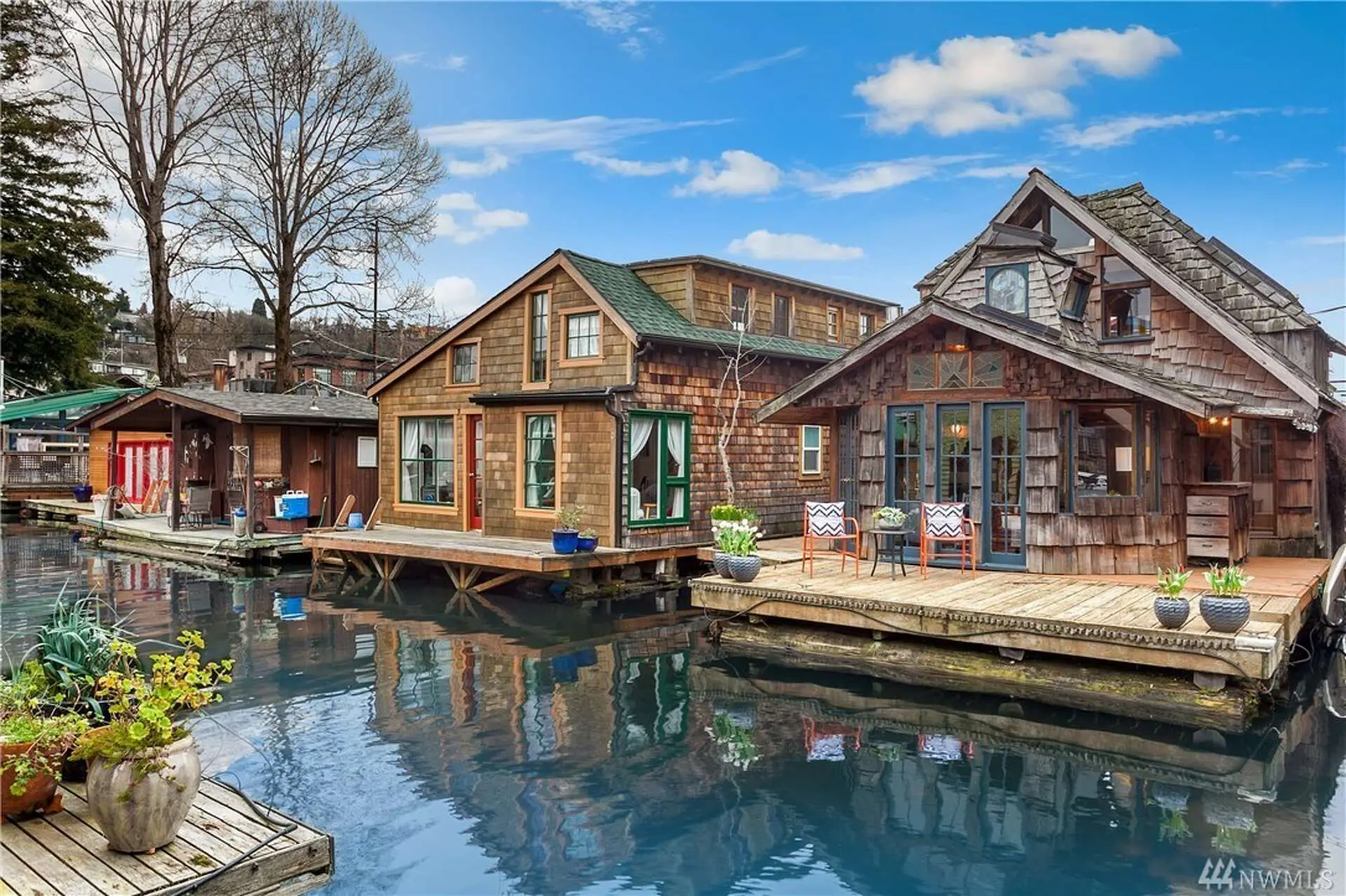
Image of a floating home in the city of Seattle, Washington furnished courtesy of seattleafloat.com

Image of Seattle floating homes furnished courtesy of secretseattle.co

The image above shows the floating home from the popular romantic 1993 film titled Sleepless in Seattle. In this Hollywood film, the romantic lead is played by the actor Tom Hanks. In this film, the male lead is a widowed father who resides with his son in a floating home in the city of Seattle. Inage furnished courtesy of king5.com

Image of a floating home for rent in Manaus, Brazil furnished courtesy of airbnb.com

Floating houses near Manaus, Brazil furnished courtesy of truckstruck.net

Image courtesy of kcmodern.com
The floating homes of many urban areas are really as fixed in their locations as land-based homes, so these floating homes are not designed to ever move. These fixed floating homes have their appeal, but they do not use the available space that sits on the surfaces of metropolitan waterways very efficiently.
As of the 2020s, the costs of repair to boat marinas keep rising simply because less and less space is available within good protected waterways, so newer marinas have been built in places that are less protected from the ocean’s fury, which in turn makes these newer marinas far more vulnerable to suffering from storm damage in the first place.
Neighborhoods that are filled with conventional floating homes must be located in suitably protected waterways, but there is a very limited supply of such prime marine locations along the world’s lakeshores, rivers, and coastlines, particularly in congested metropolitan areas. As for placing conventional floating homes within secluded river inlets, this idea offers it share of problems because rivers are prone to experiencing seasonal storms along with seasonal surging flood waters.
The solution to current problems with floating homes and floating building is to limit placement of standard floating houses to secluded inlets in rural areas and to limit use of good protected waters in metropolitan zones to placing larger floating structures that make better use of available space on the surfaces of waterer ways. It seems that larger floating structures which create higher levels of residential density will be needed in the future if floating infrastructures are to be practical and affordable places to live. Designating water surface area to stationary float homes is more sensible out in rural areas where space is not at a much of a premium as it would be within metropolitan areas.

The Good Hotel in London, England provides a reference point for how future high-density floating real estate developments in urban areas might appear. Image courtesy of stantec.com
Larger floating infrastructure would ideally consist of larger multi-use installations that incorporate residential units, business units, parks, and even institutions such as schools and hospitals.
Many very large cruise ships seem like they could work well as floating urban centers because they hold around 10,000 people in total during a typical cruise, which includes both passengers and various types of crewmembers. For example, the cruise ship that is named Icon of the Seas carries around 8,000 people on a typical voyage which includes somewhere around 5,600 passengers and somewhere around 2,350 crew. This ship also notes 40 restaurants, café, and bars, plus it offers its own central park.

The image seen above shows the central park aboard Royal Caribbean’s cruise ship named the Icon of the Seas. Image furnished courtesy of Wikipedia.org

The image above shows the Icon of the Seas leaving a port in Florida. Image courtesy of Peter Busch on facebook.com

The image above shows two of the world’s largest cruise ships as they are docked in the Bahamas during 2024. Image courtesy of businessinsider.com
Larger cruise ships also boast things such as parks what look like multi-story tenements, but they are only designed for guests to make short stays as opposed to living on these vessels for the long-term. A few modified cruise ships have been constructed which offer condominiums that are designed for long-term occupation, and these ships do move around the world, but such options are only practical for the most-wealthy residents of planet earth. Many people also may not like to reside on a ship that is continually moving around the world for long periods of time. Examples of such residential ships include “The World,” the “Villa Vie Odyssey,” and the “Storylines Residential Ship.”

Image showing an aerial photograph of The World residential ship furnished courtesy of cnbc.com
Cruise ships are also designed to move through water with a decent degree of efficiency, so they are not built to sit in one location for up to a century. Retrofitting old cruise ships to serve as floating city districts is also more expensive than simply building new ships from the hull upward. The typical working life of a cruise ship is about 30 to 45 years, and most of these ships eventually get broken and disassembled at one of the world’s ship decommissioning facilities in Turkey, India, Pakistan, or Bangladesh.
Admittedly, the international “ship-breaking industry” is associated with bad labor practices and nasty environmental problems, but the steel in these old ships can be reused and recycled steel from ships constitutes more than 80 % of Bangladesh’s annual steel consumption, and more than 15% of Pakistan’s annual steel consumption. The Indian subcontinent has become the world’s chief ship-breaking destination because this region of the world has average labor costs that are low enough to make steel that is reclaimed from old ships economically viable. The cost of labor in other parts of the world makes the process of manually reclaiming steel from old ships economically unviable.
Despite its myriad problems, the ship-breaking industry steel that is reclaimed from broken ships uses around 74% less energy to make than steel that is made from original raw materials such as coal, limestone, and iron. Some ships are deliberately sunk to make new underwater reefs that serve as habitats for marine wildlife, but the alternative to the ship-breaking industry is to witness millions of tons of usable steel simply dumped into deep ocean water which is actually quite bad for the environment because making new steel is more demanding of natural resources than recycling old steel.

Image of a ship-breaking yard in Bangladesh furnished courtesy of maritimeinjuryguide.org
If new vessels are to be built for the purpose of being floating city wards, then they need to be designed and created for this purpose from the start. If a floating structure is to serve as another ward of a city, then the dock where this vessel is secured must also be built to supply enough municipal water, enough electricity, and sufficient sewage services. As this time, most urban docks are not designed to provide permanent city utilities to whichever vessels are moored on premise.
Larger floating buildings would ideally be built more like ships then stationary floating homes because although floating buildings are designed to remain stationary for long periods of time, they should still be movable when the need arises. Constructing floating building that have bows which are designed for shedding heavy seas which are generally associated with ocean-going ships may seem a bit excessive, but if a floating building is to be moored in a coastal area, then such measures are needed for safety reasons, even if the aesthetics of such designs are compromised a bit.
For safety reasons, and to please actuaries and insurance rate-adjusters, larger floating infrastructure should be able to withstand swift moving currents from floods or incoming storm surges. Good floating buildings also need to remain stable and safe when forced to contend with larger waves and strong winds.

As of April 15, 2026, the city counsel of Vancouver, British Colombia approved the construction and placement of a 250-room floating hotel that is 136 meters long which is slated to be perpetually moored on the city’s waterfront. This proposed floating hotel will have no generators and no engines, plus it will be connected to shoreside sewage lines and municipal drinking water systems. Vancouver’s proposed floating hotel is built more like a ship than a floating building, and this design was chosen so that the floating hotel could withstand high winds and strong waves if needed. Image courtesy of cbc.ca
Floating buildings are not designed for everyday situations, they are designed to survive disasters, so engineers need to contend for the worst-case scenarios when formulating plans for floating real estate developments. Floating real estate infrastructure which is designed to only sit within inland water systems such as rivers and smaller lakes can be built with smaller bows and shallower hulls than developments which sit along ocean coastlines, but such structures must also be designed to withstand high winds, roaring flood currents, collisions from swiftly moving and large pieces of debris, and periodic strong waves.
Floating buildings that are designed for both inland waterways and coastal inlets would ideally include towing bridles that allow them to be moved by tug boats if the need arises. Any larger floating building would also need an emergency command center and an emergency backup water and electricity system.

Image of a tug boat pulling a larger ship furnished courtesy of istock.com
Barges have been used for such purposes as prison complexes, temporary housing for oilfield workers, temporary housing for construction workers, and yes, barges have also been used as notorious housing complexes to shelter rapey black and brown migrant men from the Global South who Jews have imported into Europe and elsewhere to serve as bioweapons against European people.

The Bibby Stockholm was used to house 500+ male migrants in the port of Falmouth, England during 2024. Prior to being used to house migrants in England, this barge was used to house the city of Hamburg, Germany’s homeless denizens along with “Asylum Seekers” in Germany from 1994 through 1998. True, the Bibby Stockholm has a bad reputation, so this barge currently houses homeless people in the Netherlands under the name Avon. Despite the Bibby Stockholm giving barge housing a bad image, the possibility of using steel barges for larger urban infrastructure projects is still sound and sensible. Image courtesy of Wikipedia.org

In 2023, the California Polytechnic Institute campus in Humboldt, California considered using the Bibby Renaissance barge as a place for student housing, but the idea was never implemented. The above image shows the Bibby Renaissance barge that measures 311 feet and weighs in at 12,356 tones. According to Bibby Marine, the Renaissance barge can accommodate up to 500 people. Image courtesy of Bibbymarine.com

The image above shows the Bibby Renaissance accommodation barge being moved by tug boats in Singapore during 2021. Image courtesy of shipspotting.com
Despite being used for some unpleasant housing purposes such as floating “Man Camps”” for construction work and oil fields, barges can still be put to good use as long-term housing for general citizenry. Most of the barges that have been leveraged for temporary accommodations are rather aesthetically unappealing, but large housing barges can be made to look welcoming and presentable by capable and conscientious naval architects.

The image above shows the Sunborn Gibraltar Hotel. The Sunborn Gibraltar is the only floating hotel to officially receive an international five-star rating thus far. The Sunborn Hotel serves as proof that not all housing barges need to look unappealing because they have a purely industrial and functional appearance along the line of “Man Camps.” Image courtesy of uniquehotels.com
Which Material to Use When Designing Floating Buildings?
Concrete
The hulls of large floating infrastructure projects can be made from marine-grade cement, and this material is known to last for long periods of time within corrosive marine environments. The hulls of cement floating buildings that are made from marine-grade concrete mixtures are relatively easy to service and repair. Cement foundations for floating buildings are also known to reduce noise and vibrations from oncoming waves, and they are also to be moved less by incoming waves, so buoyant buildings that rest on top of cement foundations are known to feel more like being on dry land than buildings with steel foundations.

The image above shows the cement vessel named the Fergus Ark that was built in 1921 in Wilmington North Carolina and originally named the General Frederick C. Hodgkins. This old cement vessel still floats in Fort Walton Beach, Florida where it serves as a private residence. Image courtesy of starnewsonline.com

The USS Selma was the largest concrete-hulled ship ever made. This vessel was 434 feet long and weighed in at 7,500 tones. Image courtesy of AL.com
Despite concrete’s well-known resistance to corrosion, special corrosion-resistant blends of concrete are troubling prone to cracking when subjected to physical impacts. The tendency for floating concrete marine structures crack when impacted makes marine grade concrete mixtures a less than perfect material for building the hulls of floating buildings.
Some manufacturers of floating cement building foundations use large hydraulic rams to apply continual tension to the internal steel structures of their cement creations as a means of creating more tension withing the concrete itself and within the structure’s steel internal skeleton, which in turn creates more resistance to torsion and bending, but having internal steel structures makes concrete structures more prone to corrosion as time passes. This continual pressure that is placed upon a floating building foundation’s internal steel structure can be achieved by pulling on steel cables or by pushing on firm steel rods. In such scenarios, tension is applied from top to bottom and laterally as well.
Using massive hydraulic rams to continual stress cement and steel parts can only weaken a non-living and non-biological structure as time passes because structures generally do not gain more strength when placed under continual stress and tension. Across a time frame of 100+ years, a system of hydraulic rams that apply continual tension on a floating building’s cement foundation only represent one more system that can fail and on more area of perpetual maintenance.
Although floating cement building foundations are relatively easy to repair if they are damaged, they are still difficult to survey for damage and structural integrity while submerged in water. Yes, cement represents a great choice of material for constructing the foundations of floating buildings when considering which material will resist corrosion over the long term, but resistance to corrosion is only one factor to consider when designing the foundations of floating real estate developments.
Concrete foundations for floating buildings can be made in two manners, the most common type of concrete foundations for floating buildings are hollow in the center, and these types of foundations float in a similar manner to boat hulls.

The image above shows workers beginning to construct a floating home on top of a hollow cement foundation. Image courtesy of dirkmarine.com

Image of a floating home with a hollow cement foundation furnished courtesy of dirkmarine.com

Image of a large floating building foundation furnished courtesy of concretetech.com
The other type of cement foundation for a floating building is made from large and completely solid pieces of high-density concrete that is also marine-grade which is combined with ultra-light marine grade mineral foam. The first type of concrete floating foundations; namely, the ones that have hollow interiors, present the possibility of flooding if the outer walls of these types of structures are breached or cracked.
However, very water-resistant types of aerated mineral foams that are based on silicate and alumina compounds are now on the market which offer the possibility of creating solid concrete floating pontoons that do not have hollow interiors. One such lightweight mineral foam is the Airium product that is made by the Holcim corporation of Switzerland. According to Holcim, their Airium product is 95% air, so it is lightweight, but it is also non-toxic. Furthermore, Airium is easily recycled, it resists rot and mold, plus it has a working lifespan of 100+ years.
These new Airium-filled concrete floating pontoons have outer shells that are made from high-density and marine-grade concrete, but the inner portions of these pontoons are filled with “waterproof” mineral foam, so there is no possibility for this type of floating structure to sink due to having its hollow foundational flooded with water. Building the foundations for floating buildings with pontoons that have dense marine-grade concrete outer shells and interiors that are made from waterproof mineral foam offer the safest and most environmentally friendly way to keep buildings floating on water. As of 2026, the Reef Float company of England is manufacturing floating pontoons that have marine grade outer shells and Airium interior fill.
T

he image above shows a Reef Float cement pontoon that has an outer shell of marine-grade cement and an interior fill of Airium. Image courtesy of scafffloat.co.uk
Steel
By contrast, unlike hulls that are made from marine-grade concrete, marine grade steel alloys do rust as time passes, but good steel hulls are also easy to repair and easy to service, even when they are submerged in water. Steel hulls are also very easy to survey with ultra-sound diagnostic tools while submerged in water, so service managers can know the exact condition of a steel hull very easily. Steel hulls also tend to dent and stretch when struck as opposed to cracking when subjected to impact pressures.
If the hulls of floating buildings are made from good marine grade steel alloys, then they can easily last more than 100 years if the steel plating is at least 20 centimeters thick. The Netherlands has many old steel-hulled barges that are still floating and still serving as homes that are more than 120 years old. Thick steel hulls can maintain their structural integrity for long periods of time despite losing some of their thickness due to slow corrosion.

The image above shows a Dutch barge that was built in 1926 which is for sale on the uk.boats.com website.
The technique of “Overplating” is the practice where new sheets of steel are welded on top of a boats hull for the purpose of extending the craft’s longevity. Good bottom coatings and good galvanic anti-corrosion measures also add many solid years of service time to the thick steel hulls of floating buildings.
Ideally a thick and reinforced steel hull would be supplemented by internal blocks that have outer shells which are made out of marine-grade cement and cores that are made from Airium. Combinations steel and Airium inside of floating building foundations would provide emergency flotation in the evert that the outer steel hull was ever breached for some reason. Airium and concrete could also provide sound and vibration dampening effects for steel-hulled floating buildings.

The image above shows a modern floating home in Copenhagen, Denmark that rests on top of a steel foundation. Image courtesy of dwell.com
Marine grade concrete is also galvanically and chemically compatible with steel, so inserting large buoyant blocks of concrete into a floating building’s hull will cause no real problems with increased corrosion as the years pass. The outer steel plating on a floating building’s hull can also be periodically replaced during visits to floating dry docks. Floating buildings with steel under-hulls can be designed to accept periodic dry-docking repairs from standardized types of movable dry docks that are specifically designed to service floating buildings.
Mobile Water Villages –
This refers to something in the past, but it provides an example that might prove to be of some use in the future. If a large group of people should ever need to migrate over ocean ways together, then they can travel in large convoys. The Polynesian people migrated in large convoys across the Pacific Ocean in search of suitable islands where they could live; they sailed in “convoys” of large catamarans. Each catamaran provided the living space for one family group.
These Polynesian sailing catamarans always stayed in close proximity to each other, and the whole collection of catamarans was intended to function as a single floating and moving village where all of the village’s residents came from the same place. When these floating villages of catamarans reached a suitable destination, then everyone went ashore and established a village. Upon arrival at a new location, materials from the catamarans were then broken up and used to make new dwellings on land. The Catamaran type of oceangoing vessel was developed by the Polynesians for just this purpose.

Image courtesy of samlow.com
The Triumphant Return of Shanty Boats & Rural Float Homes
America’s large river systems such as the Mississippi River and its numerous tributaries had communities of what were termed “Shanty Boats” during the late 19th and early 20th centuries. Shanty Boat communities first arose during the “Panic of 1893,” but more such communities developed in response to the “Great Depression” which began in 1929. Estimates place the number of people who were living in Shanty Boat communities during the Great Depression at about 50,000, but this number is probably a great underestimate of the real numbers.

The image seen above shows a shanty boat home in West Virginia during the 1930s. Image courtesy of mywvhome.com
Most Shanty Boat communities that arose were stationary and served as housing for the landless, yet many people chose to live this lifestyle because the enjoyed the sense of community and the low cost of living. Shanty Boats could also be moved easily when the need arose. Some Shanty Boats were simple one-room hovels, while others were larger and functioned as reasonably comfortable floating homes.
The term “Shanty Boat” may have been applied to these craft, but in truth the vast majority of old “Shanty Boats” were not boats at all, but instead they would be classified as “Float Homes” in today’s world. Back in the day, old shanty boats rarely moved from their chosen locations, and if they did move, they tended to move by drifting with river currents. Occasionally shanty boats were moved around by using long push-poles, but in later years, paddle-wheeled river boats would tow several shanty boats around for fees. Later on, steam-powered and diesel-powered tug boats would move shanty boats around if the shanty boat’s owner could pay for such services.
Old shanty boats may have lacked steering or propulsion systems, but they did have definitive “Forward” and “Aft” sections. In order to be classified as a “boat” a water craft has to have a steering system or a “Navigation” system of some type, and this same watercraft must also have some type of system for self-propulsion.
The steering systems that boats might have certainly differ; for example, a boat may have a movable outboard motor with a steering stick that is attached to the motor, or it may have submerged rudders that are moved by hydraulic rams. Some boats still have ancient “tiller” types of rudders for steering.
As for methods of propulsion, various types of engines such as steam engines or diesel engines may be in use. Moreover, ancient sailing rigs may provide the needed emotive force on some vessels that are still plying the world’s waterways; for example, crudely built Hattian sailing craft that lack electricity or running water are still plying the Caribbean’s waterways to this day.

Image of a contemporary wooden Hattian sailing sloop furnished courtesy of wlrn.com
Most of the float homes that are seen around the world’s waterways today do not have any steering or propulsion systems, and they also lack distinct forward and rear sections or “Fore” and “Aft” sections. Unlike float homes, barges have dedicated forward and aft sections, and they are designed to move under the propulsion of an external power source.
Most barges that are designed for use within inland waterways such as canals and rivers are designed to move by being pushed by another boat from the rear, while barges that are designed for moving around the oceans are meant to be pulled by a rope, a chain, or a cable that is attached to another vessel which travels in front of the barge. Barges may lack their own steering and propulsion systems, yet they are well-designed to be moved and navigated by other vessels or they are perhaps designed to be moved by shoreside operators. Historically some barges were designed to be pulled along inland waterways by teams of horses or by trains that ran along tracks which sat next to the barge’s waterway course.
Shanty Boats from the 19th and 20th century were generally made from wood and they lacked running water and electricity well into the 20th century. Toilets on these floating vessels were just large pipes that ended in the water where the vessel was floating which were installed in the aft parts of these wooden boat decks. The toilets on these vessels had wooden sheds erected around them for a bit of privacy.
America’s communities of Shanty Boaters were eventually destroyed due to increasing governmental regulations, but Shanty Boat communities endured in the southern parts of Louisiana until the 1970s. From the 1890s until well into the 20th century generations of Louisianians lived on Shanty Boats or “Camp Boats.”

The image above shows a 1930s “School Boat” that acted as a classroom for children who lived out on “Camp Boats” in the Louisiana inland waterways. Image courtesy of Bayou History Center on facebook.com

The image seen above shows a Shanty Boat that serves as a place of residence. This photograph was taken in Louisiana during the 1960s. Image courtesy of louisianafolklife.org
The Shanty Boat communities of Southern Louisiana disappeared primarily because the Zio-American Imperial government drained so many square miles of swampland during those years, which in turn made living in shanty boats communities less viable. Before so much of Southern Louisiana’s swampland was cornered in by levees then had its remaining standing water pumped out, the residents of shanty boat communities earned their livings by fishing, fur-trapping, duck-hunting, and logging.

The image above shows a Shanty Houseboat in the St. Charles Parish of Louisiana during the early 20thcentury. The image above is furnished courtesy of the St. Charles Parish Virtual Museum’s website.
The Mississippi River system and all its countless tributaries used to host many inlets that branched off of its main rivers, but the construction of many levies along river banks has done much to eliminate the peaceful havens where old Shanty Boat communities liked to reside.

The image above shows a basic overview of the Mississippi River water drainage system. Image furnished courtesy of dnr.mo.gov
As of the 2020s, only one formal old Shanty Boat community still exists along the Mississippi River system and this place is Latsch Island which sits on the Mississippi River near to the berg of Winona, Minnesota. As of the 2020s, the local county and the local city both enforce a strict limit of 100 total legal shanty boat moorings on Latch Island. These Latch Island shanty boat mooring offers no electricity, no running water, and no connections to the local municipal sewage system, so living on a shanty boat in this spot is not for everyone.

The image above shows one of the floating houses on Latsch Island during the long, cold, and dark Minnesota winter months. Image courtesy of mprnews.org
To make matters worse, Winona, Minnesota gets hit with long and brutally cold winters, so living in a shanty boat that permanently floats at this location on a year-round basis imposes its share of challenges. During the winter months, the ice that surrounds the floating houses of Latsch Island must be cut with chainsaws or broken manually in order to prevent boats from becoming damaged by lateral ice pressure. A floating home on Latsch Island can also become weighted down by heavy ice, then its interior can become flooded out by rising water levels.
According to long-time residents of Latsch Island’s shanty boat community, year-round living in a floating home on this river island imposes some hardships on those who choose this path, but the main advantage offered by living in a floating home on an island in the Mississippi River is its low cost.

Image of a neighborhood of floating homes on Latsch Island furnished courtesy of visitwinona.com
Future National Socialist societies would be much friendlier to people out in rural areas who are living in communities of floating barge homes, but as stated earlier, there would need to be a certain amount of oversight and regulation for this communities. For example, any floating home or navigable shanty boat would have to be registered, insured, and inspected. These routine inspections would check for seaworthiness, cleanliness, and general sanitation at regular intervals because a future National Socialist government will not tolerate unsanitary and unsightly floating garbage dumps of marine vessels that are blighting river systems and coastal inlets.

Image of a distressed shanty boat furnished courtesy of theadvocate.com
Demanding regular inspections for the sewage disposal systems for these residential boats would be a necessity because solid human waste poses the most danger to aquatic ecosystems. The best solution to the toilet problem on floating homes and shanty boats would be to install incineration toilets. Incineration toilets can gain the needed energy for reducing human waste to ashes from electricity, diesel fuel, or flammable gasses such as propane or methane. Solid fuels such as wood chips or wood pellets do not work well for this application because they burn too slowly and they create too much residue and smoke of their own when combusting other materials.

The image seen above is the Cinderella Travel incinerator toilet that is manufactured by the Cinderella Incineration Toilets company. Image courtesy of cinderellaeco.com

The image seen above shows the Tiny John incinerating toilet. This small incinerator toilet is designed for use in boats and RVs. This image is furnished courtesy of shop.ecojohn.com
Stationary communities of floating homes could easily be supplied with electrical shore-power connections, but introducing shoreside water access is a bit more expensive and challenging. Winter freezes make introducing shoreside potable water connections difficult for certain portions of the year.
Atmospheric water generators can work well for making clean drinking water, clean bathing water, and clean laundry water, but atmospheric water generators do not work well during freezing and dry winter months. Atmospheric water generators also may not work very well in dryer areas such as California’s river systems that run deeply into the state’s Central Valley. Inland waterway nomads may just have to use water from shoreside tanks for some portions of the year.

The image above shows the Genesis 10 atmospheric water generator system that is manufactured by the Genesis Systemscompany. The Genesis 10 gets is name as such because this produce is designed to manufacture 10 gallons of purified drinking water per day, but this same company also manufactures a 100 gallon-per-day unit, and a 1,000 gallon-per-day product. Image courtesy of genesissystems.com
Many “Float Homes” are just houses like those that sit on dry land, except the foundation of these homes consists of floating pontoons as opposed to cement or stone foundation walls. The problem with these floating homes that rest on pontoons is that they cannot be moved easily and they do not withstand high winds, waves, impacts, or rushing flood waters very well. Even if floating homes are putatively going to stay in one place for long periods of time, designing these structures along the lines of working barges still makes the most sense.

The image seen above shows a large floating home that sits atop a solid steel barge. Image courtesy of Heather on the go! from pinterest.com
Working steel barges can withstand impacts from other vessels and floating debris much more easily than pontooned floating homes. The shanty boat community in Latch Island frequently experiences floating homes coming untethered during high winds and floods, and these same boats occasionally get damaged of even destroyed by receiving impacts from large floating trees that move a bit too fast during times of flooding. By contrast, a barge structure is easily moved when it needs to be. A barge type of structure is also able to withstand waves, swift currents, and high winds during storms and floods much more effectively than a simple house that floats on blocks of ultra-lightweight concrete or polymer foam.

The image seen above shows a mobile duck hunting camp lodge in Louisiana that is built on top of top of two solid steel barges. Image courtesy of gardenandgun.com
The Present Relevance and the Present Return of Shanty Boats
As of the 2020s, shanty boat communities are returning into the fabric of life in North America, and this trend is mostly driven by economic necessity. As the Zio-American Empire’s economy worsens in the 2020s, more people are finding themselves unable to earn enough money to either pay rent on shoreside housing of any type or to ever become home owners. In response to housing becoming too expensive for many people to afford, today’s shanty boaters are following in the footsteps of their predecessors and looking for cheaper living accommodations that float on water.
As of 2026, the Shallow Drafters Shanty Boat Club operates a Facebook.com discussion group, and the Birdsong Marina in the Birdsong Marina on the Tennessee river hosts the annual Shanty Boat Rendezvous each summer.

The image seen above shows how a contemporary shanty boat of the 2020s might look. Many people have taken to living in recreational houseboats that have been traditionally used on a rental basis or for retirees to enjoy on weekends and holidays. Now, more and more people are beginning to live in these recreational houseboats on a year-round basis in the 2020s, mostly out of a sense of economic desperation. Image courtesy of ssbaotrentals.com

The image above shows a classic American houseboat from the 1950s with a solid steel hull that now serves as a shanty boat live-aboard. Image courtesy of Airbnb.com
As of the present, the Tennessee Valley Authority permits groups of boaters to anchor in one place for up to 14 days, so this legal loophole permits a growing number of people to simply live a nomadic lifestyle aboard shanty boats. As of this time, the vast Mississippi river basin still has affordable marinas that permit live-aboard residents, and the policies that govern liveaboard vary by the marina and by the locale.
These traveling shanty boat residents typically cook with wood fires and in the winter, they heat their movable floating homes with wood fires as well. It turns out that the vast inland water systems of the Tennessee Valley Authority and the Mississippi River, plus the Mississippi River’s numerous tributaries, have huge amounts of fallen wood that sit on shorelines and on uninhabited islands.

The image above shows the Annual Shanty Boat Rendezvous in Camden, Tennessee. This gathering takes place each July. Image courtesy of Hip Camden on facebook.com
Using shoreside fallen trees for personal use may be sustainable, but wood on these islands cannot be commercially harvested in a sustainable manner. Driftwood provides needed habitat for the river system’s wildlife, and it provides needed nutrients for many types of plants, animals, and fungus that form the bottom of the food chain, so harvesting driftwood is not a good idea. Driftwood also burns poorly, even when it is thoroughly dry, and it often takes quite a while for recovered driftwood to become dry enough to work well as fuel.
In the event that fuel prices become too prohibitive in the coming years, which many experts are predicting that they might, then movable river communities can simply return to using sails as emotive energy for their craft. The Dutch have been moving about their rivers and wetlands for centuries by using flat-bottomed sailing boats called Schuyts or “scows,” and the Thames River in England has a similar tradition of hosting sailing boats with shallow draughts.

The craft that is seen in the above image is a classic Dutch Schyut that is designed for traveling under sail in shallow inland waterways. Boats with similar designs offer people the ability to traverse inland waterways without relying on petroleum. Image courtesy of boats.com

Some classic Schuyt sailing craft were made of steel and were rather large. Image of the classic Schuyt sailing craft furnished courtesy of timesunion.com
Old Venetian Trabaccolos also offer a possible design blueprint for boats that can traverse coastal waters and inland waterways without needing petroleum-based fuel. Most of the shanty boats that currently move about the waterways of North America are moved by gasoline-powered outboard motors, but simple steam engines also offer the possibility of moving a boat without depending on winds or depending on petroleum-based fuels that are steadily becoming more expensive and scarce.
Gasoline-burning engines, steam engines, and sailing rigs are not mutually exclusive items, so traveling boats could easily stock all of these powering options together and operate with whichever powering systems is optimal at a given time and in a particular place.

Image of a larger houseboat that is moved by conventional gasoline-burning outboard motors furnished courtesy of waterlodge.com
Steam engines may be seen as “primitive” and “luddite” by some people, but they are relatively easy to produce, they are easy to troubleshoot, and they are easy to repair. Steam engines can also run on any fuel that will burn, including wood, animal manure, and used oils. There are currently a few companies that sell plans for full-sized functional steam engines, so these plans can be transformed into working steam engines.

Image of a triple-expansion steam engine furnished courtesy of discoverlivesteam.com
Getting Looped
One way to establish intentional communities of marine travelers is to continuously travel The Great Loop. So, what is “The Great Loop”? The Great Loop is a 6,000-mile circuit that includes the Mississippi River, the Great Lakes, the St. Laurence Canal, the Eerie Canal, the Eastern Coastal Seaboard, and the Okeechobee Waterway that crosses the state of Florida’s peninsular section.
There are basic requirements for boats if they are to complete one trip around The Great Loop, such as being able to clear bridges that are 19 feet and six inches in heigh when measured from the water surface, but the recommended vertical height, or “air draft,” for completing a trip around The Great Loop is 15 feet. Not having a vessel draft of more than five feet is also required. Relevant information about traveling The Great Loop can be found on more than one online source, such as greatloop.org

Map of “The Great Loop” furnished courtesy of greatloop.org

Image of recommended season travel routes along The Great Loop furnished courtesy of greatloop.org
As of the 2020s, European people who are looking to form intentional communities that are reserved for their people only are facing strong legal resistance from the corrupt Jewish governments of the nations where they reside, so creating rural land-based communities of their own design is proving to be difficult. One possible avenue for creating intentional communities that are reserved for European people might be to create nomadic maritime communities.
As of the 2020s, a few groups of people are already at work forming communities of oceanic nomads who travel the worlds oceans in armadas or flotillas of sailing craft, but as of yet these groups have not solidified into permanent nomadic communities. Examples of existing boat-based communities that move around include, Ocean Nomads, and Sailing Nomads. Interestingly, three different groups of people in Southeast Asia have lived nomadic lives on the tropical seas of Malaysia and Indonesia for millennia, these groups include: the Bajau, the Orang Laut, and the Moken.

Image of some modern sail-boating oceanic nomads of European descent furnished courtesy of oceannomads.co
Norway also had a group of people named The Fant who also lived nomadic lives along Norway’s craggy coastline well up into the 1970s. The Fant or the “båtreisende” as they were called, lived their unique and interesting lifestyle until the government of Norway rounded these people up, jailed them, removed custody of their children, and impounded their boats. Today, the Norwegian government is debating whether to pay reparations to the descendants of Fant families.

The image seen above shows a family of Fant or båtreisende Norwegian traveling sailers during the early 20thcentury. Image courtesy of lp.no
Admittedly, critics have contended that any types of nomadic living arrangements have traditionally been the reserve of society’s most downwardly mobile and degenerate groups along the lines of hobos, Irish Travelers, meth-spun carnival workers, kids who ran away and joined the circus, and of course the respectable Roma gypsies; however, political persecution and poverty are likely to drive even educated and civil people into nomadic living arrangements of various types in the coming decades.
Some thinkers have proposed developing intentional communities for European people that are based around groups of RVs or campers which move from place to place across continental road systems, but corrupt Jewish governments will be quick to restrict access to fuel and they will soon erect armed checkpoints along roads.
Corrupt Jewish governments will also look for ways to restrict movement along waterways, but this exercise will be more costly, and more difficult, particularly along coastlines. Luckily, as the economy of many Jewish-controlled nations worsens, the central governments of these societies will have less tax revenue to spend along with a much less component pool of flunkies to enforce their despotic will, which in turn will make clamping down on moving maritime communities much more difficult to do.
Part 5. Conclusion – Towards an Agrarian & Ecological Civilization
National Socialist Civilization is by its very nature going to be founded on the Principles of Deep Ecology.
By its very nature, future National Socialist civilization is going to be an Agrarian one as well. In future National Socialist societies, it will be agriculture rather than industry that assumes center stage. National Socialist society’s reverence for agricultural and environmentalism will be the precise reverse of what we have now in the dysfunctional states of America. Of course, there will still be industry and other such technological things. But! Agriculture and the Environment will always take precedence. Cities that will be created, and these future cities will be blended into the Natural World rather than standing apart from the natural world, or dominating and replacing the natural world as too many of today’s cities are prone to doing.
Hiel Hitler deva!
Randall Lee Hilburn